



 Chat with AI
Exam 7: Consumer Choice and Elasticity

Exam 1: The Economic Approach225 Questions
Exam 2: Some Tools of the Economist239 Questions
Exam 3: Demand, Supply, and the Market Process408 Questions
Exam 4: Supply and Demand: Applications and Extensions270 Questions
Exam 5: Difficult Cases for the Market, and the Role of Government184 Questions
Exam 6: The Economics of Political Action208 Questions
Exam 7: Consumer Choice and Elasticity229 Questions
Exam 8: Costs and the Supply of Goods222 Questions
Exam 9: Price Takers and the Competitive Process261 Questions
Exam 10: Price-Searcher Markets With Low Entry Barriers232 Questions
Exam 11: Price-Searcher Markets With High Entry Barriers260 Questions
Exam 12: The Supply of and Demand for Productive Resources154 Questions
Exam 13: Earnings, Productivity, and the Job Market91 Questions
Exam 14: Investment, the Capital Market, and the Wealth of Nations106 Questions
Exam 15: Income Inequality and Poverty105 Questions
Exam 16: Gaining From International Trade179 Questions
Select questions type


The phase out of the subsidies for the purchase of health insurance will increase the implicit marginal tax rate on earnings for which of the following groups?
(Multiple Choice)
4.9/5  (71)
(71) For a particular good, a 3 percent increase in price causes a 10 percent decrease in quantity demanded. Which of the following statements is most likely applicable to this good?
(Multiple Choice)
4.8/5 (81)
(81) If the elasticity of demand for cigarettes is 0.4, then an increase in the price of a pack of cigarettes from $1.00 to $1.30 would reduce quantities demanded by about
(Multiple Choice)
4.9/5 (79)
(79) Figure 7-17 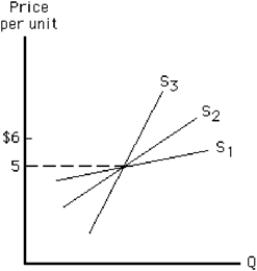 -Consider Figure 7-17. Between the prices of $5 and $6, which supply curve is most elastic and which is least elastic?
 (Multiple Choice)
4.8/5 (86)
(86) When a good is more narrowly defined (for example, airline travel versus Delta Airlines travel),
(Multiple Choice)
4.8/5 (83)
(83) Which of the following would help control the future growth of healthcare prices and expenditures?
(Multiple Choice)
4.8/5 (82)
(82) You and your college roommate eat three packages of Ramen noodles each week. After graduation last month, both of you were hired at several times your college income. You still enjoy Ramen noodles very much and buy even more, but your roommate plans to buy fewer Ramen noodles in favor of foods she prefers more. When looking at income elasticity of demand for Ramen noodles,
(Multiple Choice)
4.8/5 (84)
(84) After downing three glasses of lemonade on a hot summer afternoon, Todd says, "You would have to pay me to drink another glass!" This statement best illustrates
(Multiple Choice)
4.9/5 (80)
(80) If the price of tickets to Disney World increases 10 percent, and as a result, attendance falls by 15 percent, the demand for the tickets is
(Multiple Choice)
4.9/5 (86)
(86) Which of the following is a predictable impact of the Patient Protection and Affordable Care Act ?
(Multiple Choice)
4.9/5 (75)
(75) Nicole's income elasticity of demand for hats is 1.5. All else equal, this means that if her income increases by 20 percent, she will buy
(Multiple Choice)
4.8/5 (73)
(73) Figure 7-11 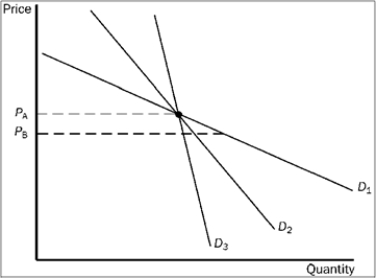 -Refer to Figure 7-11. As price falls from PA to PB, we could use the three demand curves to calculate three different values of the price elasticity of demand. Which of the three demand curves would produce the smallest elasticity?
 (Multiple Choice)
4.9/5 (70)
(70) "When a third party (for example, an insurance company or the government) pays all or most of the cost of a good or service, the incentive of consumers to shop for the best value per dollar spent and of producers to offer the item at an economical price is substantially reduced." This statement is
(Multiple Choice)
4.8/5 (88)
(88) Economic analysis indicates that the increasing government expenditures and growth of third-party payments accompanying the Medicare and Medicaid programs
(Multiple Choice)
4.9/5 (77)
(77) If the demand for a product increases as the result of a decline in income, it can be concluded that the
(Multiple Choice)
4.9/5 (82)
(82) Growth in the share of health-care expenditures covered by third parties (for example, insurance or government programs) will
(Multiple Choice)
4.8/5 (78)
(78) During the last four decades, the share of health-care expenditures paid for by third parties (either the government or insurance companies)
(Multiple Choice)
4.9/5 (81)
(81) 
Filters
- Essay(0)
- Multiple Choice(0)
- Short Answer(0)
- True False(0)
- Matching(0)