



 Chat with AI
Exam 7: Consumer Choice and Elasticity

Exam 1: The Economic Approach225 Questions
Exam 2: Some Tools of the Economist239 Questions
Exam 3: Demand, Supply, and the Market Process408 Questions
Exam 4: Supply and Demand: Applications and Extensions270 Questions
Exam 5: Difficult Cases for the Market, and the Role of Government184 Questions
Exam 6: The Economics of Political Action208 Questions
Exam 7: Consumer Choice and Elasticity229 Questions
Exam 8: Costs and the Supply of Goods222 Questions
Exam 9: Price Takers and the Competitive Process261 Questions
Exam 10: Price-Searcher Markets With Low Entry Barriers232 Questions
Exam 11: Price-Searcher Markets With High Entry Barriers260 Questions
Exam 12: The Supply of and Demand for Productive Resources154 Questions
Exam 13: Earnings, Productivity, and the Job Market91 Questions
Exam 14: Investment, the Capital Market, and the Wealth of Nations106 Questions
Exam 15: Income Inequality and Poverty105 Questions
Exam 16: Gaining From International Trade179 Questions
Select questions type


Which of the following would encourage consumers to economize on health-care expenditures and producers to supply health-care services more efficiently?
(Multiple Choice)
4.9/5  (78)
(78) If the price of gasoline goes up, and Jacob now buys fewer candy bars because he has to spend more on gas, this would best be explained by
(Multiple Choice)
4.8/5 (75)
(75) Figure 7-13 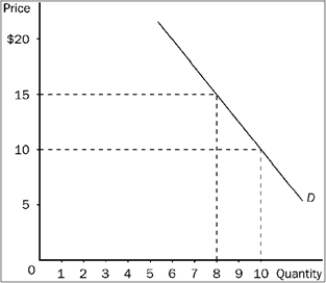 -Refer to Figure 7-13. A decrease in price from $15 to $10 leads to
 (Multiple Choice)
5.0/5 (85)
(85) When the price of a good falls, consumers buy more of the good because it is cheaper relative to competing goods. This statement describes the
(Multiple Choice)
4.8/5 (86)
(86) If consumers would be willing to purchase the same quantity of a good no matter what its price was, the demand curve would
(Multiple Choice)
4.7/5 (86)
(86) If Mr. Smith thinks the last dollar spent on shirts yields more satisfaction than the last dollar spent on cola, and Smith is a utility-maximizing consumer, he should
(Multiple Choice)
4.8/5 (83)
(83) Under the current structure of Medicare, the movement of the baby boom generation into the retirement phase of life will
(Multiple Choice)
4.9/5 (81)
(81) In which of the following cases will the total spending on a good decrease?
(Multiple Choice)
4.9/5 (66)
(66) Over the last forty years, the price index of healthcare services
(Multiple Choice)
4.8/5 (86)
(86) In the mythical nation of Oz, gasoline used to sell for $1 a gallon, and the natives purchased 100,000 gallons a week. Four years ago, the price rose to $3 a gallon, and the natives reduced their quantity demanded to 90,000 gallons a week. Calculate the price elasticity for this change. Today, gas again sells for $1 a gallon in Oz, but the natives are only buying 70,000 gallons a week. What gives?
(Essay)
4.8/5 (78)
(78) Jack, a music major, is perusing Jill's notes for her economics class, where she has written that "total revenues will rise with price rises only if demand is elastic." Jack tells Jill this is nonsense because firms can always increase their revenues by raising price. How should Jill respond?
(Essay)
4.9/5 (73)
(73) The growth of third-party payments (payments by insurers and the government) of healthcare services during the last four decades has been accompanied by
(Multiple Choice)
5.0/5 (88)
(88) New York City increased regulated taxi fares by 17.5 percent and expected taxi revenue to increase by the same amount. The taxi commission believed taxi demand was
(Multiple Choice)
4.9/5 (78)
(78) When a third party pays a larger and larger share of the purchasing price of a good, economic theory indicates that the
(Multiple Choice)
4.8/5 (96)
(96) If a third party pays for an individual to consume a good, how is the decision making of consumers affected? How does this affect the actions of suppliers?
(Essay)
4.9/5 (83)
(83) When the 2010 Patient Protection and Affordable Care Act is fully implemented, it will
(Multiple Choice)
4.7/5 (75)
(75) During the last three decades, the real (adjusted for inflation) expenditures
(Multiple Choice)
4.7/5 (81)
(81) How has public policy influenced the incentives of consumers to economize and suppliers to provide their services economically in the health-care industry?
(Essay)
4.9/5 (81)
(81) Which of the following describes a situation in which demand must be elastic?
(Multiple Choice)
4.8/5 (76)
(76) 
Filters
- Essay(0)
- Multiple Choice(0)
- Short Answer(0)
- True False(0)
- Matching(0)