



 Chat with AI
Exam 12: Sensory Mechanisms

Exam 1: Human Biology, Science, and Society85 Questions
Exam 2: The Chemistry of Living Things118 Questions
Exam 3: Structure and Function of Cells124 Questions
Exam 4: From Cells to Organ Systems107 Questions
Exam 5: The Skeletal System95 Questions
Exam 6: The Muscular System107 Questions
Exam 7: Blood114 Questions
Exam 8: Heart and Blood Vessels112 Questions
Exam 9: The Immune System and Mechanisms of Defense118 Questions
Exam 10: The Respiratory System: Exchange of Gases94 Questions
Exam 11: The Nervous System: Integration and Control111 Questions
Exam 12: Sensory Mechanisms107 Questions
Exam 13: The Endocrine System94 Questions
Exam 14: The Digestive System and Nutrition91 Questions
Exam 15: The Urinary System73 Questions
Exam 16: Reproductive Systems97 Questions
Exam 17: Cell Reproduction and Differentiation95 Questions
Exam 18: Cancer: Uncontrolled Cell Division and Differentiation89 Questions
Exam 19: Genetics and Inheritance81 Questions
Exam 20: DNA Technology and Genetic Engineering75 Questions
Exam 21: Development and Aging84 Questions
Exam 22: Evolution and the Origins of Life89 Questions
Exam 23: Ecosystems and Populations85 Questions
Exam 24: Human Impacts, Biodiversity, and Environmental Issues74 Questions
Select questions type


Foods that are potentially poisonous or inedible can often be detected by the ________ taste receptors, which are located at the very back of the tongue.
(Short Answer)
4.8/5  (68)
(68) The vestibular apparatus located in the middle ear is a system of fluid-filled chambers that is essential to the sense of hearing.
(True/False)
4.8/5 (63)
(63) LASIK surgery involves removing the cornea and reshaping the lens to correct for vision problems such as nearsightedness, farsightedness, and astigmatism.
(True/False)
4.8/5 (77)
(77) Which of the following receive(s) a physical or chemical stimulus and ultimately cause(s) nerve impulses to be generated in sensory neurons?
(Multiple Choice)
5.0/5 (77)
(77) Dim light causes the pigment ________ in rods to change shape, which causes sodium channels on the photoreceptor cell to close and activate ganglion cells.
(Short Answer)
4.9/5 (83)
(83) 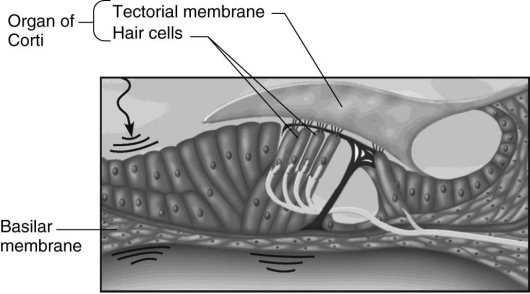 The structure shown in the figure above is found in which one of the following?
 (Multiple Choice)
4.9/5 (76)
(76) Match the following types of receptors to their definitions.
-respond to tissue damage
(Multiple Choice)
4.9/5 (78)
(78) Which one of the following occurs when bright light hits the eye?
(Multiple Choice)
4.9/5 (78)
(78) Match each of the following disorders associated with sensory mechanisms with its description.
-condition resulting from irregularities in the shape of the lens or cornea; symptoms include blurred vision
(Multiple Choice)
4.9/5 (79)
(79) Somatic sensations include temperature, touch, vibration, pressure, and pain; these sensations originate from receptors found in specific, localized areas of the body.
(True/False)
4.9/5 (89)
(89) 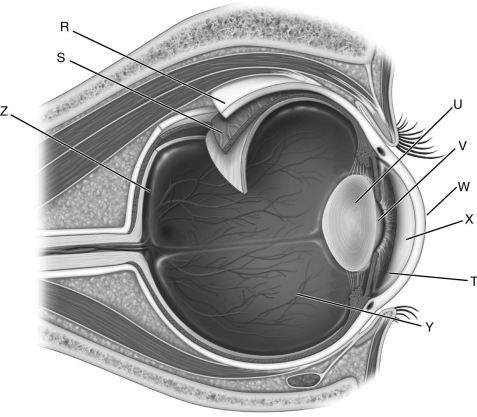 Using the figure above, identify the structures of the eye.
-Label Y represents the ________.
Using the figure above, identify the structures of the eye.
-Label Y represents the ________. (Multiple Choice)
4.9/5 (80)
(80) Both eyes have an optic disk. When an image is focused on the optic disk, it cannot be "seen."
(True/False)
4.9/5 (67)
(67) Stronger stimuli activate more receptors and trigger bigger action potentials in sensory neurons.
(True/False)
4.9/5 (83)
(83) Match the following types of receptors to their definitions.
-detect light touch of skin
(Multiple Choice)
4.9/5 (87)
(87) Pain, especially intense sensations, is unpleasant and sometimes difficult for a person to cope with. Nevertheless, pain detection is essential for human survival. Explain how pain detection is necessary for a person's survival.
(Essay)
4.8/5 (69)
(69) Which one of the following parts of the eye is affected by cataracts?
(Multiple Choice)
4.8/5 (91)
(91) Which one of the following structures is used to sense rotational movement of the head and body?
(Multiple Choice)
4.8/5 (80)
(80) During eye examinations, a test is done to monitor the pressure within the eye. This test is done to detect
(Multiple Choice)
4.8/5 (90)
(90) Match each of the following disorders associated with sensory mechanisms with its description.
-condition that generally occurs after age 40 as the lens stiffens; results in the inability to focus on objects that are nearby
(Multiple Choice)
4.9/5 (74)
(74) 
Filters
- Essay(0)
- Multiple Choice(0)
- Short Answer(0)
- True False(0)
- Matching(0)