



 Chat with AI
Exam 12: Sensory Mechanisms

Exam 1: Human Biology, Science, and Society85 Questions
Exam 2: The Chemistry of Living Things118 Questions
Exam 3: Structure and Function of Cells124 Questions
Exam 4: From Cells to Organ Systems107 Questions
Exam 5: The Skeletal System95 Questions
Exam 6: The Muscular System107 Questions
Exam 7: Blood114 Questions
Exam 8: Heart and Blood Vessels112 Questions
Exam 9: The Immune System and Mechanisms of Defense118 Questions
Exam 10: The Respiratory System: Exchange of Gases94 Questions
Exam 11: The Nervous System: Integration and Control111 Questions
Exam 12: Sensory Mechanisms107 Questions
Exam 13: The Endocrine System94 Questions
Exam 14: The Digestive System and Nutrition91 Questions
Exam 15: The Urinary System73 Questions
Exam 16: Reproductive Systems97 Questions
Exam 17: Cell Reproduction and Differentiation95 Questions
Exam 18: Cancer: Uncontrolled Cell Division and Differentiation89 Questions
Exam 19: Genetics and Inheritance81 Questions
Exam 20: DNA Technology and Genetic Engineering75 Questions
Exam 21: Development and Aging84 Questions
Exam 22: Evolution and the Origins of Life89 Questions
Exam 23: Ecosystems and Populations85 Questions
Exam 24: Human Impacts, Biodiversity, and Environmental Issues74 Questions
Select questions type


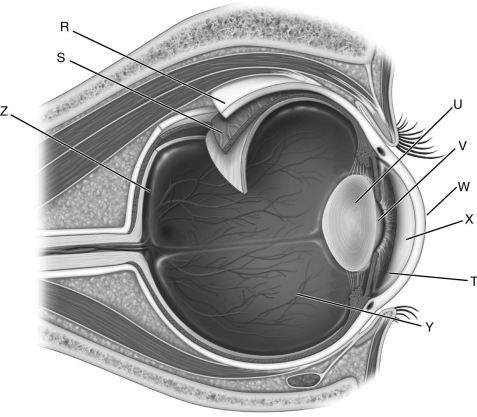 Using the figure above, identify the structures of the eye.
-Label U represents the ________.
Using the figure above, identify the structures of the eye.
-Label U represents the ________. (Multiple Choice)
4.7/5  (89)
(89) Some sensory receptors stop sending action potentials even though the original stimulus persists. This is known as which one of the following?
(Multiple Choice)
4.9/5 (74)
(74) Each of the following statements about cones is TRUE, EXCEPT which one?
(Multiple Choice)
4.8/5 (81)
(81) Mechanoreceptors include unencapsulated dendritic endings, Merkel disks, Meissner's corpuscles, Pacinian corpuscles, and olfactory receptors.
(True/False)
4.9/5 (84)
(84) Sound is amplified by components of the middle ear when they vibrate. When one of these components, the stapes, vibrates, the ________ will vibrate.
(Multiple Choice)
4.9/5 (72)
(72) Match the following types of receptors to their definitions.
-respond to light
(Multiple Choice)
4.9/5 (76)
(76) Olfactory receptors are located in which one of the following?
(Multiple Choice)
4.8/5 (90)
(90) The structure of the cochlea that converts pressure waves to nerve impulses is the ________; it is composed of hair cells and a tectorial membrane.
(Short Answer)
4.9/5 (75)
(75) Using the figure above, identify the structures of the eye.
-Label V represents the ________.
Using the figure above, identify the structures of the eye.
-Label V represents the ________. (Multiple Choice)
4.7/5 (83)
(83) Using the figure above, identify the structures of the eye.
-Label X represents the ________.
Using the figure above, identify the structures of the eye.
-Label X represents the ________. (Multiple Choice)
5.0/5 (94)
(94) Hearing loss resulting from damage to the tympanic membrane or the bones of the middle ear is known as ________ deafness.
(Short Answer)
4.8/5 (92)
(92) Slow pain originating from an internal organ is often perceived as coming from an area of the body totally unrelated to the source. This is known as
(Multiple Choice)
4.7/5 (80)
(80) Match each of the following disorders associated with sensory mechanisms with its description.
-distant objects appear out of focus because the eyeball is longer than normal; also known as nearsightedness
(Multiple Choice)
4.8/5 (70)
(70) It is common for people who are traveling in cars or planes to experience an unpleasant sensation known as ________, which is due to conflicting sensory inputs from receptors located in muscles and tendons, the eyes, and the vestibular apparatus.
(Short Answer)
4.8/5 (80)
(80) 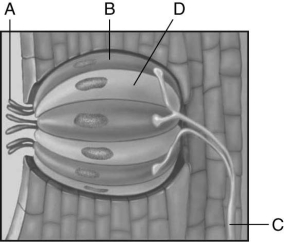 Using the figure above, match the structures of a taste bud with the regions (A-D) identified on the figure.
-supporting cell
Using the figure above, match the structures of a taste bud with the regions (A-D) identified on the figure.
-supporting cell (Multiple Choice)
4.8/5 (75)
(75) Using the figure above, identify the structures of the eye.
-Label Z represents the ________.
Using the figure above, identify the structures of the eye.
-Label Z represents the ________. (Multiple Choice)
4.8/5 (65)
(65) Match each of the following disorders associated with sensory mechanisms with its description.
-condition caused by blockage of the canal of Schlemm; increased amount of aqueous humor causes increased pressure in the eye; may lead to blindness
(Multiple Choice)
4.8/5 (83)
(83) Deafness in humans can have many causes. One form of deafness is caused by damage to hair cells. Explain how damaged hair cells can result in deafness.
(Essay)
4.9/5 (81)
(81) 
Filters
- Essay(0)
- Multiple Choice(0)
- Short Answer(0)
- True False(0)
- Matching(0)