



 Chat with AI
Exam 12: Sensory Mechanisms

Exam 1: Human Biology, Science, and Society85 Questions
Exam 2: The Chemistry of Living Things118 Questions
Exam 3: Structure and Function of Cells124 Questions
Exam 4: From Cells to Organ Systems107 Questions
Exam 5: The Skeletal System95 Questions
Exam 6: The Muscular System107 Questions
Exam 7: Blood114 Questions
Exam 8: Heart and Blood Vessels112 Questions
Exam 9: The Immune System and Mechanisms of Defense118 Questions
Exam 10: The Respiratory System: Exchange of Gases94 Questions
Exam 11: The Nervous System: Integration and Control111 Questions
Exam 12: Sensory Mechanisms107 Questions
Exam 13: The Endocrine System94 Questions
Exam 14: The Digestive System and Nutrition91 Questions
Exam 15: The Urinary System73 Questions
Exam 16: Reproductive Systems97 Questions
Exam 17: Cell Reproduction and Differentiation95 Questions
Exam 18: Cancer: Uncontrolled Cell Division and Differentiation89 Questions
Exam 19: Genetics and Inheritance81 Questions
Exam 20: DNA Technology and Genetic Engineering75 Questions
Exam 21: Development and Aging84 Questions
Exam 22: Evolution and the Origins of Life89 Questions
Exam 23: Ecosystems and Populations85 Questions
Exam 24: Human Impacts, Biodiversity, and Environmental Issues74 Questions
Select questions type


Pressure in the middle ear is equalized with the external air pressure through the auditory tube.
(True/False)
4.9/5  (88)
(88) Pain caused by a heart attack in men is often felt in the left shoulder and left arm. This phenomenon is known as ________ pain.
(Short Answer)
4.8/5 (67)
(67) The vitreous humor fills the main chamber of the eye. Which one of the following structures of the eye would vitreous humor come in direct contact with?
(Multiple Choice)
4.7/5 (76)
(76) A student noticed that when he closed his eyes, he could still determine the position of his arms and legs. This is largely due to the activity of
(Multiple Choice)
4.9/5 (79)
(79) The ________ sorts sounds by tone and converts them into electrical impulses.
(Essay)
4.9/5 (83)
(83) Whereas the sense of taste is based on ________ (how many?) classes of taste receptors, the sense of smell has over ________ (how many?) different receptors for chemicals associated with odor.
(Multiple Choice)
4.8/5 (95)
(95) Match the following. Answers may be used more than once.
-location of the auditory nerve
(Multiple Choice)
5.0/5 (74)
(74) 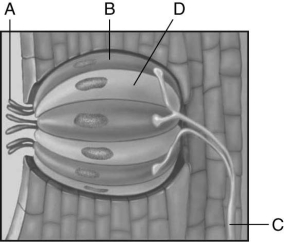 Using the figure above, match the structures of a taste bud with the regions (A-D) identified on the figure.
-taste hairs
Using the figure above, match the structures of a taste bud with the regions (A-D) identified on the figure.
-taste hairs (Multiple Choice)
4.9/5 (67)
(67) The two fluid-filled chambers of the vestibule are the ________ and ________.
(Essay)
4.8/5 (69)
(69) 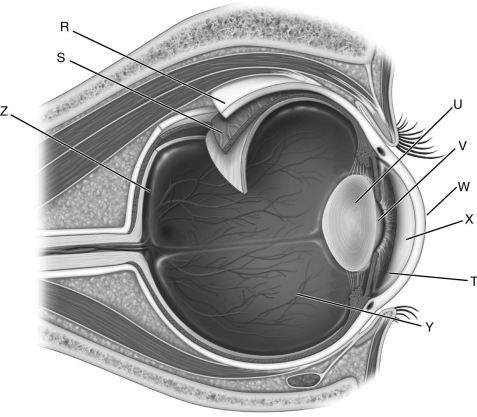 Using the figure above, identify the structures of the eye.
-Label W represents the ________.
Using the figure above, identify the structures of the eye.
-Label W represents the ________. (Multiple Choice)
5.0/5 (86)
(86) Which one of the following conditions results when the transparency of the lens decreases?
(Multiple Choice)
4.9/5 (75)
(75) Match the following types of receptors to their definitions.
-allow a person to taste food
(Multiple Choice)
4.7/5 (81)
(81) The human body may stop responding to a stimulus even though the original stimulus is still present; this is a process referred to as receptor adaptation.
(True/False)
4.9/5 (87)
(87) Using the figure above, identify the structures of the eye.
-Label T represents the ________.
Using the figure above, identify the structures of the eye.
-Label T represents the ________. (Multiple Choice)
4.8/5 (75)
(75) Using the figure above, match the structures of a taste bud with the regions (A-D) identified on the figure.
-sensory nerve cell
Using the figure above, match the structures of a taste bud with the regions (A-D) identified on the figure.
-sensory nerve cell (Multiple Choice)
4.9/5 (77)
(77) Vision in dim light is due to the activity of ________ cells because their rhodopsin pigment is much more sensitive to light than other photopigments.
(Short Answer)
4.9/5 (68)
(68) Match each of the following disorders associated with sensory mechanisms with its description.
-inflammation of the middle ear; a common cause of earaches
(Multiple Choice)
4.8/5 (89)
(89) The "blind spot" is associated with which one of the following?
(Multiple Choice)
4.9/5 (74)
(74) 
Filters
- Essay(0)
- Multiple Choice(0)
- Short Answer(0)
- True False(0)
- Matching(0)