



 Chat with AI
Exam 7: Lower Extremity

Exam 1: Preliminary Steps in Radiography32 Questions
Exam 2: General Anatomy and Radiographic Positioning Terminology119 Questions
Exam 3: Thoracic Viscera: Chest and Upper Airway79 Questions
Exam 4: Abdomen25 Questions
Exam 5: Upper Extremity136 Questions
Exam 6: Shoulder Girdle94 Questions
Exam 7: Lower Extremity154 Questions
Exam 8: Pelvis and Hip53 Questions
Exam 9: Vertebral Column179 Questions
Exam 10: Bony Thorax59 Questions
Exam 11: Cranium185 Questions
Exam 12: Trauma Radiography11 Questions
Exam 13: Contrast Arthrography3 Questions
Exam 14: Myelography and Other Central Nervous System Imaging13 Questions
Exam 15: Digestive System: Salivary Glands, alimentary Canal, and Biliary System125 Questions
Exam 16: Urinary System and Venipuncture81 Questions
Exam 17: Reproductive System9 Questions
Exam 18: Mammography27 Questions
Exam 19: Bone Densitometry16 Questions
Exam 20: Mobile Radiography12 Questions
Exam 21: Surgical Radiography11 Questions
Exam 22: Pediatric Imaging16 Questions
Exam 23: Geriatric Radiography14 Questions
Exam 24: Sectional Anatomy for Radiographers29 Questions
Exam 25: Computed Tomography14 Questions
Exam 26: Magnetic Resonance Imaging14 Questions
Exam 27: Vascular,cardiac,and Interventional Radiography37 Questions
Exam 28: Diagnostic Medical Sonography15 Questions
Exam 29: Nuclear Medicine and Molecular Imaging18 Questions
Exam 30: Radiation Oncology17 Questions
Select questions type


Which two of the following methods are used to demonstrate the intercondylar fossa? (Select all that apply.)
(Multiple Choice)
4.9/5  (84)
(84) How much should the leg be flexed for a lateral projection of the knee?
(Multiple Choice)
4.7/5 (80)
(80) Which two of the following are required to position the knee correctly for the lateral projection of the patella? (Select all that apply.)
(Multiple Choice)
4.9/5 (71)
(71) Where is the central ray directed for a lateral projection of the calcaneus?
(Multiple Choice)
4.8/5 (80)
(80) For a lateral projection of the ankle,the central ray must enter the:
(Multiple Choice)
4.8/5 (79)
(79) How far should the IR or collimated field extend beyond the ankle or knee joint for an AP projection of the leg?
(Multiple Choice)
4.9/5 (77)
(77) Which two of these are options for knee flexion for the tangential projection (Settegast method)of the patella when obtained with the patient in prone position? (Select all that apply.)
(Multiple Choice)
4.9/5 (93)
(93) The central-ray angle for an AP,bilateral weight-bearing knee is:
(Multiple Choice)
4.9/5 (66)
(66) What anatomy is labeled with the letter D in the image below? 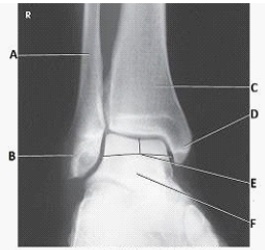
(Multiple Choice)
4.7/5 (88)
(88) 
Filters
- Essay(0)
- Multiple Choice(0)
- Short Answer(0)
- True False(0)
- Matching(0)