



 Chat with AI
Exam 7: Lower Extremity

Exam 1: Preliminary Steps in Radiography32 Questions
Exam 2: General Anatomy and Radiographic Positioning Terminology119 Questions
Exam 3: Thoracic Viscera: Chest and Upper Airway79 Questions
Exam 4: Abdomen25 Questions
Exam 5: Upper Extremity136 Questions
Exam 6: Shoulder Girdle94 Questions
Exam 7: Lower Extremity154 Questions
Exam 8: Pelvis and Hip53 Questions
Exam 9: Vertebral Column179 Questions
Exam 10: Bony Thorax59 Questions
Exam 11: Cranium185 Questions
Exam 12: Trauma Radiography11 Questions
Exam 13: Contrast Arthrography3 Questions
Exam 14: Myelography and Other Central Nervous System Imaging13 Questions
Exam 15: Digestive System: Salivary Glands, alimentary Canal, and Biliary System125 Questions
Exam 16: Urinary System and Venipuncture81 Questions
Exam 17: Reproductive System9 Questions
Exam 18: Mammography27 Questions
Exam 19: Bone Densitometry16 Questions
Exam 20: Mobile Radiography12 Questions
Exam 21: Surgical Radiography11 Questions
Exam 22: Pediatric Imaging16 Questions
Exam 23: Geriatric Radiography14 Questions
Exam 24: Sectional Anatomy for Radiographers29 Questions
Exam 25: Computed Tomography14 Questions
Exam 26: Magnetic Resonance Imaging14 Questions
Exam 27: Vascular,cardiac,and Interventional Radiography37 Questions
Exam 28: Diagnostic Medical Sonography15 Questions
Exam 29: Nuclear Medicine and Molecular Imaging18 Questions
Exam 30: Radiation Oncology17 Questions
Select questions type


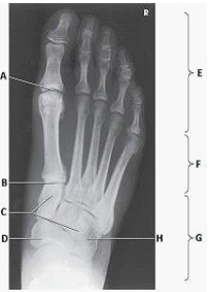

Which of the following projections of the knee best demonstrates the narrowing of a joint space?
(Multiple Choice)
5.0/5  (63)
(63) Which two of the following are the allowed amount of knee flexion for the PA axial intercondylar fossa (Camp-Coventry)projection? (Select all that apply.)
(Multiple Choice)
4.9/5 (87)
(87) Which two of the following projections would benefit from the use of a compensating filter? (Select all that apply.)
(Multiple Choice)
4.8/5 (92)
(92) The second largest tarsal bone,and the one that occupies the highest position in the foot,is the:
(Multiple Choice)
4.7/5 (78)
(78) When the ASIS-to-tabletop measurement is less than 19 cm,the central-ray angulation for an AP knee is:
(Multiple Choice)
4.7/5 (77)
(77) All of the following must be rotated for all oblique projections of the ankle,except:
(Multiple Choice)
4.7/5 (82)
(82) The group of bones labeled as G in the image below are the: 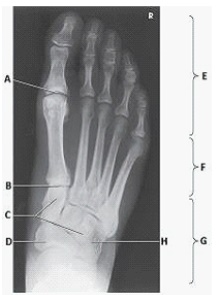
(Multiple Choice)
5.0/5 (78)
(78) What lower limb position is required to obtain the image below? 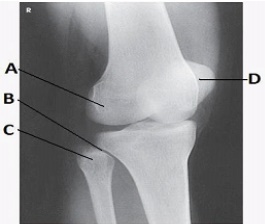
(Multiple Choice)
4.8/5 (88)
(88) 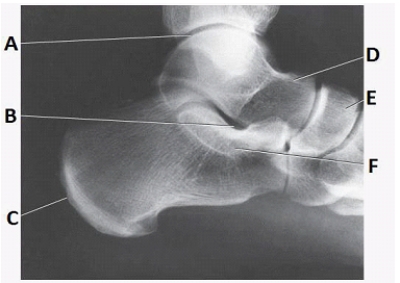
Which projections of the foot will best demonstrate the structural status of the longitudinal arch?
(Multiple Choice)
4.9/5 (87)
(87) When the ASIS-to-tabletop measurement is between 19 and 24 cm,the central-ray angulation for an AP knee is:
(Multiple Choice)
4.8/5 (75)
(75) Which lateral projection of the foot is the most commonly performed?
(Multiple Choice)
4.8/5 (74)
(74) What is the central-ray direction needed to produce the image below? 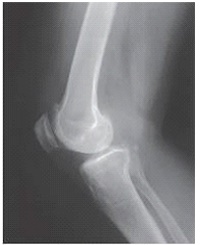
(Multiple Choice)
4.9/5 (59)
(59) Which two are the essential oblique projections of the ankle? (Select all that apply.)
(Multiple Choice)
4.8/5 (83)
(83) To prevent lateral rotation,how should the foot be positioned for a lateral projection of the ankle?
(Multiple Choice)
4.8/5 (72)
(72) In which position is the patient placed for a PA projection of the patella?
(Multiple Choice)
4.8/5 (85)
(85) When the femur is vertical,the medial condyle is lower than the lateral condyle.How many degrees difference is there between the two?
(Multiple Choice)
5.0/5 (85)
(85) 
Filters
- Essay(0)
- Multiple Choice(0)
- Short Answer(0)
- True False(0)
- Matching(0)