



 Chat with AI
Exam 7: Lower Extremity

Exam 1: Preliminary Steps in Radiography32 Questions
Exam 2: General Anatomy and Radiographic Positioning Terminology119 Questions
Exam 3: Thoracic Viscera: Chest and Upper Airway79 Questions
Exam 4: Abdomen25 Questions
Exam 5: Upper Extremity136 Questions
Exam 6: Shoulder Girdle94 Questions
Exam 7: Lower Extremity154 Questions
Exam 8: Pelvis and Hip53 Questions
Exam 9: Vertebral Column179 Questions
Exam 10: Bony Thorax59 Questions
Exam 11: Cranium185 Questions
Exam 12: Trauma Radiography11 Questions
Exam 13: Contrast Arthrography3 Questions
Exam 14: Myelography and Other Central Nervous System Imaging13 Questions
Exam 15: Digestive System: Salivary Glands, alimentary Canal, and Biliary System125 Questions
Exam 16: Urinary System and Venipuncture81 Questions
Exam 17: Reproductive System9 Questions
Exam 18: Mammography27 Questions
Exam 19: Bone Densitometry16 Questions
Exam 20: Mobile Radiography12 Questions
Exam 21: Surgical Radiography11 Questions
Exam 22: Pediatric Imaging16 Questions
Exam 23: Geriatric Radiography14 Questions
Exam 24: Sectional Anatomy for Radiographers29 Questions
Exam 25: Computed Tomography14 Questions
Exam 26: Magnetic Resonance Imaging14 Questions
Exam 27: Vascular,cardiac,and Interventional Radiography37 Questions
Exam 28: Diagnostic Medical Sonography15 Questions
Exam 29: Nuclear Medicine and Molecular Imaging18 Questions
Exam 30: Radiation Oncology17 Questions
Select questions type


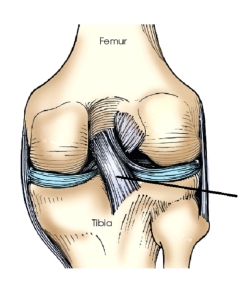
The bone part identified by the arrow in this figure is the: 
(Multiple Choice)
4.7/5  (73)
(73) The central-ray angulation for a lateral projection of the calcaneus is:
(Multiple Choice)
4.9/5 (72)
(72) The inferior aspect of the foot is termed the _____ surface.
(Multiple Choice)
4.9/5 (68)
(68) All of the joints of the foot are synovial (freely movable)except the:
(Multiple Choice)
4.8/5 (74)
(74) Where should the central ray be directed for a PA projection of the patella?
(Multiple Choice)
4.9/5 (78)
(78) 
How many degrees are the lower leg and foot rotated for the AP oblique projection of the toes in medial rotation?
(Multiple Choice)
5.0/5 (66)
(66) The fibula articulates with the tibia at the: (Select all that apply.)
(Multiple Choice)
4.9/5 (78)
(78) Which anatomic part must be identified on lateral radiographs of the knee in order to identify over- or under-rotation?
(Multiple Choice)
4.7/5 (69)
(69) How far should the patient be rolled posteriorly from the lateral position,for a lateral projection of the hip that will include the proximal femur?
(Multiple Choice)
4.9/5 (77)
(77) The anatomy labeled with letter E in the image below is the: 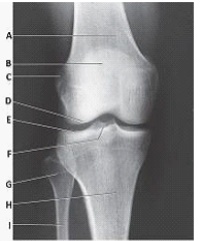
(Multiple Choice)
4.9/5 (91)
(91) Which of the following will clearly demonstrate the cuboid?
(Multiple Choice)
4.8/5 (87)
(87) For an AP projection of the ankle,the central ray must enter the:
(Multiple Choice)
4.9/5 (89)
(89) If a lateral projection of the femur will include the hip joint,where should the top of the IR/collimated field be placed?
(Multiple Choice)
4.8/5 (77)
(77) The projection of the patella demonstrated in this figure is the: 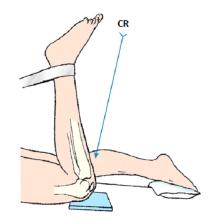
(Multiple Choice)
4.8/5 (86)
(86) The patient position and central-ray method demonstrated in this figure is the: 
(Multiple Choice)
4.8/5 (85)
(85) How is the patient placed for a lateral projection of the great toe and second toe?
(Multiple Choice)
4.8/5 (85)
(85) To better demonstrate the TMT joint spaces of the foot,a posterior angulation of how many degrees is required?
(Multiple Choice)
4.8/5 (74)
(74) The superior surface of the foot is termed the _____ surface.
(Multiple Choice)
4.8/5 (87)
(87) 
Filters
- Essay(0)
- Multiple Choice(0)
- Short Answer(0)
- True False(0)
- Matching(0)