



 Chat with AI
Exam 9: Vertebral Column

Exam 1: Preliminary Steps in Radiography32 Questions
Exam 2: General Anatomy and Radiographic Positioning Terminology119 Questions
Exam 3: Thoracic Viscera: Chest and Upper Airway79 Questions
Exam 4: Abdomen25 Questions
Exam 5: Upper Extremity136 Questions
Exam 6: Shoulder Girdle94 Questions
Exam 7: Lower Extremity154 Questions
Exam 8: Pelvis and Hip53 Questions
Exam 9: Vertebral Column179 Questions
Exam 10: Bony Thorax59 Questions
Exam 11: Cranium185 Questions
Exam 12: Trauma Radiography11 Questions
Exam 13: Contrast Arthrography3 Questions
Exam 14: Myelography and Other Central Nervous System Imaging13 Questions
Exam 15: Digestive System: Salivary Glands, alimentary Canal, and Biliary System125 Questions
Exam 16: Urinary System and Venipuncture81 Questions
Exam 17: Reproductive System9 Questions
Exam 18: Mammography27 Questions
Exam 19: Bone Densitometry16 Questions
Exam 20: Mobile Radiography12 Questions
Exam 21: Surgical Radiography11 Questions
Exam 22: Pediatric Imaging16 Questions
Exam 23: Geriatric Radiography14 Questions
Exam 24: Sectional Anatomy for Radiographers29 Questions
Exam 25: Computed Tomography14 Questions
Exam 26: Magnetic Resonance Imaging14 Questions
Exam 27: Vascular,cardiac,and Interventional Radiography37 Questions
Exam 28: Diagnostic Medical Sonography15 Questions
Exam 29: Nuclear Medicine and Molecular Imaging18 Questions
Exam 30: Radiation Oncology17 Questions
Select questions type


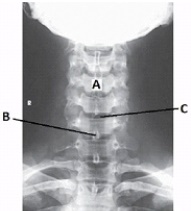

An abnormal increase in the convexity of the thoracic spine is termed:
(Multiple Choice)
4.9/5  (76)
(76) The articulating facet on the inferior articular process of the vertebrae is located on its _____ surface.
(Multiple Choice)
4.9/5 (68)
(68) Which positioning maneuver helps to reduce the lordotic curvature of the lumbar spine for the AP projection?
(Multiple Choice)
4.8/5 (72)
(72) What anatomy is labeled with the letter C in the image below? 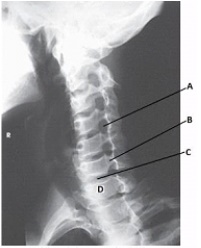
(Multiple Choice)
4.9/5 (87)
(87) All of the following might be used to provide an optimal image on a lateral projection of the lumbar spine,except:
(Multiple Choice)
4.8/5 (96)
(96) A typical vertebra is composed of which two main parts? (Select all that apply.)
(Multiple Choice)
4.8/5 (74)
(74) Where should the center of the IR be positioned for the "open mouth" AP projection of the atlas and axis?
(Multiple Choice)
4.8/5 (88)
(88) What is the central-ray angle for the AP axial oblique projection of the cervical intervertebral foramina?
(Multiple Choice)
4.8/5 (77)
(77) What is the central-ray angulation for the AP projection of the dens,Fuchs method?
(Multiple Choice)
4.9/5 (81)
(81) What anatomy is labeled with the letter C in the image below? 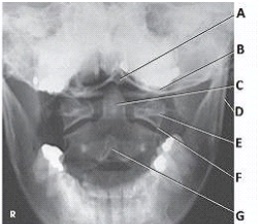
(Multiple Choice)
4.9/5 (90)
(90) The vertebral column articulates with the hip bone at the:
(Multiple Choice)
4.8/5 (79)
(79) What is the projection and anatomy of interest in the figure below? 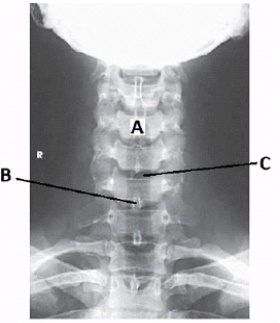
(Multiple Choice)
5.0/5 (74)
(74) If the lumbar spine cannot be adjusted so it is horizontal for the lateral projection,the central ray should be angled:
(Multiple Choice)
4.7/5 (84)
(84) Which projection of the vertebral column is depicted in the figure below? 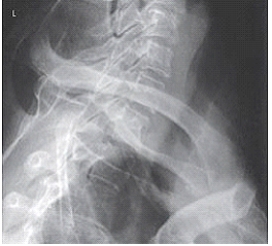
(Multiple Choice)
4.8/5 (87)
(87) Where is the central ray directed for a PA axial oblique projection of the cervical intervertebral foramina?
(Multiple Choice)
4.9/5 (92)
(92) The zygapophyseal joints of the thoracic spine form an angle of how many degrees with the midsagittal plane?
(Multiple Choice)
4.8/5 (86)
(86) The articulating surfaces of the articular processes of the vertebrae are covered with fibrocartilage.These surfaces are called:
(Multiple Choice)
4.8/5 (75)
(75) Which projection is recommended to demonstrate the cervical vertebral arches or pillars when the patient cannot hyperextend the neck?
(Multiple Choice)
4.9/5 (72)
(72) 
Filters
- Essay(0)
- Multiple Choice(0)
- Short Answer(0)
- True False(0)
- Matching(0)