



 Chat with AI
Exam 9: Vertebral Column

Exam 1: Preliminary Steps in Radiography32 Questions
Exam 2: General Anatomy and Radiographic Positioning Terminology119 Questions
Exam 3: Thoracic Viscera: Chest and Upper Airway79 Questions
Exam 4: Abdomen25 Questions
Exam 5: Upper Extremity136 Questions
Exam 6: Shoulder Girdle94 Questions
Exam 7: Lower Extremity154 Questions
Exam 8: Pelvis and Hip53 Questions
Exam 9: Vertebral Column179 Questions
Exam 10: Bony Thorax59 Questions
Exam 11: Cranium185 Questions
Exam 12: Trauma Radiography11 Questions
Exam 13: Contrast Arthrography3 Questions
Exam 14: Myelography and Other Central Nervous System Imaging13 Questions
Exam 15: Digestive System: Salivary Glands, alimentary Canal, and Biliary System125 Questions
Exam 16: Urinary System and Venipuncture81 Questions
Exam 17: Reproductive System9 Questions
Exam 18: Mammography27 Questions
Exam 19: Bone Densitometry16 Questions
Exam 20: Mobile Radiography12 Questions
Exam 21: Surgical Radiography11 Questions
Exam 22: Pediatric Imaging16 Questions
Exam 23: Geriatric Radiography14 Questions
Exam 24: Sectional Anatomy for Radiographers29 Questions
Exam 25: Computed Tomography14 Questions
Exam 26: Magnetic Resonance Imaging14 Questions
Exam 27: Vascular,cardiac,and Interventional Radiography37 Questions
Exam 28: Diagnostic Medical Sonography15 Questions
Exam 29: Nuclear Medicine and Molecular Imaging18 Questions
Exam 30: Radiation Oncology17 Questions
Select questions type


Where is the central ray directed for a lateral thoracic spine?
(Multiple Choice)
4.9/5  (84)
(84) 
Which of the following methods is used to evaluate the thoracic and lumbar spine during scoliosis radiography?
(Multiple Choice)
4.8/5 (87)
(87) 
The short,thick processes that project posteriorly on each side of a vertebral body are called the:
(Multiple Choice)
4.8/5 (78)
(78) The articulating facet on the superior articular process of the vertebrae is located on its _____ surface.
(Multiple Choice)
4.8/5 (74)
(74) What anatomy is demonstrated in this AP oblique projection in the image below? 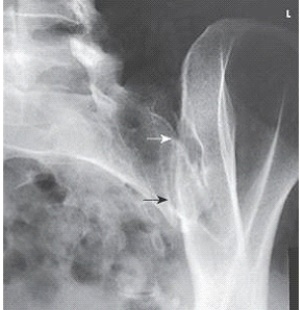
(Multiple Choice)
4.9/5 (85)
(85) If this is an AP oblique projection,what is the patient position in the image below? 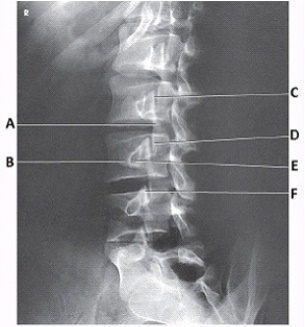
(Multiple Choice)
4.9/5 (87)
(87) The respiration phase for the "open mouth" AP projection of the atlas and axis is:
(Multiple Choice)
4.7/5 (81)
(81) The zygapophyseal joints of the cervical spine are clearly demonstrated on which projection?
(Multiple Choice)
4.8/5 (79)
(79) The articulations between the articular processes of the vertebral arches are called the _____ joints.
(Multiple Choice)
5.0/5 (79)
(79) Where is the longitudinal plane of the lumbar spine positioned for the AP oblique projection?
(Multiple Choice)
4.8/5 (93)
(93) In reference to the ASIS,where is the central-ray entrance for a lateral coccyx?
(Multiple Choice)
4.7/5 (77)
(77) The intervertebral foramina of the cervical spine are demonstrated on which two of the following projections? (Select all that apply.)
(Multiple Choice)
4.9/5 (81)
(81) Where does the central ray enter the body for the AP axial projection (Ferguson method)of the lumbosacral junction?
(Multiple Choice)
4.8/5 (95)
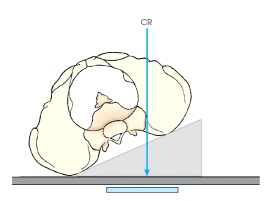
(95) 
What anatomy is labeled with the letter B in the image below? 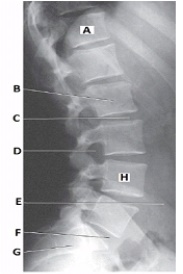
(Multiple Choice)
4.8/5 (77)
(77) Where is the central ray centered on the patient to obtain the image below? 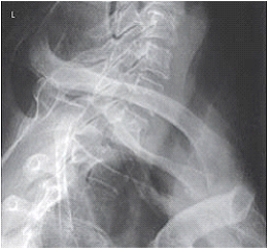
(Multiple Choice)
4.7/5 (65)
(65) How much is the body rotated for an AP axial oblique projection of the cervical intervertebral foramina?
(Multiple Choice)
4.9/5 (83)
(83) 
Filters
- Essay(0)
- Multiple Choice(0)
- Short Answer(0)
- True False(0)
- Matching(0)