



 Chat with AI
Exam 31:International Trade Policy

Exam 1: What Is Economics?198 Questions
Exam 2: The Economic Problem143 Questions
Exam 3: Demand and Supply178 Questions
Exam 4: Elasticity168 Questions
Exam 5: Efficiency and Equity108 Questions
Exam 6: Government Actions in Markets119 Questions
Exam 7: Global Markets in Action129 Questions
Exam 8: Utility and Demand110 Questions
Exam 9: Possibilities, Preferences, and Choices113 Questions
Exam 10: Organizing Production104 Questions
Exam 11: Output and Costs133 Questions
Exam 12: Perfect Competition118 Questions
Exam 13: Monopoly107 Questions
Exam 14: Monopolistic Competition111 Questions
Exam 15: Oligopoly97 Questions
Exam 16: Externalities112 Questions
Exam 17: Public Goods and Common Resources89 Questions
Exam 18: Markets for Factors of Production119 Questions
Exam 19: Economic Inequality117 Questions
Exam 20: Measuring GDP and Economic Growth127 Questions
Exam 21: Monitoring Jobs and Inflation112 Questions
Exam 22: Economic Growth90 Questions
Exam 23: Finance, Saving, and Investment142 Questions
Exam 24: Money, the Price Level, and Inflation115 Questions
Exam 25: The Exchange Rate and the Balance of Payments114 Questions
Exam 26: Aggregate Supply and Aggregate Demand124 Questions
Exam 27: Expenditure Multipliers: The Keynesian Model158 Questions
Exam 28: Canadian Inflation, Unemployment, and Business Cycle101 Questions
Exam 29: Fiscal Policy91 Questions
Exam 30: Monetary Policy88 Questions
Exam 31:International Trade Policy116 Questions
Select questions type


A tariff imposed by Canada on Japanese cars ________ the price of cars in Canada and ________ the quantity of Japanese cars imported into Canada.
(Multiple Choice)
4.8/5  (78)
(78) In developing countries,there is more reliance on ________ as opposed to ________ for government revenue.
(Multiple Choice)
4.9/5 (80)
(80) A tariff ________ the domestic price of the good and an import quota ________ the domestic price of the good.
(Multiple Choice)
4.7/5 (83)
(83) A Canadian tariff imposed on items that can be produced more cheaply abroad
(Multiple Choice)
4.7/5 (79)
(79) Refer to the figure below to answer the following questions.
 The figure shows the market for shirts in Canada, where D is the domestic demand curve and S is the domestic supply curve.The world price is $20 per shirt.Canada imposes a tariff on imported shirts of $4 per shirt.
Figure 31.2.1
-Refer to Figure 31.2.1,with the tariff Canada imports ________ million shirts per year.
The figure shows the market for shirts in Canada, where D is the domestic demand curve and S is the domestic supply curve.The world price is $20 per shirt.Canada imposes a tariff on imported shirts of $4 per shirt.
Figure 31.2.1
-Refer to Figure 31.2.1,with the tariff Canada imports ________ million shirts per year. (Multiple Choice)
4.9/5 (74)
(74) Refer to the figure below to answer the following questions.
 The figure shows the market for shirts in Canada, where D is the domestic demand curve and S is the domestic supply curve.The world price is $20 per shirt.
Figure 31.1.1
-In Figure 31.1.1,with international trade Canadians buy ________ million shirts per year.
The figure shows the market for shirts in Canada, where D is the domestic demand curve and S is the domestic supply curve.The world price is $20 per shirt.
Figure 31.1.1
-In Figure 31.1.1,with international trade Canadians buy ________ million shirts per year. (Multiple Choice)
4.8/5 (78)
(78) Import quotas ________ the price of imported goods and ________ the quantity consumed in the country imposing the quota.
(Multiple Choice)
4.7/5 (74)
(74) Table 31.1.3
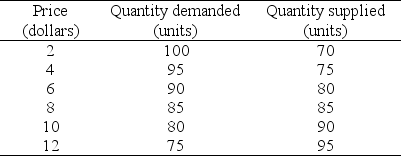 Refer to the table below to answer the following question.
-Refer to Table 31.1.3.The table shows a country's demand and supply schedules.At what world price would the country export?
Refer to the table below to answer the following question.
-Refer to Table 31.1.3.The table shows a country's demand and supply schedules.At what world price would the country export? (Multiple Choice)
4.9/5 (88)
(88) Which of the following is an explanation for the existence of trade restrictions?
(Multiple Choice)
4.9/5 (76)
(76) Table 31.1.1
Glazeland's Doughnut Market
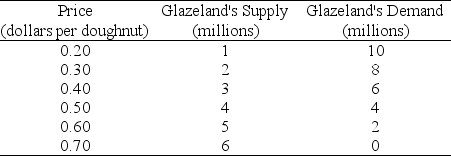 Refer to the table below to answer the following questions.
-Table 31.1.1 shows Glazeland's doughnut market before international trade.Glazeland opens up to international trade.If the world price is $0.60,then Glazeland will produce ________ doughnuts and will ________ doughnuts.
Refer to the table below to answer the following questions.
-Table 31.1.1 shows Glazeland's doughnut market before international trade.Glazeland opens up to international trade.If the world price is $0.60,then Glazeland will produce ________ doughnuts and will ________ doughnuts. (Multiple Choice)
4.9/5 (74)
(74) Refer to the figure below to answer the following questions.
 The figure shows the market for helicopters in Canada, where D is the domestic demand curve and S is the domestic supply curve.Canada trades helicopters with the rest of the world at a price of $36 million per helicopter.
Figure 31.1.2
-In Figure 31.1.2,with international trade Canadian firms buy ________ helicopters per year.
The figure shows the market for helicopters in Canada, where D is the domestic demand curve and S is the domestic supply curve.Canada trades helicopters with the rest of the world at a price of $36 million per helicopter.
Figure 31.1.2
-In Figure 31.1.2,with international trade Canadian firms buy ________ helicopters per year. (Multiple Choice)
4.9/5 (84)
(84) The gains from free trade are enjoyed by a ________ number of people and the costs of free trade are imposed on a ________ number of people.
(Multiple Choice)
4.8/5 (86)
(86) Refer to the figure below to answer the following questions.
The figure shows the market for shirts in Canada, where D is the domestic demand curve and S is the domestic supply curve.The world price is $20 per shirt.Canada imposes a tariff on imported shirts of $4 per shirt.
Figure 31.2.1
-Refer to Figure 31.2.1,the tariff ________ Canada's imports of shirts by ________ million shirts per year.
The figure shows the market for shirts in Canada, where D is the domestic demand curve and S is the domestic supply curve.The world price is $20 per shirt.Canada imposes a tariff on imported shirts of $4 per shirt.
Figure 31.2.1
-Refer to Figure 31.2.1,the tariff ________ Canada's imports of shirts by ________ million shirts per year. (Multiple Choice)
4.8/5 (82)
(82) 
Filters
- Essay(0)
- Multiple Choice(0)
- Short Answer(0)
- True False(0)
- Matching(0)