



 Chat with AI
Exam 27: Expenditure Multipliers: The Keynesian Model

Exam 1: What Is Economics?198 Questions
Exam 2: The Economic Problem143 Questions
Exam 3: Demand and Supply178 Questions
Exam 4: Elasticity168 Questions
Exam 5: Efficiency and Equity108 Questions
Exam 6: Government Actions in Markets119 Questions
Exam 7: Global Markets in Action129 Questions
Exam 8: Utility and Demand110 Questions
Exam 9: Possibilities, Preferences, and Choices113 Questions
Exam 10: Organizing Production104 Questions
Exam 11: Output and Costs133 Questions
Exam 12: Perfect Competition118 Questions
Exam 13: Monopoly107 Questions
Exam 14: Monopolistic Competition111 Questions
Exam 15: Oligopoly97 Questions
Exam 16: Externalities112 Questions
Exam 17: Public Goods and Common Resources89 Questions
Exam 18: Markets for Factors of Production119 Questions
Exam 19: Economic Inequality117 Questions
Exam 20: Measuring GDP and Economic Growth127 Questions
Exam 21: Monitoring Jobs and Inflation112 Questions
Exam 22: Economic Growth90 Questions
Exam 23: Finance, Saving, and Investment142 Questions
Exam 24: Money, the Price Level, and Inflation115 Questions
Exam 25: The Exchange Rate and the Balance of Payments114 Questions
Exam 26: Aggregate Supply and Aggregate Demand124 Questions
Exam 27: Expenditure Multipliers: The Keynesian Model158 Questions
Exam 28: Canadian Inflation, Unemployment, and Business Cycle101 Questions
Exam 29: Fiscal Policy91 Questions
Exam 30: Monetary Policy88 Questions
Exam 31:International Trade Policy116 Questions
Select questions type


If the saving function is S = -25 + 0.4YD,then autonomous consumption is

Free
(Multiple Choice)
4.8/5  (70)
(70) Correct Answer: Verified
A
Use the figure below to answer the following questions.
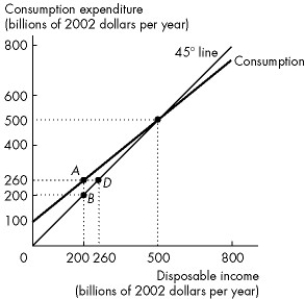 Figure 27.1.1
This figure describes the relationship between consumption expenditure and disposable income for a model economy.
-Refer to Figure 27.1.1.Consumption and disposable income are equal
Figure 27.1.1
This figure describes the relationship between consumption expenditure and disposable income for a model economy.
-Refer to Figure 27.1.1.Consumption and disposable income are equalFree
(Multiple Choice)
4.8/5 (90)
(90) Correct Answer:Verified
VerifiedC
Use the figure below to answer the following questions.
Figure 27.1.1
This figure describes the relationship between consumption expenditure and disposable income for a model economy.
-Refer to Figure 27.1.1.When disposable income is equal to $200 billion,saving is
Figure 27.1.1
This figure describes the relationship between consumption expenditure and disposable income for a model economy.
-Refer to Figure 27.1.1.When disposable income is equal to $200 billion,saving isFree
(Multiple Choice)
4.8/5 (88)
(88) Correct Answer:Verified
VerifiedE
The consumption functions for the Canadian economy covering the period from 1970 to 2010 indicate a marginal propensity to consume approximately equal to
(Multiple Choice)
4.7/5 (78)
(78) Use the information below to answer the following question.
Fact 27.5.1
The economy of Beverly Hills has a consumption function of C = 10 + 0.8Y, investment equal to 6, government expenditure equal to 10, exports equal to 10, and an import function of M = 0.1Y.
-Refer to Fact 27.5.1.What is the equation for the aggregate expenditure curve for this economy?
(Multiple Choice)
4.8/5 (79)
(79) Use the figure below to answer the following questions.
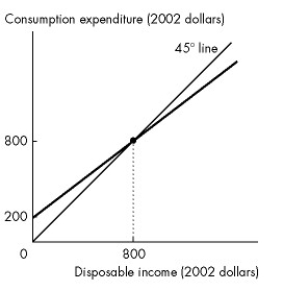 Figure 27.1.2
-Refer to Figure 27.1.2.The marginal propensity to consume is
Figure 27.1.2
-Refer to Figure 27.1.2.The marginal propensity to consume is (Multiple Choice)
4.9/5 (95)
(95) The fact that imports increase as real GDP increases implies that imports are part of
(Multiple Choice)
4.9/5 (86)
(86) If consumption expenditure for a household increases from $300 to $500 when disposable income increases from $200 to $500,the marginal propensity to consume is
(Multiple Choice)
4.8/5 (79)
(79) As the aggregate expenditure curve becomes steeper,the value of the multiplier becomes
(Multiple Choice)
4.7/5 (89)
(89) Use the figure below to answer the following questions.
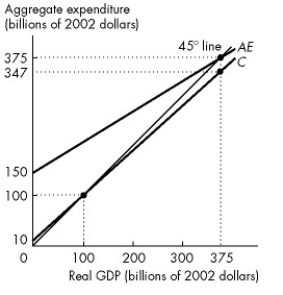 Figure 27.2.3
There are no taxes in this economy.
-In Figure 27.2.3,equilibrium expenditure is
Figure 27.2.3
There are no taxes in this economy.
-In Figure 27.2.3,equilibrium expenditure is (Multiple Choice)
4.9/5 (81)
(81) If the marginal propensity to consume is 0.85,what change in consumption expenditure would you expect if disposable income increases by $200 million?
(Multiple Choice)
4.8/5 (82)
(82) Use the figure below to answer the following questions.
Figure 27.2.3
There are no taxes in this economy.
-In Figure 27.2.3,autonomous expenditure is
Figure 27.2.3
There are no taxes in this economy.
-In Figure 27.2.3,autonomous expenditure is (Multiple Choice)
4.8/5 (81)
(81) 
Filters
- Essay(0)
- Multiple Choice(0)
- Short Answer(0)
- True False(0)
- Matching(0)