



 Chat with AI
Exam 7: Global Markets in Action

Exam 1: What Is Economics?198 Questions
Exam 2: The Economic Problem143 Questions
Exam 3: Demand and Supply178 Questions
Exam 4: Elasticity168 Questions
Exam 5: Efficiency and Equity108 Questions
Exam 6: Government Actions in Markets119 Questions
Exam 7: Global Markets in Action129 Questions
Exam 8: Utility and Demand110 Questions
Exam 9: Possibilities, Preferences, and Choices113 Questions
Exam 10: Organizing Production104 Questions
Exam 11: Output and Costs133 Questions
Exam 12: Perfect Competition118 Questions
Exam 13: Monopoly107 Questions
Exam 14: Monopolistic Competition111 Questions
Exam 15: Oligopoly97 Questions
Exam 16: Externalities112 Questions
Exam 17: Public Goods and Common Resources89 Questions
Exam 18: Markets for Factors of Production119 Questions
Exam 19: Economic Inequality117 Questions
Exam 20: Measuring GDP and Economic Growth127 Questions
Exam 21: Monitoring Jobs and Inflation112 Questions
Exam 22: Economic Growth90 Questions
Exam 23: Finance, Saving, and Investment142 Questions
Exam 24: Money, the Price Level, and Inflation115 Questions
Exam 25: The Exchange Rate and the Balance of Payments114 Questions
Exam 26: Aggregate Supply and Aggregate Demand124 Questions
Exam 27: Expenditure Multipliers: The Keynesian Model158 Questions
Exam 28: Canadian Inflation, Unemployment, and Business Cycle101 Questions
Exam 29: Fiscal Policy91 Questions
Exam 30: Monetary Policy88 Questions
Exam 31:International Trade Policy116 Questions
Select questions type


Usually the imposition of trade barriers affecting a particular good benefits ________ people domestically,each of whom gains a ________.

Free
(Multiple Choice)
4.8/5  (83)
(83) Correct Answer: Verified
B
A key difference between tariffs and import quotas is that
Free
(Multiple Choice)
4.9/5 (88)
(88) Correct Answer:Verified
VerifiedC
A tariff is a tax that is imposed by the ________ country when an ________ good crosses its international boundary.
Free
(Multiple Choice)
4.8/5 (82)
(82) Correct Answer:Verified
VerifiedD
A country opens up to trade.In an import industry,surplus has been redistributed from
(Multiple Choice)
4.8/5 (66)
(66) ________ occurs when a foreign firm sells its exports at a lower price than its cost of production.
(Multiple Choice)
4.8/5 (96)
(96) Reducing a tariff ________ the domestic production of the good and ________ the total domestic consumption of the good.
(Multiple Choice)
4.9/5 (96)
(96) Refer to the figure below to answer the following questions.
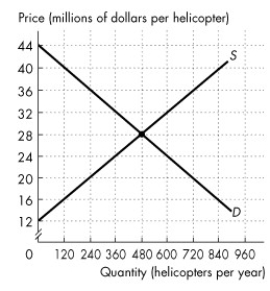 The figure shows the market for helicopters in Canada, where D is the domestic demand curve and S is the domestic supply curve.Canada trades helicopters with the rest of the world at a price of $36 million per helicopter.
Figure 7.2.2
-In Figure 7.2.2,with international trade ________ helicopters per year are produced in Canada.
The figure shows the market for helicopters in Canada, where D is the domestic demand curve and S is the domestic supply curve.Canada trades helicopters with the rest of the world at a price of $36 million per helicopter.
Figure 7.2.2
-In Figure 7.2.2,with international trade ________ helicopters per year are produced in Canada. (Multiple Choice)
4.9/5 (67)
(67) Which of the following statements about Canada's international trade in 2010 is correct?
(Multiple Choice)
4.9/5 (81)
(81) Refer to the figure below to answer the following questions.
The figure shows the market for helicopters in Canada, where D is the domestic demand curve and S is the domestic supply curve.Canada trades helicopters with the rest of the world at a price of $36 million per helicopter.
Figure 7.2.2
-In Figure 7.2.2,international trade ________ total surplus in Canada by ________.
The figure shows the market for helicopters in Canada, where D is the domestic demand curve and S is the domestic supply curve.Canada trades helicopters with the rest of the world at a price of $36 million per helicopter.
Figure 7.2.2
-In Figure 7.2.2,international trade ________ total surplus in Canada by ________. (Multiple Choice)
4.8/5 (84)
(84) In poorer countries,free trade ________ the demand for labour in these countries and ________ the wages paid in these countries.
(Multiple Choice)
5.0/5 (71)
(71) If a government imposes a quota on imports of a popular doll,the price of the doll in the importing country ________ and the quantity purchased in the importing country ________.
(Multiple Choice)
4.9/5 (76)
(76) Refer to the figure below to answer the following questions.
The figure shows the market for helicopters in Canada, where D is the domestic demand curve and S is the domestic supply curve.Canada trades helicopters with the rest of the world at a price of $36 million per helicopter.
Figure 7.2.2
-In Figure 7.2.2,international trade ________ producer surplus in Canada by ________.
The figure shows the market for helicopters in Canada, where D is the domestic demand curve and S is the domestic supply curve.Canada trades helicopters with the rest of the world at a price of $36 million per helicopter.
Figure 7.2.2
-In Figure 7.2.2,international trade ________ producer surplus in Canada by ________. (Multiple Choice)
4.8/5 (64)
(64) A tariff imposed by Canada on Japanese cars ________ the price of cars in Canada and ________ the quantity of Japanese cars imported into Canada.
(Multiple Choice)
5.0/5 (75)
(75) Refer to the figure below to answer the following questions.
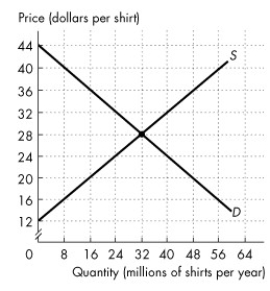 The figure shows the market for shirts in Canada, where D is the domestic demand curve and S is the domestic supply curve.The world price is $20 per shirt.Canada imposes a tariff on imported shirts of $4 per shirt.
Figure 7.3.1
-Refer to Figure 7.3.1,the tariff ________ Canada's imports of shirts by ________ million shirts per year.
The figure shows the market for shirts in Canada, where D is the domestic demand curve and S is the domestic supply curve.The world price is $20 per shirt.Canada imposes a tariff on imported shirts of $4 per shirt.
Figure 7.3.1
-Refer to Figure 7.3.1,the tariff ________ Canada's imports of shirts by ________ million shirts per year. (Multiple Choice)
4.9/5 (89)
(89) When Canada exports a good,the amount of the ________ in Canada's consumer surplus is ________ the amount of the ________ in Canada's producer surplus.
(Multiple Choice)
4.7/5 (76)
(76) ________ specifies the maximum quantity of a good that may be imported in a given period of time.
(Multiple Choice)
4.8/5 (78)
(78) A country opens up to trade and becomes an importer of some good.Consumer surplus ________,producer surplus ________,and total surplus ________.
(Multiple Choice)
4.8/5 (83)
(83) Import quotas ________ the price of imported goods and ________ the quantity consumed in the country imposing the quota.
(Multiple Choice)
4.8/5 (70)
(70) Table 7.3.1
Canada's Market for Widgets
 Refer to the table below to answer the following questions.
-Table 7.3.1 shows the Canadian supply of and demand for widgets.Widgets are available on the world market for $7.If the Canadian government imposes a tariff of $1,the domestic selling price will be ________ and quantity bought will be ________.
Refer to the table below to answer the following questions.
-Table 7.3.1 shows the Canadian supply of and demand for widgets.Widgets are available on the world market for $7.If the Canadian government imposes a tariff of $1,the domestic selling price will be ________ and quantity bought will be ________. (Multiple Choice)
4.8/5 (75)
(75) 
Filters
- Essay(0)
- Multiple Choice(0)
- Short Answer(0)
- True False(0)
- Matching(0)