



 Chat with AI
Exam 7: Global Markets in Action

Exam 1: What Is Economics?198 Questions
Exam 2: The Economic Problem143 Questions
Exam 3: Demand and Supply178 Questions
Exam 4: Elasticity168 Questions
Exam 5: Efficiency and Equity108 Questions
Exam 6: Government Actions in Markets119 Questions
Exam 7: Global Markets in Action129 Questions
Exam 8: Utility and Demand110 Questions
Exam 9: Possibilities, Preferences, and Choices113 Questions
Exam 10: Organizing Production104 Questions
Exam 11: Output and Costs133 Questions
Exam 12: Perfect Competition118 Questions
Exam 13: Monopoly107 Questions
Exam 14: Monopolistic Competition111 Questions
Exam 15: Oligopoly97 Questions
Exam 16: Externalities112 Questions
Exam 17: Public Goods and Common Resources89 Questions
Exam 18: Markets for Factors of Production119 Questions
Exam 19: Economic Inequality117 Questions
Exam 20: Measuring GDP and Economic Growth127 Questions
Exam 21: Monitoring Jobs and Inflation112 Questions
Exam 22: Economic Growth90 Questions
Exam 23: Finance, Saving, and Investment142 Questions
Exam 24: Money, the Price Level, and Inflation115 Questions
Exam 25: The Exchange Rate and the Balance of Payments114 Questions
Exam 26: Aggregate Supply and Aggregate Demand124 Questions
Exam 27: Expenditure Multipliers: The Keynesian Model158 Questions
Exam 28: Canadian Inflation, Unemployment, and Business Cycle101 Questions
Exam 29: Fiscal Policy91 Questions
Exam 30: Monetary Policy88 Questions
Exam 31:International Trade Policy116 Questions
Select questions type


Canada produces both lumber and wine.Canada exports lumber and imports wine.The rest of the world imports Canadian lumber and exports wine to Canada.If Canada did not trade with the rest of the world,then the equilibrium price of lumber would be ________ in Canada than the rest of the world,and the equilibrium price of wine would be ________ in Canada than the rest of the world.
(Multiple Choice)
4.8/5  (80)
(80) A tariff ________ the domestic price of the good and an import quota ________ the domestic price of the good.
(Multiple Choice)
4.8/5 (80)
(80) Refer to the figure below to answer the following questions.
 The figure shows the market for shirts in Canada, where D is the domestic demand curve and S is the domestic supply curve.The world price is $20 per shirt.Canada imposes a tariff on imported shirts of $4 per shirt.
Figure 7.3.1
-Refer to Figure 7.3.1,the tariff ________ the domestic production of shirts in Canada by ________ per year.
The figure shows the market for shirts in Canada, where D is the domestic demand curve and S is the domestic supply curve.The world price is $20 per shirt.Canada imposes a tariff on imported shirts of $4 per shirt.
Figure 7.3.1
-Refer to Figure 7.3.1,the tariff ________ the domestic production of shirts in Canada by ________ per year. (Multiple Choice)
4.8/5 (82)
(82) Refer to the figure below to answer the following questions.
 The figure shows the market for helicopters in Canada, where D is the domestic demand curve and S is the domestic supply curve.Canada trades helicopters with the rest of the world at a price of $36 million per helicopter.
Figure 7.2.2
-In Figure 7.2.2,Canada ________ helicopters per year.
The figure shows the market for helicopters in Canada, where D is the domestic demand curve and S is the domestic supply curve.Canada trades helicopters with the rest of the world at a price of $36 million per helicopter.
Figure 7.2.2
-In Figure 7.2.2,Canada ________ helicopters per year. (Multiple Choice)
5.0/5 (74)
(74) Refer to the figure below to answer the following question.
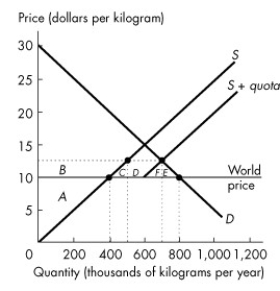 Figure 7.3.2
-Refer to Figure 7.3.2.The supply of peanuts in Canada is made up of Canadian grown peanuts and imported peanuts.Initially,Canada engages in free trade in the peanut market.Then Canada puts a quota on peanut imports.The graph shows the Canadian market for peanuts when the Canadian government puts a quota on peanut imports.The Canadian consumer surplus that is redistributed to Canadian producers is ________ and the quota creates a deadweight loss equal to ________.
Figure 7.3.2
-Refer to Figure 7.3.2.The supply of peanuts in Canada is made up of Canadian grown peanuts and imported peanuts.Initially,Canada engages in free trade in the peanut market.Then Canada puts a quota on peanut imports.The graph shows the Canadian market for peanuts when the Canadian government puts a quota on peanut imports.The Canadian consumer surplus that is redistributed to Canadian producers is ________ and the quota creates a deadweight loss equal to ________. (Multiple Choice)
5.0/5 (74)
(74) If a quota is set at the same quantity of imports that results from a tariff,
(Multiple Choice)
4.9/5 (73)
(73) Which of the following are reasons economists consider valid for trade protection?
I.Protection penalizes countries that have weak environmental standards.
II.Protection limits dumping of low-wage jobs into the domestic economy.
III.Protection prevents low-wage jobs in foreign countries from lowering wages in Canada.
(Multiple Choice)
4.9/5 (76)
(76) Table 7.2.2
 -The table shows a country's demand and supply schedules.Based on Table 7.2.2,at what world price would the country export?
 (Multiple Choice)
4.8/5 (91)
(91) A country opens up to trade and becomes an exporter of a good.Consumer surplus ________,producer surplus ________,and total surplus ________.
(Multiple Choice)
4.7/5 (82)
(82) Refer to the figure below to answer the following questions.
 The figure shows the market for shirts in Canada, where D is the domestic demand curve and S is the domestic supply curve.The world price is $20 per shirt.
Figure 7.2.1
-In Figure 7.2.1,international trade ________ consumer surplus in Canada by ________.
The figure shows the market for shirts in Canada, where D is the domestic demand curve and S is the domestic supply curve.The world price is $20 per shirt.
Figure 7.2.1
-In Figure 7.2.1,international trade ________ consumer surplus in Canada by ________. (Multiple Choice)
4.9/5 (75)
(75) Refer to the figure below to answer the following questions.
The figure shows the market for shirts in Canada, where D is the domestic demand curve and S is the domestic supply curve.The world price is $20 per shirt.Canada imposes a tariff on imported shirts of $4 per shirt.
Figure 7.3.1
-Refer to Figure 7.3.1,with the tariff Canada imports ________ million shirts per year.
The figure shows the market for shirts in Canada, where D is the domestic demand curve and S is the domestic supply curve.The world price is $20 per shirt.Canada imposes a tariff on imported shirts of $4 per shirt.
Figure 7.3.1
-Refer to Figure 7.3.1,with the tariff Canada imports ________ million shirts per year. (Multiple Choice)
4.9/5 (88)
(88) A country opens up to trade.In an export industry,surplus has been redistributed from
(Multiple Choice)
4.8/5 (81)
(81) Refer to the figure below to answer the following questions.
The figure shows the market for shirts in Canada, where D is the domestic demand curve and S is the domestic supply curve.The world price is $20 per shirt.Canada imposes a tariff on imported shirts of $4 per shirt.
Figure 7.3.1
-Refer to Figure 7.3.1,Canadian producers' ________ from the tariff is ________.
The figure shows the market for shirts in Canada, where D is the domestic demand curve and S is the domestic supply curve.The world price is $20 per shirt.Canada imposes a tariff on imported shirts of $4 per shirt.
Figure 7.3.1
-Refer to Figure 7.3.1,Canadian producers' ________ from the tariff is ________. (Multiple Choice)
4.7/5 (75)
(75) Usually the removal of trade barriers affecting a particular good benefits ________ people domestically,each of whom gains a ________.
(Multiple Choice)
4.8/5 (88)
(88) Compared to the situation before international trade,after Canada imports a good,production in Canada ________ and consumption in Canada ________.
(Multiple Choice)
4.8/5 (82)
(82) In one year,Brazil exported more than 1.8 billion kilograms of coffee to the rest of the world.We can conclude that
(Multiple Choice)
4.9/5 (71)
(71) When Canada exports a good,Canada's consumer surplus ________ and Canada's total surplus ________.
(Multiple Choice)
4.8/5 (79)
(79) The proposition that protection is necessary to allow an infant industry to grow into a mature industry so that it can compete in world markets is the ________.
(Multiple Choice)
4.9/5 (73)
(73) The effects of offshoring from opening up call centres in India are similar to the effects from
(Multiple Choice)
4.8/5 (69)
(69) 
Filters
- Essay(0)
- Multiple Choice(0)
- Short Answer(0)
- True False(0)
- Matching(0)