



 Chat with AI
Exam 28: Canadian Inflation, Unemployment, and Business Cycle

Exam 1: What Is Economics?198 Questions
Exam 2: The Economic Problem143 Questions
Exam 3: Demand and Supply178 Questions
Exam 4: Elasticity168 Questions
Exam 5: Efficiency and Equity108 Questions
Exam 6: Government Actions in Markets119 Questions
Exam 7: Global Markets in Action129 Questions
Exam 8: Utility and Demand110 Questions
Exam 9: Possibilities, Preferences, and Choices113 Questions
Exam 10: Organizing Production104 Questions
Exam 11: Output and Costs133 Questions
Exam 12: Perfect Competition118 Questions
Exam 13: Monopoly107 Questions
Exam 14: Monopolistic Competition111 Questions
Exam 15: Oligopoly97 Questions
Exam 16: Externalities112 Questions
Exam 17: Public Goods and Common Resources89 Questions
Exam 18: Markets for Factors of Production119 Questions
Exam 19: Economic Inequality117 Questions
Exam 20: Measuring GDP and Economic Growth127 Questions
Exam 21: Monitoring Jobs and Inflation112 Questions
Exam 22: Economic Growth90 Questions
Exam 23: Finance, Saving, and Investment142 Questions
Exam 24: Money, the Price Level, and Inflation115 Questions
Exam 25: The Exchange Rate and the Balance of Payments114 Questions
Exam 26: Aggregate Supply and Aggregate Demand124 Questions
Exam 27: Expenditure Multipliers: The Keynesian Model158 Questions
Exam 28: Canadian Inflation, Unemployment, and Business Cycle101 Questions
Exam 29: Fiscal Policy91 Questions
Exam 30: Monetary Policy88 Questions
Exam 31:International Trade Policy116 Questions
Select questions type


A cost-price inflation spiral results if the policy response to stagflation is to keep
(Multiple Choice)
4.9/5  (83)
(83) Use the figure below to answer the following questions.
 Figure 28.2.2
-Refer to Figure 28.2.2.The figure illustrates an economy's Phillips curves.If the expected inflation rate changes to 3 percent,the
Figure 28.2.2
-Refer to Figure 28.2.2.The figure illustrates an economy's Phillips curves.If the expected inflation rate changes to 3 percent,the (Multiple Choice)
4.8/5 (70)
(70) "Intertemporal substitution" in real business cycle theory refers to the change in the ________ as a result of the change in the real interest rate.
(Multiple Choice)
4.8/5 (74)
(74) Suppose that in response to a decrease in real interest rates,a person decides to reduce his supply of labour today and increase it in the future.This behaviour is most consistent with the
(Multiple Choice)
4.8/5 (85)
(85) According to ________,the business cycle is the result of aggregate demand growing at a fluctuating rate.
(Multiple Choice)
4.8/5 (78)
(78) Use the figure below to answer the following questions.
 Figure 28.1.2
-Refer to Figure 28.1.2.The economy is in long-run equilibrium.If the short-run aggregate supply curve shifts leftward from SAS? to SAS?,ceteris paribus,then people expected
Figure 28.1.2
-Refer to Figure 28.1.2.The economy is in long-run equilibrium.If the short-run aggregate supply curve shifts leftward from SAS? to SAS?,ceteris paribus,then people expected (Multiple Choice)
4.7/5 (84)
(84) Use the figure below to answer the following questions.
 Figure 28.1.3
-Refer to Figure 28.1.3.Assume that the figure illustrates an economy initially in equilibrium at the intersection of the SAS? curve and the AD? curve.If the aggregate demand curve is expected to remain at AD? but shifts to AD?,the new equilibrium real GDP is ________ and the new equilibrium price level is ________.
Figure 28.1.3
-Refer to Figure 28.1.3.Assume that the figure illustrates an economy initially in equilibrium at the intersection of the SAS? curve and the AD? curve.If the aggregate demand curve is expected to remain at AD? but shifts to AD?,the new equilibrium real GDP is ________ and the new equilibrium price level is ________. (Multiple Choice)
5.0/5 (66)
(66) Use the figure below to answer the following questions.
Figure 28.2.2
-Refer to Figure 28.2.2.The figure illustrates an economy's Phillips curves.What is the natural unemployment rate?
Figure 28.2.2
-Refer to Figure 28.2.2.The figure illustrates an economy's Phillips curves.What is the natural unemployment rate? (Multiple Choice)
4.9/5 (67)
(67) Inflation resulting from an increase in aggregate demand is called
(Multiple Choice)
4.9/5 (87)
(87) Along the short-run Phillips curve,if the actual unemployment rate falls below the natural unemployment rate,the
(Multiple Choice)
4.9/5 (82)
(82) Use the figure below to answer the following question.
 Figure 28.1.5
-Refer to Figure 28.1.5.Which one of the graphs in the figure represents an economy with the price level expected to remain constant?
Figure 28.1.5
-Refer to Figure 28.1.5.Which one of the graphs in the figure represents an economy with the price level expected to remain constant? (Multiple Choice)
4.9/5 (77)
(77) Both new Keynesian and new classical cycle theories claim that
(Multiple Choice)
4.8/5 (72)
(72) The new classical theory argues that the primary factor leading to business cycles is
(Multiple Choice)
4.8/5 (91)
(91) The factor leading to business cycles in the ________ cycle theory is unexpected fluctuations in aggregate demand while in the ________ cycle theory both unexpected and expected fluctuations in aggregate demand are factors that lead to business cycles.
(Multiple Choice)
4.9/5 (80)
(80) The Canadian short-run Phillips curve ________ when the expected inflation rate rises and ________ when the expected inflation rate falls.
The Canadian short-run Phillips curve ________ when the natural unemployment rate increases and ________ when the natural unemployment rate decreases.
(Multiple Choice)
5.0/5 (89)
(89) If the inflation rate is lower than the expected inflation rate,
(Multiple Choice)
4.8/5 (71)
(71) Use the figure below to answer the following question.
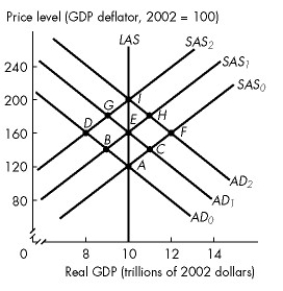 Figure 28.1.6
-Refer to Figure 28.1.6.Starting at point A,the initial effect of a cost-push inflation is a move to point ________.As a cost-push inflation spiral proceeds,it follows the path ________.
Figure 28.1.6
-Refer to Figure 28.1.6.Starting at point A,the initial effect of a cost-push inflation is a move to point ________.As a cost-push inflation spiral proceeds,it follows the path ________. (Multiple Choice)
4.8/5 (70)
(70) Use the figure below to answer the following questions.
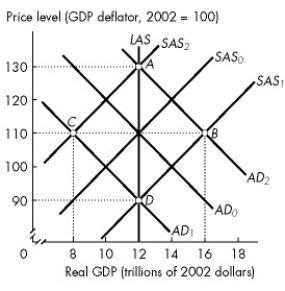 Figure 28.3.1
-Refer to Figure 28.3.1.Suppose the economy moves from point D to point B.According to the monetarist theory of the business cycle,what could have caused this movement?
Figure 28.3.1
-Refer to Figure 28.3.1.Suppose the economy moves from point D to point B.According to the monetarist theory of the business cycle,what could have caused this movement? (Multiple Choice)
4.8/5 (85)
(85) 
Filters
- Essay(0)
- Multiple Choice(0)
- Short Answer(0)
- True False(0)
- Matching(0)