



 Chat with AI
Exam 24: Money, the Price Level, and Inflation

Exam 1: What Is Economics?198 Questions
Exam 2: The Economic Problem143 Questions
Exam 3: Demand and Supply178 Questions
Exam 4: Elasticity168 Questions
Exam 5: Efficiency and Equity108 Questions
Exam 6: Government Actions in Markets119 Questions
Exam 7: Global Markets in Action129 Questions
Exam 8: Utility and Demand110 Questions
Exam 9: Possibilities, Preferences, and Choices113 Questions
Exam 10: Organizing Production104 Questions
Exam 11: Output and Costs133 Questions
Exam 12: Perfect Competition118 Questions
Exam 13: Monopoly107 Questions
Exam 14: Monopolistic Competition111 Questions
Exam 15: Oligopoly97 Questions
Exam 16: Externalities112 Questions
Exam 17: Public Goods and Common Resources89 Questions
Exam 18: Markets for Factors of Production119 Questions
Exam 19: Economic Inequality117 Questions
Exam 20: Measuring GDP and Economic Growth127 Questions
Exam 21: Monitoring Jobs and Inflation112 Questions
Exam 22: Economic Growth90 Questions
Exam 23: Finance, Saving, and Investment142 Questions
Exam 24: Money, the Price Level, and Inflation115 Questions
Exam 25: The Exchange Rate and the Balance of Payments114 Questions
Exam 26: Aggregate Supply and Aggregate Demand124 Questions
Exam 27: Expenditure Multipliers: The Keynesian Model158 Questions
Exam 28: Canadian Inflation, Unemployment, and Business Cycle101 Questions
Exam 29: Fiscal Policy91 Questions
Exam 30: Monetary Policy88 Questions
Exam 31:International Trade Policy116 Questions
Select questions type


When the Bank of Canada sells government securities to a bank,how are the Bank of Canada's assets affected?
(Multiple Choice)
5.0/5  (87)
(87) Which of the following will increase the size of the money multiplier?
(Multiple Choice)
4.9/5 (80)
(80) If households and firms find they are holding more money than desired,they will
(Multiple Choice)
4.8/5 (87)
(87) If the interest rate is above the equilibrium rate,how is equilibrium achieved in the money market?
(Multiple Choice)
4.8/5 (78)
(78) Use the information below to answer the following questions.
Fact 24.3.2
The Bank of Hobbiton has chosen the following initial balance sheet:
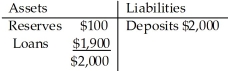 -Refer to Fact 24.3.2.Bilbo Baggins comes to the bank and deposits a $100 bill.After Bilbo's deposit,but before any other actions occur,the total quantity of money in the economy
 (Multiple Choice)
4.9/5 (75)
(75) The higher and more unpredictable the changes in a monetary unit,the
(Multiple Choice)
4.8/5 (83)
(83) The Canadian currency drain ratio for M1 is approximately ________ percent in 2010.
(Multiple Choice)
4.7/5 (85)
(85) When the interest rate falls in the money market,the quantity of money demanded ________ and the quantity of money supplied ________.
(Multiple Choice)
4.9/5 (75)
(75) If people decide to transfer their currency into their bank deposits then,all else constant,their decisions will
(Multiple Choice)
4.8/5 (71)
(71) You are given the following information about the economy of Nocoin:
The banks have deposits of $300 billion.Their reserves are $15 billion,two thirds of which is in deposits with the central bank.Households and firms hold $30 billion in bank notes.There are no coins!
The banks have no excess reserves.
The Bank of Nocoin,the central bank,increases bank reserves by $0.5 billion.
The quantity of money ________.
The change in the quantity of money is not equal to the change in the monetary base because ________.
The money multiplier is ________.
(Multiple Choice)
4.7/5 (81)
(81) The amount of real money people want to hold will increase if either the amount they are spending increases or the
(Multiple Choice)
4.8/5 (78)
(78) Suppose that the banking system has excess reserves of $10 million,the desired reserve ratio is 10 percent and the currency drain ratio is 40 percent.By how much will the quantity of money increase?
(Multiple Choice)
4.7/5 (84)
(84) 
Filters
- Essay(0)
- Multiple Choice(0)
- Short Answer(0)
- True False(0)
- Matching(0)