



 Chat with AI
Exam 23: Finance, Saving, and Investment

Exam 1: What Is Economics?198 Questions
Exam 2: The Economic Problem143 Questions
Exam 3: Demand and Supply178 Questions
Exam 4: Elasticity168 Questions
Exam 5: Efficiency and Equity108 Questions
Exam 6: Government Actions in Markets119 Questions
Exam 7: Global Markets in Action129 Questions
Exam 8: Utility and Demand110 Questions
Exam 9: Possibilities, Preferences, and Choices113 Questions
Exam 10: Organizing Production104 Questions
Exam 11: Output and Costs133 Questions
Exam 12: Perfect Competition118 Questions
Exam 13: Monopoly107 Questions
Exam 14: Monopolistic Competition111 Questions
Exam 15: Oligopoly97 Questions
Exam 16: Externalities112 Questions
Exam 17: Public Goods and Common Resources89 Questions
Exam 18: Markets for Factors of Production119 Questions
Exam 19: Economic Inequality117 Questions
Exam 20: Measuring GDP and Economic Growth127 Questions
Exam 21: Monitoring Jobs and Inflation112 Questions
Exam 22: Economic Growth90 Questions
Exam 23: Finance, Saving, and Investment142 Questions
Exam 24: Money, the Price Level, and Inflation115 Questions
Exam 25: The Exchange Rate and the Balance of Payments114 Questions
Exam 26: Aggregate Supply and Aggregate Demand124 Questions
Exam 27: Expenditure Multipliers: The Keynesian Model158 Questions
Exam 28: Canadian Inflation, Unemployment, and Business Cycle101 Questions
Exam 29: Fiscal Policy91 Questions
Exam 30: Monetary Policy88 Questions
Exam 31:International Trade Policy116 Questions
Select questions type


Table 23.3.3
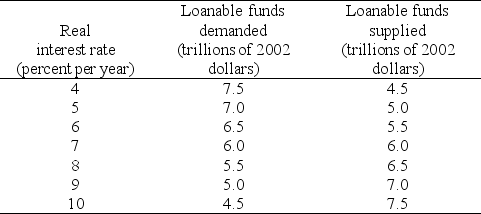 -Refer to Table 23.3.3.The table shows the demand for loanable funds schedule and the private supply of loanable funds schedule when the government's budget is balanced.If the Ricardo-Barro effect occurs,and if the government budget deficit is $2.0 trillion,the real interest rate is ________ percent a year and the quantity of investment is ________ trillion.
 (Multiple Choice)
4.9/5  (72)
(72) Which of the following is true?
I.As the real interest rate increases,people increase the quantity they save.
II.The supply of loanable funds curve is downward sloping.
III.As disposable income increases,the supply of loanable funds curve becomes steeper.
(Multiple Choice)
4.8/5 (82)
(82) 
Filters
- Essay(0)
- Multiple Choice(0)
- Short Answer(0)
- True False(0)
- Matching(0)