



 Chat with AI
Exam 22: Economic Growth

Exam 1: What Is Economics?198 Questions
Exam 2: The Economic Problem143 Questions
Exam 3: Demand and Supply178 Questions
Exam 4: Elasticity168 Questions
Exam 5: Efficiency and Equity108 Questions
Exam 6: Government Actions in Markets119 Questions
Exam 7: Global Markets in Action129 Questions
Exam 8: Utility and Demand110 Questions
Exam 9: Possibilities, Preferences, and Choices113 Questions
Exam 10: Organizing Production104 Questions
Exam 11: Output and Costs133 Questions
Exam 12: Perfect Competition118 Questions
Exam 13: Monopoly107 Questions
Exam 14: Monopolistic Competition111 Questions
Exam 15: Oligopoly97 Questions
Exam 16: Externalities112 Questions
Exam 17: Public Goods and Common Resources89 Questions
Exam 18: Markets for Factors of Production119 Questions
Exam 19: Economic Inequality117 Questions
Exam 20: Measuring GDP and Economic Growth127 Questions
Exam 21: Monitoring Jobs and Inflation112 Questions
Exam 22: Economic Growth90 Questions
Exam 23: Finance, Saving, and Investment142 Questions
Exam 24: Money, the Price Level, and Inflation115 Questions
Exam 25: The Exchange Rate and the Balance of Payments114 Questions
Exam 26: Aggregate Supply and Aggregate Demand124 Questions
Exam 27: Expenditure Multipliers: The Keynesian Model158 Questions
Exam 28: Canadian Inflation, Unemployment, and Business Cycle101 Questions
Exam 29: Fiscal Policy91 Questions
Exam 30: Monetary Policy88 Questions
Exam 31:International Trade Policy116 Questions
Select questions type


According to the law of diminishing returns,along the aggregate production function an additional unit of
(Multiple Choice)
4.9/5  (58)
(58) The Industrial Revolution in England was largely the result of
(Multiple Choice)
4.9/5 (67)
(67) Use the figure below to answer the following question.
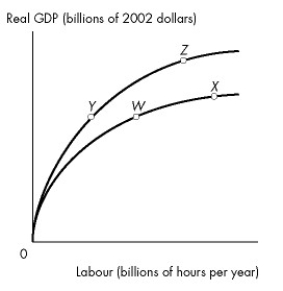 Figure 22.3.1
-If the money wage rate is $15.00 an hour and the price level is 120,the real wage rate is
Figure 22.3.1
-If the money wage rate is $15.00 an hour and the price level is 120,the real wage rate is (Multiple Choice)
4.9/5 (71)
(71) If capital per worker decreases,real GDP per hour of labour
(Multiple Choice)
4.8/5 (75)
(75) Which of the following ideas apply to the neoclassical growth theory?
I.The rate of technological change influences the rate of economic growth.
II.Technological change promotes saving and investment.
III.Convergence of economic growth rates across countries.
(Multiple Choice)
4.7/5 (86)
(86) In the labour market,an increase in labour productivity ________ the real wage rate and ________ the level of employment.
(Multiple Choice)
4.9/5 (87)
(87) If new capital increases labour productivity,the supply of labour ________ and the demand for labour ________.
(Multiple Choice)
4.9/5 (78)
(78) If real GDP per person is growing at 4 percent per year,it will double in
(Multiple Choice)
4.8/5 (78)
(78) Compared to growth in other countries,between 1960 and 2010 Canada
(Multiple Choice)
4.8/5 (73)
(73) 
Filters
- Essay(0)
- Multiple Choice(0)
- Short Answer(0)
- True False(0)
- Matching(0)