



 Chat with AI
Exam 18: Markets for Factors of Production

Exam 1: What Is Economics?198 Questions
Exam 2: The Economic Problem143 Questions
Exam 3: Demand and Supply178 Questions
Exam 4: Elasticity168 Questions
Exam 5: Efficiency and Equity108 Questions
Exam 6: Government Actions in Markets119 Questions
Exam 7: Global Markets in Action129 Questions
Exam 8: Utility and Demand110 Questions
Exam 9: Possibilities, Preferences, and Choices113 Questions
Exam 10: Organizing Production104 Questions
Exam 11: Output and Costs133 Questions
Exam 12: Perfect Competition118 Questions
Exam 13: Monopoly107 Questions
Exam 14: Monopolistic Competition111 Questions
Exam 15: Oligopoly97 Questions
Exam 16: Externalities112 Questions
Exam 17: Public Goods and Common Resources89 Questions
Exam 18: Markets for Factors of Production119 Questions
Exam 19: Economic Inequality117 Questions
Exam 20: Measuring GDP and Economic Growth127 Questions
Exam 21: Monitoring Jobs and Inflation112 Questions
Exam 22: Economic Growth90 Questions
Exam 23: Finance, Saving, and Investment142 Questions
Exam 24: Money, the Price Level, and Inflation115 Questions
Exam 25: The Exchange Rate and the Balance of Payments114 Questions
Exam 26: Aggregate Supply and Aggregate Demand124 Questions
Exam 27: Expenditure Multipliers: The Keynesian Model158 Questions
Exam 28: Canadian Inflation, Unemployment, and Business Cycle101 Questions
Exam 29: Fiscal Policy91 Questions
Exam 30: Monetary Policy88 Questions
Exam 31:International Trade Policy116 Questions
Select questions type


Use the figure below to answer the following questions.
 Figure 18.3.1
-Refer to Figure 18.3.1.This figure shows the value of marginal product of labour curve,the labour supply curve,and the marginal cost of labour curve.If this labour market is competitive,the quantity of labour employed is
Figure 18.3.1
-Refer to Figure 18.3.1.This figure shows the value of marginal product of labour curve,the labour supply curve,and the marginal cost of labour curve.If this labour market is competitive,the quantity of labour employed is (Multiple Choice)
4.7/5  (77)
(77) Which of the following would unions be least likely to support?
(Multiple Choice)
4.8/5 (73)
(73) Use the table below to answer the following questions.
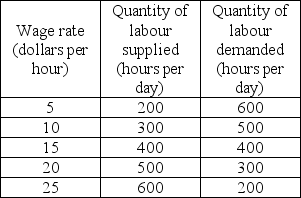 Table 18.3.1
-Refer to Table 18.3.1.Table 18.3.1 gives information about the labour market in Lantis,a community in which the labour market is perfectly competitive.The equilibrium wage rate is ________ an hour and the quantity of labour employed is ________ hours per day.
Table 18.3.1
-Refer to Table 18.3.1.Table 18.3.1 gives information about the labour market in Lantis,a community in which the labour market is perfectly competitive.The equilibrium wage rate is ________ an hour and the quantity of labour employed is ________ hours per day. (Multiple Choice)
4.7/5 (93)
(93) Use the table below to answer the following questions.
Table 18.2.1
 -Refer to Table 18.2.1.If the firm can sell all the output it wants for the price of $5 a unit,what is the profit-maximizing number of workers if the wage rate is $30?
 (Multiple Choice)
4.8/5 (64)
(64) Use the figure below to answer the following questions.
Figure 18.3.1
-Refer to Figure 18.3.1.This figure shows the value of marginal product of labour curve,the labour supply curve,and the marginal cost of labour curve.Suppose the government passes a minimum wage law that prohibits anyone from hiring labour at less than $6.50 per hour.The monopsonist will hire
Figure 18.3.1
-Refer to Figure 18.3.1.This figure shows the value of marginal product of labour curve,the labour supply curve,and the marginal cost of labour curve.Suppose the government passes a minimum wage law that prohibits anyone from hiring labour at less than $6.50 per hour.The monopsonist will hire (Multiple Choice)
4.8/5 (71)
(71) Suppose a gift shop in Corner Brook Newfoundland hires workers to personalize ornaments for Christmas.The store sells the personalized ornaments for $6 each.The value of marginal product of this store's fourth worker is $60.The marginal product of the fourth worker is
(Multiple Choice)
4.9/5 (92)
(92) If the present value of $500 to be received in one year is $463,the interest rate is
(Multiple Choice)
4.9/5 (78)
(78) To increase the demand for union labour,unions do all of the following except support
(Multiple Choice)
4.8/5 (84)
(84) A firm's value of marginal product of labour curve is also its
(Multiple Choice)
4.8/5 (90)
(90) Use the figure below to answer the following questions.
Figure 18.3.1
-Refer to Figure 18.3.1.This figure shows the value of marginal product of labour curve,the labour supply curve,and the marginal cost of labour curve.If this labour market is controlled by a monopsony,then the monopsonist
Figure 18.3.1
-Refer to Figure 18.3.1.This figure shows the value of marginal product of labour curve,the labour supply curve,and the marginal cost of labour curve.If this labour market is controlled by a monopsony,then the monopsonist (Multiple Choice)
4.8/5 (79)
(79) 
Filters
- Essay(0)
- Multiple Choice(0)
- Short Answer(0)
- True False(0)
- Matching(0)