



 Chat with AI
Exam 15: Oligopoly

Exam 1: What Is Economics?198 Questions
Exam 2: The Economic Problem143 Questions
Exam 3: Demand and Supply178 Questions
Exam 4: Elasticity168 Questions
Exam 5: Efficiency and Equity108 Questions
Exam 6: Government Actions in Markets119 Questions
Exam 7: Global Markets in Action129 Questions
Exam 8: Utility and Demand110 Questions
Exam 9: Possibilities, Preferences, and Choices113 Questions
Exam 10: Organizing Production104 Questions
Exam 11: Output and Costs133 Questions
Exam 12: Perfect Competition118 Questions
Exam 13: Monopoly107 Questions
Exam 14: Monopolistic Competition111 Questions
Exam 15: Oligopoly97 Questions
Exam 16: Externalities112 Questions
Exam 17: Public Goods and Common Resources89 Questions
Exam 18: Markets for Factors of Production119 Questions
Exam 19: Economic Inequality117 Questions
Exam 20: Measuring GDP and Economic Growth127 Questions
Exam 21: Monitoring Jobs and Inflation112 Questions
Exam 22: Economic Growth90 Questions
Exam 23: Finance, Saving, and Investment142 Questions
Exam 24: Money, the Price Level, and Inflation115 Questions
Exam 25: The Exchange Rate and the Balance of Payments114 Questions
Exam 26: Aggregate Supply and Aggregate Demand124 Questions
Exam 27: Expenditure Multipliers: The Keynesian Model158 Questions
Exam 28: Canadian Inflation, Unemployment, and Business Cycle101 Questions
Exam 29: Fiscal Policy91 Questions
Exam 30: Monetary Policy88 Questions
Exam 31:International Trade Policy116 Questions
Select questions type


Caven and John have been arrested by the police,who have evidence that will convict them of robbing a bank.If convicted,each will receive a sentence of 6 years for the robbery.During questioning,the police suspect that Caven and John are responsible for a series of bank robberies.If both confess to the series,each will receive 12 years in jail.If only one confesses,he will receive 4 years and the one who does not confess will receive 14 years.What is the equilibrium for this game?
(Multiple Choice)
4.9/5  (87)
(87) All of the following except ________ are noncriminal offences under the Competition Act.
(Multiple Choice)
4.9/5 (87)
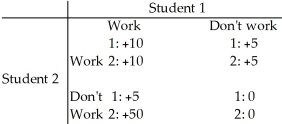
(87) Table 15.2.9
 Refer to the table below to answer the following question.
-Refer to Table 15.2.9.Two students are assigned a group project.Each has the option to work or not work to achieve a high grade.The payoffs are shown in the above table.Student 1
Refer to the table below to answer the following question.
-Refer to Table 15.2.9.Two students are assigned a group project.Each has the option to work or not work to achieve a high grade.The payoffs are shown in the above table.Student 1 (Multiple Choice)
4.9/5 (71)
(71) The distinguishing features of oligopoly are ________ and ________ in the industry.
(Multiple Choice)
4.8/5 (79)
(79) A strategy in which a player cooperates in the current period if the other player cooperated in the previous period,but the player cheats in the current period if the other player cheated in the previous period is called a
(Multiple Choice)
5.0/5 (57)
(57) If there is a successful collusive agreement in a duopoly to maximize profit,
(Multiple Choice)
4.9/5 (82)
(82) Use the table below to answer the following questions.
Table 15.2.2
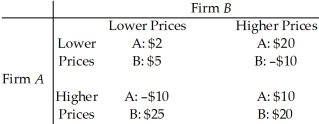 -Table 15.2.2 gives the payoff matrix in terms of economic profit for firms A and B when there are two strategies facing each firm: (1)charge a low price,or (2)charge a high price.Refer to the nonrepeated game in the table.If both firms could successfully collude,what would be firm A's economic profit?
 (Multiple Choice)
4.8/5 (76)
(76) Consider the cartel of Trick and Gear.The game is repeated indefinitely and each firm employs a tit-for-tat strategy.The equilibrium is called
(Multiple Choice)
4.7/5 (80)
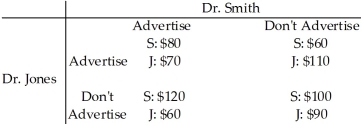
(80) Table 15.2.8
 Refer to the table below to answer the following questions.
-Refer to Table 15.2.8.Libertyville has two optometrists,Dr.Smith and Dr.Jones.Each optometrist can choose to advertise his service or not.The incomes of each optometrist,in thousands of dollars,are given in the payoff matrix above.Which of the following statements correctly describes Dr.Smith's strategy given what Dr.Jones may do?
Refer to the table below to answer the following questions.
-Refer to Table 15.2.8.Libertyville has two optometrists,Dr.Smith and Dr.Jones.Each optometrist can choose to advertise his service or not.The incomes of each optometrist,in thousands of dollars,are given in the payoff matrix above.Which of the following statements correctly describes Dr.Smith's strategy given what Dr.Jones may do? (Multiple Choice)
4.8/5 (70)
(70) Firm X is competing in an oligopolistic industry.When firm X increases its price
(Multiple Choice)
4.8/5 (90)
(90) Use the table below to answer the following question.
Table 15.3.1
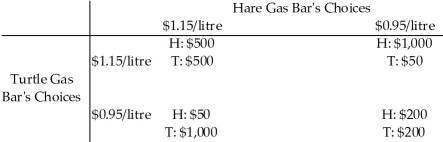 -Consider the game shown in Table 15.3.1 based on potential gas prices between two competitors.The game is played repeatedly and the result is a cooperative equilibrium.The payoffs in the table show the economic profit of the firms.The most likely outcome is
 (Multiple Choice)
4.8/5 (70)
(70) Use the table below to answer the following questions.
Table 15.2.4
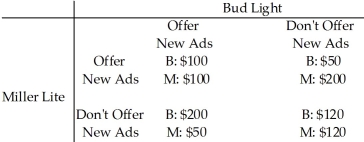 -Refer to Table 15.2.4.The marketers of Budweiser Light beer and Miller Lite beer must decide whether or not to offer new advertising campaigns promoting their products.The payoffs in the table are the economic profit made by Bud and Miller.Which one of the following observations is correct?
 (Multiple Choice)
4.8/5 (61)
(61) 
Filters
- Essay(0)
- Multiple Choice(0)
- Short Answer(0)
- True False(0)
- Matching(0)