



 Chat with AI
Exam 13: Monopoly

Exam 1: What Is Economics?198 Questions
Exam 2: The Economic Problem143 Questions
Exam 3: Demand and Supply178 Questions
Exam 4: Elasticity168 Questions
Exam 5: Efficiency and Equity108 Questions
Exam 6: Government Actions in Markets119 Questions
Exam 7: Global Markets in Action129 Questions
Exam 8: Utility and Demand110 Questions
Exam 9: Possibilities, Preferences, and Choices113 Questions
Exam 10: Organizing Production104 Questions
Exam 11: Output and Costs133 Questions
Exam 12: Perfect Competition118 Questions
Exam 13: Monopoly107 Questions
Exam 14: Monopolistic Competition111 Questions
Exam 15: Oligopoly97 Questions
Exam 16: Externalities112 Questions
Exam 17: Public Goods and Common Resources89 Questions
Exam 18: Markets for Factors of Production119 Questions
Exam 19: Economic Inequality117 Questions
Exam 20: Measuring GDP and Economic Growth127 Questions
Exam 21: Monitoring Jobs and Inflation112 Questions
Exam 22: Economic Growth90 Questions
Exam 23: Finance, Saving, and Investment142 Questions
Exam 24: Money, the Price Level, and Inflation115 Questions
Exam 25: The Exchange Rate and the Balance of Payments114 Questions
Exam 26: Aggregate Supply and Aggregate Demand124 Questions
Exam 27: Expenditure Multipliers: The Keynesian Model158 Questions
Exam 28: Canadian Inflation, Unemployment, and Business Cycle101 Questions
Exam 29: Fiscal Policy91 Questions
Exam 30: Monetary Policy88 Questions
Exam 31:International Trade Policy116 Questions
Select questions type


Use the table below to answer the following questions.
Table 13.4.1
 -Refer to Table 13.4.1.If a perfect price-discriminating monopoly faces the demand schedule shown in Table 13.4.1 and if marginal cost is constant at $3,output is
 (Multiple Choice)
4.7/5  (90)
(90) Use the figure below to answer the following questions.
 Figure 13.3.1
-Refer to Figure 13.3.1.The efficient quantity is
Figure 13.3.1
-Refer to Figure 13.3.1.The efficient quantity is (Multiple Choice)
4.8/5 (90)
(90) Use the figure below to answer the following questions.
 Figure 13.5.2
-Consider the natural monopoly depicted in Figure 13.5.2.If a regulatory agency sets a price just sufficient for the firm to make zero economic profit,and if the firm inflates its costs as much as possible,the regulated price will be
Figure 13.5.2
-Consider the natural monopoly depicted in Figure 13.5.2.If a regulatory agency sets a price just sufficient for the firm to make zero economic profit,and if the firm inflates its costs as much as possible,the regulated price will be (Multiple Choice)
4.9/5 (92)
(92) Use the information below to answer the following questions.
Fact 13.5.1
Cascade Springs Inc.is a natural monopoly that bottles water from a spring high in the Rocky Mountains.The total fixed cost it incurs is $80,000, and its marginal cost is 10 cents a bottle.The demand curve for Cascade Springs bottled water is shown in the following figure:
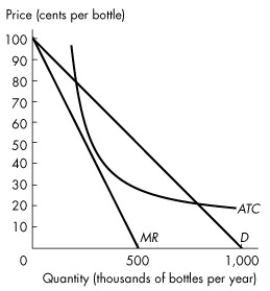 Figure 13.5.1
-Refer to Figure 13.5.1.Suppose the industry is unregulated.In this case,output is
Figure 13.5.1
-Refer to Figure 13.5.1.Suppose the industry is unregulated.In this case,output is (Multiple Choice)
5.0/5 (83)
(83) Use the figure below to answer the following questions.
 Figure 13.2.2
-For the single-price monopoly shown in Figure 13.2.2,when profit is maximized,quantity is
Figure 13.2.2
-For the single-price monopoly shown in Figure 13.2.2,when profit is maximized,quantity is (Multiple Choice)
4.9/5 (87)
(87) Which one of the following is most likely to be a natural monopoly?
(Multiple Choice)
4.8/5 (69)
(69) Which of the following markets will have the largest deadweight loss?
(Multiple Choice)
4.9/5 (70)
(70) Donna owns the only dog grooming salon on Lonely Island.If Donna can price discriminate between dog owners who are seniors and those who are not,her economic profit will be ________ than if she does not price discriminate and the number of dog groomings will be ________ if she does not price discriminate.
(Multiple Choice)
4.7/5 (86)
(86) Use the figure below to answer the following questions.
 Figure 13.2.3
-Refer to Figure 13.2.3.Assume this firm is a single-price monopoly.What is the profit-maximizing price to charge for the tickets?
Figure 13.2.3
-Refer to Figure 13.2.3.Assume this firm is a single-price monopoly.What is the profit-maximizing price to charge for the tickets? (Multiple Choice)
4.9/5 (84)
(84) Use the figure below to answer the following questions.
 Figure 13.3.3
-Consider the market demand curve in Figure 13.3.3.If the market is perfectly competitive,which area indicates consumer surplus?
Figure 13.3.3
-Consider the market demand curve in Figure 13.3.3.If the market is perfectly competitive,which area indicates consumer surplus? (Multiple Choice)
4.9/5 (76)
(76) A monopoly ________ make positive economic profit in the long run because ________.
(Multiple Choice)
4.8/5 (89)
(89) Use the information below to answer the following questions.
Fact 13.5.1
Cascade Springs Inc.is a natural monopoly that bottles water from a spring high in the Rocky Mountains.The total fixed cost it incurs is $80,000, and its marginal cost is 10 cents a bottle.The demand curve for Cascade Springs bottled water is shown in the following figure:
Figure 13.5.1
-Refer to Figure 13.5.1.Suppose the government regulates the firm with average cost pricing.What is the price?
Figure 13.5.1
-Refer to Figure 13.5.1.Suppose the government regulates the firm with average cost pricing.What is the price? (Multiple Choice)
4.9/5 (81)
(81) Use the figure below to answer the following question.
 Figure 13.4.1
-Which area in Figure 13.4.1 indicates the deadweight loss from a perfect price-discriminating monopoly?
Figure 13.4.1
-Which area in Figure 13.4.1 indicates the deadweight loss from a perfect price-discriminating monopoly? (Multiple Choice)
4.9/5 (96)
(96) Which one of the following is an example of a natural barrier to entry of new firms into an industry?
(Multiple Choice)
4.9/5 (86)
(86) Use the figure below to answer the following question.
 Figure 13.4.2
-Refer to Figure 13.4.2.Assume this monopolist practises perfect price discrimination.What is total revenue?
Figure 13.4.2
-Refer to Figure 13.4.2.Assume this monopolist practises perfect price discrimination.What is total revenue? (Multiple Choice)
4.9/5 (82)
(82) If marginal revenue equals zero,then demand at this level of output is
(Multiple Choice)
4.8/5 (74)
(74) Firms that can price discriminate between customers do so to ________.
(Multiple Choice)
4.9/5 (85)
(85) 
Filters
- Essay(0)
- Multiple Choice(0)
- Short Answer(0)
- True False(0)
- Matching(0)