



 Chat with AI
Exam 2: Some Tools of the Economist

Exam 1: The Economic Approach164 Questions
Exam 2: Some Tools of the Economist200 Questions
Exam 3: Demand, Supply, and the Market Process336 Questions
Exam 4: Supply and Demand: Applications and Extensions254 Questions
Exam 5: Difficult Cases for the Market, and the Role of Government130 Questions
Exam 6: The Economics of Political Action154 Questions
Exam 7: Taking the Nations Economic Pulse214 Questions
Exam 8: Economic Fluctuations, Unemployment, and Inflation174 Questions
Exam 9: An Introduction to Basic Macroeconomic Markets219 Questions
Exam 10: Dynamic Change, Economic Fluctuations, and the Ad-As Model189 Questions
Exam 11: Fiscal Policy: the Keynesian View and the Historical Development of Macroeconomics109 Questions
Exam 12: Fiscal Policy, Incentives, and Secondary Effects146 Questions
Exam 13: Money and the Banking System209 Questions
Exam 14: Modern Macroeconomics and Monetary Policy192 Questions
Exam 15: Stabilization Policy, Output, and Employment148 Questions
Exam 16: Creating an Environment for Growth and Prosperity120 Questions
Exam 17: Institutions, Policies, and Cross-Country Differences in Income and Growth111 Questions
Exam 18: Gaining From International Trade170 Questions
Exam 19: International Finance and the Foreign Exchange Market148 Questions
Select questions type


Table 2-1
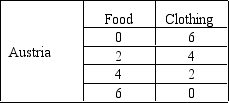
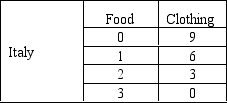 -Refer to Table 2-1. According to the law of comparative advantage, both Austria and Italy could gain if
 (Multiple Choice)
4.8/5  (71)
(71) Suppose that in Australia, the government allows private ownership of chickens but not of cows. If the people of Australia permanently increase their desire to purchase more chicken and beef, in the long run, we would expect
(Multiple Choice)
4.8/5 (77)
(77) Which of the following most accurately states the economic significance of exchange?
(Multiple Choice)
4.8/5 (77)
(77) When private ownership of a resource is clearly defined and enforced, the private owner
(Multiple Choice)
4.7/5 (73)
(73) The student government associations at several universities have experimented with purchasing bicycles to leave around campus for everyone's use. Anyone who needs the bike can use it, and they are not allowed to lock the bike up or take it home, but rather must leave it on campus for someone else to use. Economic theory would predict that
(Multiple Choice)
4.9/5 (71)
(71) Figure 2-10  -Refer to Figure 2-10. If this economy put all available resources into the production of bananas, it could produce
 (Multiple Choice)
4.9/5 (74)
(74) Mark and John are 10-year-old twins who do not get along. They have opened separate lemonade stands and are competing with each other, selling lemonade on their block. Their mother observes that Mark is very good at making lemonade and John is an excellent young salesman. She suggests they both could make more money if they worked together. John counters that two stands will always make more money than one. Who is right? Why?
(Essay)
5.0/5 (78)
(78) Table 2-3
 -Refer to Table 2-3. The opportunity cost of 1 pound of potatoes for the rancher is
 (Multiple Choice)
4.9/5 (84)
(84) The law of comparative advantage applies to exchange between
(Multiple Choice)
5.0/5 (71)
(71) An improvement in a country's legal system that enhanced the ability of citizens to protect their property rights and enforce contracts would result in which of the following changes to the country's production possibilities curve?
(Multiple Choice)
4.8/5 (72)
(72) Sophia is an architect and she is trying to decide whether to hire Jacob, a draftsman, to assist with her work. Sophia could hire Jacob at $20 per hour but it would take him three times as long to complete a task as it takes Sophia. Sophia is able to earn $90 per hour and has more architectural jobs than she is able to handle. Which of the following is true?
(Multiple Choice)
4.9/5 (74)
(74) The reason that the production possibilities curve is usually a bow-shaped curve instead of a straight line is that
(Multiple Choice)
4.9/5 (69)
(69) Which of the following most accurately reflects the opportunity cost to a pharmacist who drives a taxi?
(Multiple Choice)
5.0/5 (77)
(77) A production possibilities curve graphically represents the maximum quantities of two products produced when all resources in the economy are being used efficiently. If an economy operates at a point inside its production possibilities curve,
(Multiple Choice)
4.8/5 (73)
(73) In Zimbabwe and Botswana, elephants can be owned by local tribes and trade in ivory is legal, while in countries such as Kenya, it is illegal to trade in ivory and elephants cannot be privately owned but are protected by the government. Which of the following is true regarding the change in the elephant populations since 1979 in these countries?
(Multiple Choice)
4.9/5 (84)
(84) Which of the following is an implication of the law of comparative advantage?
(Multiple Choice)
5.0/5 (80)
(80) According to the law of comparative advantage, a particular task is performed most efficiently by the individual with the lowest
(Multiple Choice)
4.9/5 (79)
(79) With time, which one of the following strategies would most likely result in an outward shift in the production possibilities curve of an economy?
(Multiple Choice)
4.8/5 (69)
(69) 
Filters
- Essay(0)
- Multiple Choice(0)
- Short Answer(0)
- True False(0)
- Matching(0)