



 Chat with AI
Exam 2: Some Tools of the Economist

Exam 1: The Economic Approach164 Questions
Exam 2: Some Tools of the Economist200 Questions
Exam 3: Demand, Supply, and the Market Process336 Questions
Exam 4: Supply and Demand: Applications and Extensions254 Questions
Exam 5: Difficult Cases for the Market, and the Role of Government130 Questions
Exam 6: The Economics of Political Action154 Questions
Exam 7: Taking the Nations Economic Pulse214 Questions
Exam 8: Economic Fluctuations, Unemployment, and Inflation174 Questions
Exam 9: An Introduction to Basic Macroeconomic Markets219 Questions
Exam 10: Dynamic Change, Economic Fluctuations, and the Ad-As Model189 Questions
Exam 11: Fiscal Policy: the Keynesian View and the Historical Development of Macroeconomics109 Questions
Exam 12: Fiscal Policy, Incentives, and Secondary Effects146 Questions
Exam 13: Money and the Banking System209 Questions
Exam 14: Modern Macroeconomics and Monetary Policy192 Questions
Exam 15: Stabilization Policy, Output, and Employment148 Questions
Exam 16: Creating an Environment for Growth and Prosperity120 Questions
Exam 17: Institutions, Policies, and Cross-Country Differences in Income and Growth111 Questions
Exam 18: Gaining From International Trade170 Questions
Exam 19: International Finance and the Foreign Exchange Market148 Questions
Select questions type


Isabella decides to buy a dress that Olivia has for sale; they agree on a price of $20. Which of the following best describes who gains and who loses from the transaction?
(Multiple Choice)
4.7/5  (80)
(80) Retired persons travel by bus and automobile more frequently than do business executives, who more commonly use air travel. An economic explanation for this would be that
(Multiple Choice)
4.8/5 (90)
(90) The most important source of gain from the division of labor is
(Multiple Choice)
4.8/5 (87)
(87) Internet sites such as eBay make it easier for sellers and buyers to find one another and, by doing so,
(Multiple Choice)
5.0/5 (86)
(86) Suppose an airline ticket from Portland to Orlando costs $760. A bus ticket costs $360. Traveling by plane will take 6 hours, compared with 26 hours by bus. Other things constant, the minimum value of one's time that would induce a rational individual to fly rather than drive would be
(Multiple Choice)
4.9/5 (69)
(69) Figure 2-3 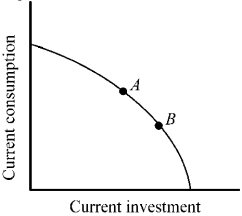 -Points A and B in Figure 2-3 indicate consumption and investment for two economies. Other things constant, which of the economies is likely to grow more rapidly in the future?
 (Multiple Choice)
4.8/5 (73)
(73) Table 2-1
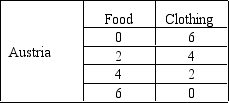
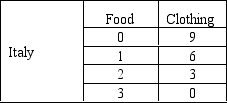 -Refer to Table 2-1. Which of the following would be a mutually agreeable rate of exchange?
 (Multiple Choice)
4.8/5 (72)
(72) If the resources of an economy are being used inefficiently, it would be
(Multiple Choice)
4.9/5 (79)
(79) Melanie has a choice of driving or flying from Durham, North Carolina to Knoxville, Tennessee for a one-day business trip. If she travels by air, she will be able to work seven hours in Knoxville, while if she drives, she will only have time to work four hours once there. Her expected income from each hour of work in Knoxville is $40. If Melanie a rational decision maker, she will chose to fly if and only if the price differential (air cost minus driving cost) is less than
(Multiple Choice)
4.8/5 (87)
(87) According to the law of comparative advantage, both individuals and nations will be able to produce a larger joint output if each productive activity is undertaken by
(Multiple Choice)
5.0/5 (81)
(81) The notion that specialization in goods that one can produce at a low opportunity cost will make it possible for trading partners to produce a larger joint output is called
(Multiple Choice)
4.7/5 (89)
(89) Maurice can drive or fly from Jacksonville, Florida to Atlanda, Georgia, for a one-day business trip. If he drives, he will be able to work three hours once he arrives in Atlanta, whereas traveling by plane will enable him to work eight hours. His expected income from each hour of work in Atlanta is $30. If Maurice is a rational decision maker, he will fly if and only if the price differential (air cost minus driving cost) is less than
(Multiple Choice)
4.9/5 (84)
(84) Table 2-3
 -Refer to Table 2-3. The opportunity cost of 1 pound of meat for the rancher is
 (Multiple Choice)
4.9/5 (72)
(72) In Europe during the 14th century, the Black Plague killed 24 million people or close to 37 percent of the population. How would this affect the production possibilities curves for the countries of Europe at that time?
(Multiple Choice)
4.8/5 (74)
(74) Production possibilities curve are usually bowed outward. This is because
(Multiple Choice)
4.9/5 (74)
(74) Use the table below to choose the correct answer. The table outlines the production possibilities of Robinson Crusoe and Joe Friday. 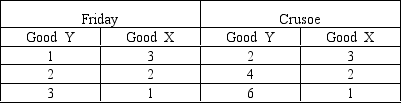 If Crusoe and Friday want to maximize their consumption possibilities,
 (Multiple Choice)
4.8/5 (76)
(76) Jim values his car at $2,000, and Kelly values it at $5,000. Can value be created in this situation? How? Suppose Jim refuses to sell for less than $6,000. Is value destroyed? Why or why not?
(Essay)
4.9/5 (84)
(84) 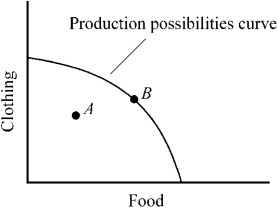 -Which of the following is true of Figure 2-4?
Land used to grow alfalfa could also be used to grow hay. Which of the following is true when the farmer plants hay and the market price of alfalfa rises?
(Multiple Choice)
4.8/5 (82)
(82) 
Filters
- Essay(0)
- Multiple Choice(0)
- Short Answer(0)
- True False(0)
- Matching(0)