



 Chat with AI
Exam 2: Some Tools of the Economist

Exam 1: The Economic Approach164 Questions
Exam 2: Some Tools of the Economist200 Questions
Exam 3: Demand, Supply, and the Market Process336 Questions
Exam 4: Supply and Demand: Applications and Extensions254 Questions
Exam 5: Difficult Cases for the Market, and the Role of Government130 Questions
Exam 6: The Economics of Political Action154 Questions
Exam 7: Taking the Nations Economic Pulse214 Questions
Exam 8: Economic Fluctuations, Unemployment, and Inflation174 Questions
Exam 9: An Introduction to Basic Macroeconomic Markets219 Questions
Exam 10: Dynamic Change, Economic Fluctuations, and the Ad-As Model189 Questions
Exam 11: Fiscal Policy: the Keynesian View and the Historical Development of Macroeconomics109 Questions
Exam 12: Fiscal Policy, Incentives, and Secondary Effects146 Questions
Exam 13: Money and the Banking System209 Questions
Exam 14: Modern Macroeconomics and Monetary Policy192 Questions
Exam 15: Stabilization Policy, Output, and Employment148 Questions
Exam 16: Creating an Environment for Growth and Prosperity120 Questions
Exam 17: Institutions, Policies, and Cross-Country Differences in Income and Growth111 Questions
Exam 18: Gaining From International Trade170 Questions
Exam 19: International Finance and the Foreign Exchange Market148 Questions
Select questions type


Which of the following is true regarding value, transaction costs, and exchange?
(Multiple Choice)
4.9/5  (80)
(80) The economic principle that states that individuals or nations can gain by specializing in the production of goods that they produce cheaply and exchanging for other desired goods that they could only produce at a higher cost is
(Multiple Choice)
4.8/5 (92)
(92) Suppose a country attempts to be self-sufficient and doesn't trade with any other countries. From an economic perspective, citizens of this nation can be expected to
(Multiple Choice)
4.9/5 (96)
(96) A profit-seeking decision maker who decides which business projects to undertake and how they should be undertaken is called
(Multiple Choice)
4.9/5 (81)
(81) Table 2-2
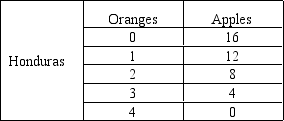
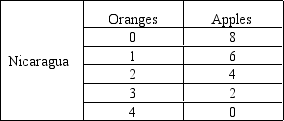 -Refer to Table 2-2. According to the law of comparative advantage, both Honduras and Nicaragua could gain if
 (Multiple Choice)
4.9/5 (63)
(63) A nation that protects its workers from unemployment by limiting the use (by employers) of technological improvements will
(Multiple Choice)
4.8/5 (72)
(72) Economic analysis suggests that gains from specialization and exchange
(Multiple Choice)
4.9/5 (86)
(86) Todd owns a truck that he values at $2,000. Susan, who does a lot of hauling, values the truck at $6,000. If these two are allowed to negotiate, which of the following will most likely occur?
(Multiple Choice)
4.9/5 (70)
(70) The number of cattle slaughtered every year for meat far exceeds the number of elephants slaughtered every year for their ivory. Despite this, cows can be found everywhere while elephants are on the verge of extinction in some countries. Which of the following best explains this difference?
(Multiple Choice)
4.8/5 (77)
(77) When private ownership rights are well-defined and enforced, owners
(Multiple Choice)
4.7/5 (95)
(95) When private ownership rights are well-defined and enforced, owners of physical assets and resources
(Multiple Choice)
4.9/5 (81)
(81) It can be said that, ultimately, consumers are the driving force in answering the three basic economic questions. Explain the consumer's role in providing these answers.
(Essay)
4.7/5 (74)
(74) A point on the production possibilities curve represents a combination of goods that is
(Multiple Choice)
4.9/5 (76)
(76) If a firm or a nation desires to maximize its output, each productive assignment should be carried out by those persons who
(Multiple Choice)
4.8/5 (76)
(76) "Now that Terrance paints the broad surfaces and I do the trim work, we can paint a house in three-fourths the time that it took for each of us to do both." This statement most clearly reflects
(Multiple Choice)
4.7/5 (79)
(79) Table 2-2
-Refer to Table 2-2. Which of the following would be a mutually agreeable rate of exchange?
-Refer to Table 2-2. Which of the following would be a mutually agreeable rate of exchange? (Multiple Choice)
4.8/5 (80)
(80) What are the three basic questions faced by every economy?
(Multiple Choice)
4.9/5 (93)
(93) 
Filters
- Essay(0)
- Multiple Choice(0)
- Short Answer(0)
- True False(0)
- Matching(0)