



 Chat with AI
Exam 19: The Kinetic Theory of Gases

Exam 1: Measurement37 Questions
Exam 2: Motion Along a Straight Line90 Questions
Exam 3: Vector32 Questions
Exam 4: Motion in Two and Three Dimensions53 Questions
Exam 5: Force and Motion I73 Questions
Exam 6: Force and Motion II74 Questions
Exam 7: Kinetic Energy and Work72 Questions
Exam 8: Potential Energy and Conservation of Energy62 Questions
Exam 9: Center of Mass and Linear Momentum98 Questions
Exam 10: Rotation99 Questions
Exam 11: Rolling, Torque, and Angular Momentum65 Questions
Exam 12: Equilibrium and Elasticity57 Questions
Exam 13: Gravitation54 Questions
Exam 14: Fluids87 Questions
Exam 15: Oscillations75 Questions
Exam 16: Waves I80 Questions
Exam 17: Waves II70 Questions
Exam 18: Temperature, Heat, and the First Law of Thermodynamics96 Questions
Exam 19: The Kinetic Theory of Gases111 Questions
Exam 20: Entropy and the Second Law of Thermodynamics61 Questions
Exam 21: Electric Charge51 Questions
Exam 22: Electric Fields52 Questions
Exam 23: Gauss Law39 Questions
Exam 24: Electric Potential50 Questions
Exam 25: Capacitance59 Questions
Exam 26: Current and Resistance54 Questions
Exam 27: Circuits73 Questions
Exam 28: Magnetic Fields51 Questions
Exam 29: Magnetic Fields Due to Currents48 Questions
Exam 30: Induction and Inductance90 Questions
Exam 31: Electromagnetic Oscillations and Alternating Current86 Questions
Exam 32: Maxwells Equations; Magnetism of Matter81 Questions
Exam 33: Electromagnetic Waves81 Questions
Exam 34: Images78 Questions
Exam 35: Interference45 Questions
Exam 36: Diffraction77 Questions
Exam 37: Relativity68 Questions
Exam 38: Photons and Matter Waves57 Questions
Exam 39: More About Matter Waves41 Questions
Exam 40: All About Atoms76 Questions
Exam 41: Conduction of Electricity in Solids49 Questions
Exam 42: Nuclear Physics68 Questions
Exam 43: Energy From the Nucleus50 Questions
Exam 44: Quarks, Leptons, and the Big Bang55 Questions
Select questions type


The mean free path of molecules in a gas is proportional to:
(Multiple Choice)
4.8/5  (64)
(64) The pressure of an ideal gas is doubled in an isothermal process.The root-mean-square speed of the molecules:
(Multiple Choice)
4.8/5 (91)
(91) The diagram shows three isotherms for an ideal gas, with T3-T2 the same as T2-T1.It also shows five thermodynamic processes carried out on the gas.Rank the processes in order of the change in the internal energy of the gas, least to greatest. 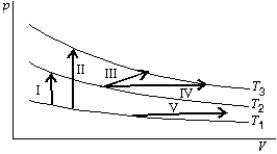
(Multiple Choice)
4.9/5 (102)
(102) A real gas undergoes a process which can be represented as a curve on a p-V diagram.The work done by the gas during this process is:
(Multiple Choice)
4.9/5 (77)
(77) The temperature of n moles of an ideal monatomic gas is increased by T at constant pressure.The energy Q absorbed as heat, change Eint in internal energy, and work W done by the environment are given by:
(Multiple Choice)
5.0/5 (89)
(89) A system consists of N gas molecules, each with mass m.Their rms speed is vrms.Their total translational kinetic energy is:
(Multiple Choice)
5.0/5 (88)
(88) A gas is confined to a cylindrical container of radius 1 cm and length 1 m.The pressure exerted on an end face, compared with the pressure exerted on the long curved face, is:
(Multiple Choice)
4.8/5 (76)
(76) The rms speed of an oxygen molecule at 0 C is 460 m/s.If the molar mass of oxygen is 32 g and of helium is 4 g, then the rms speed of a helium molecule at 0 C is:
(Multiple Choice)
4.7/5 (87)
(87) As the pressure in an ideal gas is increased isothermally the average molecular speed:
(Multiple Choice)
4.9/5 (72)
(72) Over 1 cycle of a cyclic process in which a system does net work on its environment:
(Multiple Choice)
4.9/5 (70)
(70) For a gas at thermal equilibrium the average speed v, the most probable speed vp, and the root-mean-square speed vrms are in the order:
(Multiple Choice)
4.9/5 (77)
(77) As the volume of an ideal gas is increased at constant pressure the average molecular speed:
(Multiple Choice)
4.8/5 (67)
(67) Use R = 8.2* 10-5 m3 .atm/mol . K and NA = 6.02 *1023 mol-1.The approximate number of air molecules in a 1 m3 volume at room temperature (300 K)and atmospheric pressure is:
(Multiple Choice)
4.9/5 (81)
(81) According to the Maxwellian speed distribution, as the temperature increases the average speed:
(Multiple Choice)
4.8/5 (87)
(87) The "Principle of equipartition of energy" states that the internal energy of a gas is shared equally:
(Multiple Choice)
4.7/5 (90)
(90) The temperature of n moles of an ideal monatomic gas is increased by T at constant volume.The energy Q absorbed as heat, change Eint in internal energy, and work W done by the environment are given by:
(Multiple Choice)
4.8/5 (80)
(80) The number of degrees of freedom of a triatomic molecule is:
(Multiple Choice)
4.8/5 (91)
(91) 
Filters
- Essay(0)
- Multiple Choice(0)
- Short Answer(0)
- True False(0)
- Matching(0)