



 Chat with AI
Exam 25: Capacitance

Exam 1: Measurement37 Questions
Exam 2: Motion Along a Straight Line90 Questions
Exam 3: Vector32 Questions
Exam 4: Motion in Two and Three Dimensions53 Questions
Exam 5: Force and Motion I73 Questions
Exam 6: Force and Motion II74 Questions
Exam 7: Kinetic Energy and Work72 Questions
Exam 8: Potential Energy and Conservation of Energy62 Questions
Exam 9: Center of Mass and Linear Momentum98 Questions
Exam 10: Rotation99 Questions
Exam 11: Rolling, Torque, and Angular Momentum65 Questions
Exam 12: Equilibrium and Elasticity57 Questions
Exam 13: Gravitation54 Questions
Exam 14: Fluids87 Questions
Exam 15: Oscillations75 Questions
Exam 16: Waves I80 Questions
Exam 17: Waves II70 Questions
Exam 18: Temperature, Heat, and the First Law of Thermodynamics96 Questions
Exam 19: The Kinetic Theory of Gases111 Questions
Exam 20: Entropy and the Second Law of Thermodynamics61 Questions
Exam 21: Electric Charge51 Questions
Exam 22: Electric Fields52 Questions
Exam 23: Gauss Law39 Questions
Exam 24: Electric Potential50 Questions
Exam 25: Capacitance59 Questions
Exam 26: Current and Resistance54 Questions
Exam 27: Circuits73 Questions
Exam 28: Magnetic Fields51 Questions
Exam 29: Magnetic Fields Due to Currents48 Questions
Exam 30: Induction and Inductance90 Questions
Exam 31: Electromagnetic Oscillations and Alternating Current86 Questions
Exam 32: Maxwells Equations; Magnetism of Matter81 Questions
Exam 33: Electromagnetic Waves81 Questions
Exam 34: Images78 Questions
Exam 35: Interference45 Questions
Exam 36: Diffraction77 Questions
Exam 37: Relativity68 Questions
Exam 38: Photons and Matter Waves57 Questions
Exam 39: More About Matter Waves41 Questions
Exam 40: All About Atoms76 Questions
Exam 41: Conduction of Electricity in Solids49 Questions
Exam 42: Nuclear Physics68 Questions
Exam 43: Energy From the Nucleus50 Questions
Exam 44: Quarks, Leptons, and the Big Bang55 Questions
Select questions type


What is the difference between a polar dielectric and a nonpolar dielectric?
(Multiple Choice)
4.8/5  (66)
(66) Each plate of a capacitor stores a charge of magnitude 1 mC when a 100-V potential difference is applied.The capacitance is:
(Multiple Choice)
4.9/5 (78)
(78) Capacitor C1 is connected alone to a battery and charged until the magnitude of the charge on each plate is 4.0 * 10-8 C.Then it is removed from the battery and connected to two other capacitors C2 and C3, as shown.The charge on the positive plate of C1 is then 1.0 * 10-8 C.The charges on the positive plates of C2 and C3 are: 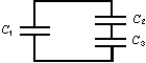
(Multiple Choice)
4.9/5 (74)
(74) Let Q denote charge, V denote potential difference and U denote stored energy.Of these quantities, capacitors in parallel must have the same:
(Multiple Choice)
4.8/5 (70)
(70) If both the plate area and the plate separation of a parallel-plate capacitor are doubled, the capacitance is:
(Multiple Choice)
4.8/5 (74)
(74) A 2- F and a 1- F capacitor are connected in series and a potential difference is applied across the combination.The 2- F capacitor has:
(Multiple Choice)
4.9/5 (74)
(74) Capacitors A and B are identical.Capacitor A is charged so it stores 4 J of energy and capacitor B is uncharged.The capacitors are then connected in parallel.The total stored energy in the capacitors is now:
(Multiple Choice)
4.9/5 (66)
(66) Capacitors C1 and C2 are connected in series and a potential difference is applied to the combination.If the capacitor that is equivalent to the combination has the same potential difference, then the charge on the equivalent capacitor is the same as:
(Multiple Choice)
4.8/5 (68)
(68) Two parallel-plate capacitors with different plate separation but the same capacitance are connected in series to a battery.Both capacitors are filled with air.The quantity that is NOT the same for both capacitors when they are fully charged is:
(Multiple Choice)
5.0/5 (68)
(68) An air-filled capacitor is charged, and then a dielectric is inserted.As a result, there is an induced charge on the dielectric.What is the difference between induced charge and free charge?
(Multiple Choice)
4.9/5 (90)
(90) If the plate separation of an isolated charged parallel-plate capacitor is doubled:
(Multiple Choice)
4.8/5 (89)
(89) Two capacitors are identical except that one is filled with air and the other with oil.Both capacitors carry the same charge.The ratio of the electric fields Eair/Eoil is:
(Multiple Choice)
4.8/5 (91)
(91) A 20-µF capacitor is charged to 200 V.Its stored energy is:
(Multiple Choice)
4.8/5 (92)
(92) A parallel-plate capacitor has a plate area of 0.2 m2 and a plate separation of 0.1 mm.To obtain an electric field of 2.0 *106 V/m between the plates, the magnitude of the charge on each plate should be:
(Multiple Choice)
4.8/5 (81)
(81) If the plate area of an isolated charged parallel-plate capacitor is doubled:
(Multiple Choice)
4.9/5 (82)
(82) A 2- F and a 1- F capacitor are connected in series and charged from a battery.They store charges P and Q, respectively.When disconnected and charged separately using the same battery, they have charges R and S, respectively.Then:
(Multiple Choice)
4.8/5 (90)
(90) A charged capacitor stores 10 C at 40 V.Its stored energy is:
(Multiple Choice)
4.8/5 (82)
(82) 
Filters
- Essay(0)
- Multiple Choice(0)
- Short Answer(0)
- True False(0)
- Matching(0)