



 Chat with AI
Exam 25: Capacitance

Exam 1: Measurement37 Questions
Exam 2: Motion Along a Straight Line90 Questions
Exam 3: Vector32 Questions
Exam 4: Motion in Two and Three Dimensions53 Questions
Exam 5: Force and Motion I73 Questions
Exam 6: Force and Motion II74 Questions
Exam 7: Kinetic Energy and Work72 Questions
Exam 8: Potential Energy and Conservation of Energy62 Questions
Exam 9: Center of Mass and Linear Momentum98 Questions
Exam 10: Rotation99 Questions
Exam 11: Rolling, Torque, and Angular Momentum65 Questions
Exam 12: Equilibrium and Elasticity57 Questions
Exam 13: Gravitation54 Questions
Exam 14: Fluids87 Questions
Exam 15: Oscillations75 Questions
Exam 16: Waves I80 Questions
Exam 17: Waves II70 Questions
Exam 18: Temperature, Heat, and the First Law of Thermodynamics96 Questions
Exam 19: The Kinetic Theory of Gases111 Questions
Exam 20: Entropy and the Second Law of Thermodynamics61 Questions
Exam 21: Electric Charge51 Questions
Exam 22: Electric Fields52 Questions
Exam 23: Gauss Law39 Questions
Exam 24: Electric Potential50 Questions
Exam 25: Capacitance59 Questions
Exam 26: Current and Resistance54 Questions
Exam 27: Circuits73 Questions
Exam 28: Magnetic Fields51 Questions
Exam 29: Magnetic Fields Due to Currents48 Questions
Exam 30: Induction and Inductance90 Questions
Exam 31: Electromagnetic Oscillations and Alternating Current86 Questions
Exam 32: Maxwells Equations; Magnetism of Matter81 Questions
Exam 33: Electromagnetic Waves81 Questions
Exam 34: Images78 Questions
Exam 35: Interference45 Questions
Exam 36: Diffraction77 Questions
Exam 37: Relativity68 Questions
Exam 38: Photons and Matter Waves57 Questions
Exam 39: More About Matter Waves41 Questions
Exam 40: All About Atoms76 Questions
Exam 41: Conduction of Electricity in Solids49 Questions
Exam 42: Nuclear Physics68 Questions
Exam 43: Energy From the Nucleus50 Questions
Exam 44: Quarks, Leptons, and the Big Bang55 Questions
Select questions type


The plate areas and plate separations of five parallel plate capacitors are 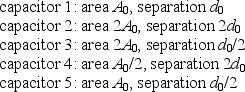 Rank these according to their capacitances, least to greatest.
 (Multiple Choice)
4.8/5  (83)
(83) Let Q denote charge, V denote potential difference and U denote stored energy.Of these quantities, capacitors in series must have the same:
(Multiple Choice)
4.9/5 (79)
(79) What happens to the atoms in a dielectric when it is placed between the plates of a charged capacitor?
(Multiple Choice)
4.7/5 (68)
(68) A parallel-plate capacitor has a plate area of 0.3 m2 and a plate separation of 0.1 mm.If the charge on each plate has a magnitude of 5 *10-6 C then the force exerted by one plate on the other has a magnitude of about:
(Multiple Choice)
4.8/5 (77)
(77) To store a total of 0.040 J of energy in the two identical capacitors shown, each should have a capacitance of: 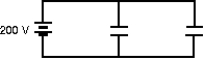
(Multiple Choice)
4.9/5 (81)
(81) A battery is used to charge a series combination of two identical capacitors.If the potential difference across the battery terminals is V and total charge Q flows through the battery during the charging process then the charge on the positive plate of each capacitor and the potential difference across each capacitor are:
(Multiple Choice)
4.9/5 (90)
(90) Each of the three 25- F capacitors shown is initially uncharged.How many coulombs of charge pass through the ammeter A after the switch S is closed? 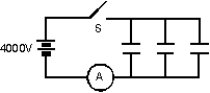
(Multiple Choice)
4.8/5 (90)
(90) A parallel-plate capacitor has a plate area of 0.30 m2 and a plate separation of 0.10 mm.If the charge on each plate has a magnitude of 5.0 *10-6 C, what is the energy density in its electric field?
(Multiple Choice)
4.9/5 (76)
(76) To charge a 1-F capacitor with 2 C requires a potential difference of:
(Multiple Choice)
4.9/5 (75)
(75) The diagram shows six 6- F capacitors.The capacitance between points a and b is: 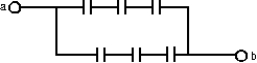
(Multiple Choice)
4.7/5 (84)
(84) A 2- F and a 1- F capacitor are connected in series and charged by a battery.They store energies P and Q, respectively.When disconnected and charged separately using the same battery, they have energies R and S, respectively.Then:
(Multiple Choice)
4.8/5 (68)
(68) Each of the four capacitors shown is 500 F.The voltmeter reads 1000V.The magnitude of the charge on each capacitor plate is: 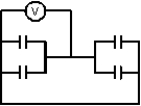
(Multiple Choice)
4.9/5 (85)
(85) A parallel-plate capacitor C has a charge Q.The actual charges on its plates are:
(Multiple Choice)
4.8/5 (86)
(86) A parallel-plate capacitor has a plate area of 0.2 m2 and a plate separation of 0.1 mm.If the charge on each plate has a magnitude of 4 *10-6 C the potential difference across the plates is approximately:
(Multiple Choice)
4.9/5 (88)
(88) A 2- F and a 1- F capacitor are connected in parallel and a potential difference is applied across the combination.The 2- F capacitor has:
(Multiple Choice)
4.9/5 (84)
(84) Capacitors C1 and C2 are connected in series.The equivalent capacitance is given by:
(Multiple Choice)
4.8/5 (73)
(73) A battery is used to charge a parallel-plate capacitor, after which it is disconnected.Then the plates are pulled apart to twice their original separation.This process will double the:
(Multiple Choice)
4.7/5 (75)
(75) Two parallel-plate capacitors with different capacitance but the same plate separation are connected in series to a battery.Both capacitors are filled with air.The quantity that is the same for both capacitors when they are fully charged is:
(Multiple Choice)
5.0/5 (84)
(84) 
Filters
- Essay(0)
- Multiple Choice(0)
- Short Answer(0)
- True False(0)
- Matching(0)