Multiple Choice
Capacitor C1 is connected alone to a battery and charged until the magnitude of the charge on each plate is 4.0 * 10-8 C.Then it is removed from the battery and connected to two other capacitors C2 and C3, as shown.The charge on the positive plate of C1 is then 1.0 * 10-8 C.The charges on the positive plates of C2 and C3 are: 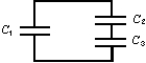
A) q2 = 3.0 *0 10 - -8 C and q3 = 3.0 *10 - 8 C
B) q2 = 2.0 *10 - 8 C and q3 = 2.0 *10 - 8 C
C) q2 = 5.0 *10 - 8 C and q3 = 1.0 *10 - 8 C
D) q2 = 3.0 * 10 - 8 C and q3 = 1.0 *10 - 8 C
E) q2 = 1.0 * 10 - 8 C and q3 = 3.0 *10 - 8 C
Correct Answer:

Verified
Correct Answer:
Verified
Q6: Let Q denote charge, V denote potential
Q17: What is the difference between a polar
Q24: If both the plate area and the
Q27: The units of capacitance are equivalent to:<br>A)J/C<br>B)V/C<br>C)J<sup>2</sup>/C<br>D)C/J<br>E)C<sup>2</sup>/J
Q37: Capacitors C<sub>1</sub> and C<sub>2</sub> are connected in
Q45: A 2- <span class="ql-formula" data-value="\mu"><span class="katex"><span
Q50: Each plate of a capacitor stores
Q53: A battery is used to charge a
Q56: Two parallel-plate capacitors with different capacitance but
Q60: Capacitors A and B are identical.Capacitor A