



 Chat with AI
Exam 11: Alcohols, Phenols, Thiols, Ethers, and Amines

Exam 1: Matter, Energy, and Measurement91 Questions
Exam 2: Atomic Structure and Radioisotopes107 Questions
Exam 3: Ionic and Covalent Compounds95 Questions
Exam 4: Molecular Geometry, Polarity, and Intermolecular86 Questions
Exam 5: Chemical Quantities and Introduction to Reactions88 Questions
Exam 6: Chemical Reactions: Energy, Rates, and Equilibrium87 Questions
Exam 7: Changes of State and Gas Laws99 Questions
Exam 8: Mixtures, Solution Concentrations, and Diffusion97 Questions
Exam 9: Acids and Bases, Ph, and Buffers83 Questions
Exam 10: Introduction to Organic Chemistry:111 Questions
Exam 11: Alcohols, Phenols, Thiols, Ethers, and Amines69 Questions
Exam 12: The Carbonyl Containing Functional Groups70 Questions
Exam 13: The Common Organic Reactions in Biochemistry82 Questions
Exam 14: Carbohydrates: Structure and Function97 Questions
Exam 15: Lipids: Structure and Function106 Questions
Exam 16: Proteins: Structure and Function134 Questions
Exam 17: Nucleotides and Nucleic Acids109 Questions
Exam 18: Energy and Metabolism115 Questions
Select questions type


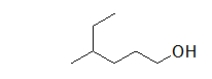
Which of the following molecules contain(s)a primary alcohol? 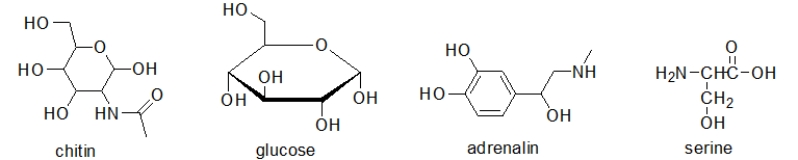
(Multiple Choice)
4.8/5  (68)
(68) Which choice BEST describes the functional groups in adrenaline, the neurotransmitter responsible for the "fight or flight" response? 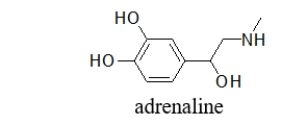
(Multiple Choice)
4.9/5 (73)
(73) 
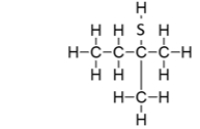
Alcohols are classified as primary, secondary, or tertiary alcohols.In order to determine how to classify an alcohol, the number of carbon groups attached to a particular atom in the molecule is counted.Which atom in the molecule below is it? 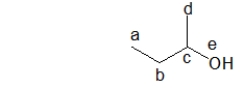
(Multiple Choice)
4.8/5 (78)
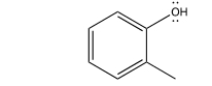
(78) 
Amines are _____________ because they react with water to ___________ a proton.
(Multiple Choice)
4.7/5 (87)
(87) Select the compound containing the alkyne functional group. 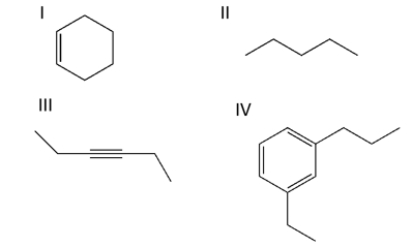
(Multiple Choice)
4.8/5 (70)
(70) Which of the following molecules is the MOST water soluble?
(Multiple Choice)
4.7/5 (94)
(94) 
What is the structure of the conjugate acid formed when methylamine accepts a hydrogen ion (H+)from water? 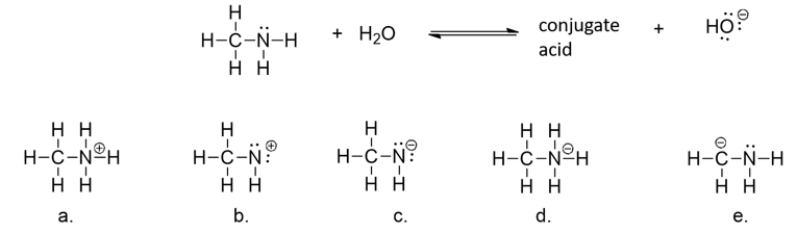
(Multiple Choice)
4.9/5 (73)
(73) 

How do molecules with polar functional groups behave differently than molecules with nonpolar functional groups?
(Multiple Choice)
4.7/5 (76)
(76) 

Which diagram BEST illustrates the interaction of dimethyl ether with water? Note that dashed lines indicate intermolecular forces of attraction. 
(Multiple Choice)
4.8/5 (66)
(66) 
Filters
- Essay(0)
- Multiple Choice(0)
- Short Answer(0)
- True False(0)
- Matching(0)