



 Chat with AI
Exam 22: Aerobic Respiration and Energy Production

Exam 1: Chemistry - Methods and Measurement104 Questions
Exam 2: The Structure of the Atom and the Periodic Table115 Questions
Exam 3: Structure and Properties of Ionic and Covalent Compounds93 Questions
Exam 4: Calculations, chemical Changes, and the Chemical Equation85 Questions
Exam 5: States of Matter: Gases, liquids, and Solids76 Questions
Exam 6: Solutions69 Questions
Exam 7: Energy,rate and Equilibrium67 Questions
Exam 8: Acids and Bases67 Questions
Exam 9: The Nucleus, radioactivity, and Nuclear Medicine86 Questions
Exam 10: An Introduction to Organic Chemistry104 Questions
Exam 11: The Unsaturated Hydrocarbons: Alkenes, alkynes, and Aromatics74 Questions
Exam 12: Alcohols, phenols, thiols, and Ethers69 Questions
Exam 13: Aldehydes and Ketones63 Questions
Exam 14: Carboxylic Acids and Carboxylic Acid Derivatives83 Questions
Exam 15: Amines and Amides82 Questions
Exam 16: Carbohydrates81 Questions
Exam 17: Lipids and Their Functions in Biochemical Systems78 Questions
Exam 18: Protein Structure and Function75 Questions
Exam 19: Enzymes74 Questions
Exam 20: Introduction to Molecular Genetics85 Questions
Exam 21: Carbohydrate Metabolism76 Questions
Exam 22: Aerobic Respiration and Energy Production75 Questions
Exam 23: Fatty Acid Metabolism75 Questions
Select questions type


A portion of the citric acid cycle is shown below.What are the identities of A and B? citrate → A → isocitrate → B
(Multiple Choice)
4.8/5  (95)
(95) Which of the following best describes the function of NAD+ and FAD in catabolic pathways?
(Multiple Choice)
4.8/5 (80)
(80) Which statement concerning regulation of the citric acid cycle is TRUE?
(Multiple Choice)
5.0/5 (75)
(75) Pyruvate is the key intermediate through which carbohydrates,amino acids,and fatty acids degrade and enter into the citric acid cycle.
(True/False)
4.8/5 (78)
(78) Cells in fast twitch muscle fibers contain more mitochondria than do cells in slow twitch fibers.
(True/False)
4.9/5 (85)
(85) The protein complexes responsible for oxidative phosphorylation are embedded in the inner mitochondrial membrane.
(True/False)
4.9/5 (83)
(83) Which organelle in the cytoplasm of the cell is the energy-producing factory of the cell?
(Multiple Choice)
4.9/5 (72)
(72) Which of the following compounds is aconitate,the intermediate produced when the enzyme aconitase catalyzes the dehydration of citrate? 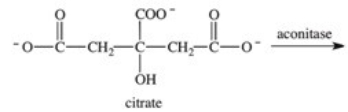
(Multiple Choice)
4.7/5 (90)
(90) The outer mitochondrial membrane is porous and permeable to substances with molar masses less than 10,000 g/mol.
(True/False)
5.0/5 (81)
(81) Which of the following substances,when present in high concentrations,inhibits the α-ketoglutarate dehydrogenase complex? 
(Multiple Choice)
4.9/5 (66)
(66) In the final step of the citric acid cycle,malate dehydrogenase reduces NAD+ to NADH.Into what product is malate converted in this reaction?
(Multiple Choice)
4.9/5 (83)
(83) What type of bond in acetyl CoA links the acetyl group to the rest of the molecule?
(Multiple Choice)
4.8/5 (81)
(81) What is the primary function of the citric acid cycle in metabolism?
(Multiple Choice)
4.7/5 (80)
(80) What is the primary function of electron transport and oxidative phosphorylation?
(Multiple Choice)
4.8/5 (84)
(84) The first step of the urea cycle involves which of the following substances?
(Multiple Choice)
4.9/5 (83)
(83) How many molecules of FADH2 are produced by the complete oxidation of one acetyl group by the citric acid cycle?
(Multiple Choice)
4.9/5 (82)
(82) A deficiency of urea cycle enzymes causes an elevation of the ammonium ion concentration.
(True/False)
4.9/5 (82)
(82) What is the name of the first compound formed in the citric acid cycle,produced by the transfer of an acetyl group from acetyl CoA to oxaloacetate?
(Multiple Choice)
4.9/5 (74)
(74) The enzymes for the citric acid cycle are found in what area of the mitochondria?
(Multiple Choice)
4.8/5 (90)
(90) 
Filters
- Essay(0)
- Multiple Choice(0)
- Short Answer(0)
- True False(0)
- Matching(0)