



 Chat with AI
Exam 14: Bond Prices and Yields

Exam 1: The Investment Environment51 Questions
Exam 2: Financial Markets, Asset Classes and Financial Instruments82 Questions
Exam 3: How Securities Are Traded65 Questions
Exam 4: Mutual Funds and Other Investment Companies59 Questions
Exam 5: Risk, Return, and the Historical Record64 Questions
Exam 6: Capital Allocation to Risky Assets59 Questions
Exam 7: Optimal Risky Portfolios63 Questions
Exam 8: Index Models76 Questions
Exam 9: The Capital Asset Pricing Model71 Questions
Exam 10: Arbitrage Pricing Theory and Multifactor Models of Risk and Return62 Questions
Exam 11: The Efficient Market Hypothesis42 Questions
Exam 12: Behavioural Finance and Technical Analysis41 Questions
Exam 13: Empirical Evidence on Security Returns41 Questions
Exam 14: Bond Prices and Yields110 Questions
Exam 15: The Term Structure of Interest Rates58 Questions
Exam 16: Managing Bond Portfolios69 Questions
Exam 17: Macroeconomic and Industry Analysis67 Questions
Exam 18: Equity Valuation Models106 Questions
Exam 19: Financial Statement Analysis71 Questions
Exam 20: Options Markets: Introduction88 Questions
Exam 21: Option Valuation85 Questions
Exam 22: Futures Markets85 Questions
Exam 23: Futures, Swaps, and Risk Management51 Questions
Exam 24: Portfolio Performance Evaluation68 Questions
Exam 25: International Diversification48 Questions
Exam 26: Hedge Funds46 Questions
Exam 27: The Theory of Active Portfolio Management48 Questions
Exam 28: Investment Policy and the Framework of the Cfa Institute76 Questions
Select questions type


What is the relationship between the price of a straight bond and the price of a callable bond?
(Multiple Choice)
4.8/5  (68)
(68) Floating-rate bonds are designed to ___________, while convertible bonds are designed to __________.
(Multiple Choice)
4.9/5 (84)
(84) Which of the following is not a type of international bond?
(Multiple Choice)
4.9/5 (82)
(82) A coupon bond that pays interest of $90 annually has a par value of $1,000, matures in nine years, and is selling today at a $66 discount from par value.The yield to maturity on this bond is
(Multiple Choice)
4.7/5 (87)
(87) A coupon bond that pays interest of $100 annually has a par value of $1,000, matures in five years, and is selling today at a $72 discount from par value.The yield to maturity on this bond is
(Multiple Choice)
4.9/5 (84)
(84) Consider the following $1,000-par-value zero-coupon bonds: 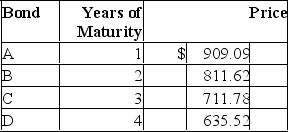 The yield to maturity on bond D is
 (Multiple Choice)
4.8/5 (79)
(79) A 10% coupon bond with annual payments and 10 years to maturity is callable in three years at a call price of $1,100.If the bond is selling today for $975, the yield to call is
(Multiple Choice)
4.8/5 (84)
(84) The invoice price of a bond that a buyer would pay is equal to
(Multiple Choice)
4.9/5 (83)
(83) A coupon bond that pays interest annually has a par value of $1,000, matures in seven years, and has a yield to maturity of 9.3%.The intrinsic value of the bond today will be ______ if the coupon rate is 8.5%.
(Multiple Choice)
4.9/5 (86)
(86) Which one of the following statements about convertibles is true?
(Multiple Choice)
4.9/5 (82)
(82) A convertible bond has a par value of $1,000 and a current market value of $850.The current price of the issuing firm's stock is $27, and the conversion ratio is 30 shares.The bond's conversion premium is
(Multiple Choice)
5.0/5 (76)
(76) A convertible bond has a par value of $1,000 and a current market price of $975.The current price of the issuing firm's stock is $42, and the conversion ratio is 22 shares.The bond's market conversion value is
(Multiple Choice)
4.8/5 (68)
(68) The ________ is used to calculate the present value of a bond.
(Multiple Choice)
4.9/5 (74)
(74) If a 7.25% coupon bond is trading for $982.00, it has a current yield of
(Multiple Choice)
4.8/5 (81)
(81) 
Filters
- Essay(0)
- Multiple Choice(0)
- Short Answer(0)
- True False(0)
- Matching(0)