



 Chat with AI
Exam 14: Bond Prices and Yields

Exam 1: The Investment Environment51 Questions
Exam 2: Financial Markets, Asset Classes and Financial Instruments82 Questions
Exam 3: How Securities Are Traded65 Questions
Exam 4: Mutual Funds and Other Investment Companies59 Questions
Exam 5: Risk, Return, and the Historical Record64 Questions
Exam 6: Capital Allocation to Risky Assets59 Questions
Exam 7: Optimal Risky Portfolios63 Questions
Exam 8: Index Models76 Questions
Exam 9: The Capital Asset Pricing Model71 Questions
Exam 10: Arbitrage Pricing Theory and Multifactor Models of Risk and Return62 Questions
Exam 11: The Efficient Market Hypothesis42 Questions
Exam 12: Behavioural Finance and Technical Analysis41 Questions
Exam 13: Empirical Evidence on Security Returns41 Questions
Exam 14: Bond Prices and Yields110 Questions
Exam 15: The Term Structure of Interest Rates58 Questions
Exam 16: Managing Bond Portfolios69 Questions
Exam 17: Macroeconomic and Industry Analysis67 Questions
Exam 18: Equity Valuation Models106 Questions
Exam 19: Financial Statement Analysis71 Questions
Exam 20: Options Markets: Introduction88 Questions
Exam 21: Option Valuation85 Questions
Exam 22: Futures Markets85 Questions
Exam 23: Futures, Swaps, and Risk Management51 Questions
Exam 24: Portfolio Performance Evaluation68 Questions
Exam 25: International Diversification48 Questions
Exam 26: Hedge Funds46 Questions
Exam 27: The Theory of Active Portfolio Management48 Questions
Exam 28: Investment Policy and the Framework of the Cfa Institute76 Questions
Select questions type


A Treasury bond due in one year has a yield of 5.7%; a Treasury bond due in 5 years has a yield of 6.2%.A bond issued by Ford Motor Company due in 5 years has a yield of 7.5%; a bond issued by Shell Oil due in one year has a yield of 6.5%.The default risk premiums on the bonds issued by Shell and Ford, respectively, are
(Multiple Choice)
4.9/5  (82)
(82) A 10% coupon bond maturing in 10 years that requires annual payments is expected to make all coupon payments but to pay only 50% of par value at maturity.What is the expected yield on this bond if the bond is purchased for $975?
(Multiple Choice)
5.0/5 (80)
(80) A zero-coupon bond has a yield to maturity of 9% and a par value of $1,000.If the bond matures in eight years, the bond should sell for a price of _______ today.
(Multiple Choice)
4.9/5 (80)
(80) You have just purchased a 7-year zero-coupon bond with a yield to maturity of 11% and a par value of $1,000.What would your rate of return at the end of the year be if you sell the bond? Assume the yield to maturity on the bond is 9% at the time you sell.
(Multiple Choice)
4.8/5 (83)
(83) Of the following five investments, ________ is (are) considered the least risky.
(Multiple Choice)
4.9/5 (70)
(70) What should happen to prices of zero-coupon securities as time passes?
(Multiple Choice)
5.0/5 (83)
(83) The yield to maturity of a 20-year zero-coupon bond that is selling for $372.50 with a value at maturity of $1,000 is
(Multiple Choice)
5.0/5 (80)
(80) You have just purchased a 12-year zero-coupon bond with a yield to maturity of 9% and a par value of $1,000.What would your rate of return at the end of the year be if you sell the bond? Assume the yield to maturity on the bond is 10% at the time you sell.
(Multiple Choice)
4.7/5 (86)
(86) Consider the following $1,000-par-value zero-coupon bonds: 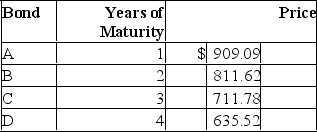 The yield to maturity on bond B is
 (Multiple Choice)
4.8/5 (83)
(83) A coupon bond that pays interest annually has a par value of $1,000, matures in eight years, and has a yield to maturity of 9%.The intrinsic value of the bond today will be ______ if the coupon rate is 6%.
(Multiple Choice)
4.9/5 (70)
(70) A convertible bond has a par value of $1,000 and a current market value of $1,150.The current price of the issuing firm's stock is $65, and the conversion ratio is 15 shares.The bond's conversion premium is
(Multiple Choice)
4.9/5 (83)
(83) Altman's Z scores are assigned based on a firm's financial characteristics and are used to predict
(Multiple Choice)
4.8/5 (81)
(81) A coupon bond pays annual interest, has a par value of $1,000, matures in four years, has a coupon rate of 8.25%, and has a yield to maturity of 8.64%.The current yield on this bond is
(Multiple Choice)
4.8/5 (94)
(94) A coupon bond that pays interest semi-annually has a par value of $1,000, matures in seven years, and has a yield to maturity of 9.3%.The intrinsic value of the bond today will be ________ if the coupon rate is 9.5%.
(Multiple Choice)
4.8/5 (84)
(84) Consider the following $1,000-par-value zero-coupon bonds: 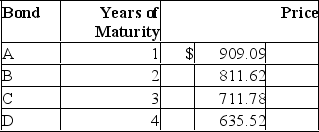 The yield to maturity on bond A is
 (Multiple Choice)
4.9/5 (78)
(78) The process of retiring high-coupon debt and issuing new bonds at a lower coupon to reduce interest payments is called
(Multiple Choice)
4.9/5 (78)
(78) You purchased an annual interest coupon bond one year ago that had nine years remaining to maturity at that time.The coupon interest rate was 10%, and the par value was $1,000.At the time you purchased the bond, the yield to maturity was 8%.If you sold the bond after receiving the first interest payment and the yield to maturity continued to be 8%, your annual total rate of return on holding the bond for that year would have been
(Multiple Choice)
4.9/5 (76)
(76) If a 7.5% coupon bond is trading for $1,050.00, it has a current yield of
(Multiple Choice)
4.8/5 (85)
(85) A coupon bond that pays interest semi-annually has a par value of $1,000, matures in five years, and has a yield to maturity of 10%.The intrinsic value of the bond today will be ________ if the coupon rate is 12%.
(Multiple Choice)
4.9/5 (92)
(92) A coupon bond that pays interest semi-annually has a par value of $1,000, matures in seven years, and has a yield to maturity of 11%.The intrinsic value of the bond today will be __________ if the coupon rate is 8.8%.
(Multiple Choice)
4.9/5 (62)
(62) 
Filters
- Essay(0)
- Multiple Choice(0)
- Short Answer(0)
- True False(0)
- Matching(0)