



 Chat with AI
Exam 12: Surveying the Stars

Exam 1: A Modern View of the Universe118 Questions
Exam 2: Discovering the Universe for Yourself137 Questions
Exam 3: The Science of Astronomy111 Questions
Exam 4: Making Sense of the Universe: Understanding Motion, Energy, and Gravity122 Questions
Exam 5: Light: the Cosmic Messenger148 Questions
Exam 6: Formation of the Solar System142 Questions
Exam 7: Earth and the Terrestrial Worlds193 Questions
Exam 8: Jovian Planet System98 Questions
Exam 9: Asteroids, Comets, and Dwarf Planets: Their Nature, Orbits, and Impacts130 Questions
Exam 10: Other Planetary Systems: the New Science of Distant Worlds86 Questions
Exam 11: Our Star114 Questions
Exam 12: Surveying the Stars146 Questions
Exam 13: Star Stuff142 Questions
Exam 14: The Bizarre Stellar Graveyard116 Questions
Exam 15: Our Galaxy124 Questions
Exam 16: A Universe of Galaxies160 Questions
Exam 17: The Birth of the Universe96 Questions
Exam 18: Dark Matter, Dark Energy, and the Fate of the Universe117 Questions
Exam 19: Life in the Universe94 Questions
Select questions type


A star with an apparent magnitude of 10 appears fainter than a star with an apparent magnitude of 9.
(True/False)
4.9/5  (90)
(90) The sketch above shows groups of stars on the H- R diagram, labeled (a)through (e); note that (a)represents the entire main sequence while (c)and (d)represent only small parts of the main sequence. Which group represents the most common type of stars?
(Multiple Choice)
5.0/5 (69)
(69) The sketch above shows groups of stars on the H- R diagram, labeled (a)through (e); note that (a)represents the entire main sequence while (c)and (d)represent only small parts of the main sequence. Which group represents stars that are cool and dim?
(Multiple Choice)
4.8/5 (88)
(88) What is the spectral type of a star with very strong hydrogen absorption lines?
(Multiple Choice)
4.8/5 (76)
(76) Which of the following statements about globular clusters is true?
(Multiple Choice)
4.8/5 (76)
(76) The choices below each describe the appearance of an H- R diagram for a different star cluster. Which cluster is the youngest?
(Multiple Choice)
4.8/5 (83)
(83) A star of spectral type B with a mass of 10 times the mass of the Sun lives approximately how long on the main sequence?
(Multiple Choice)
4.9/5 (82)
(82) 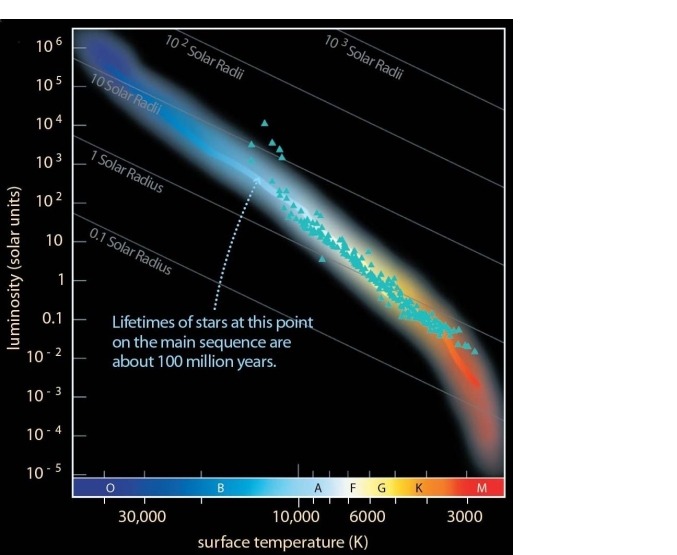 -A star is observed with a surface temperature of 3,000 K and a luminosity of 10-2 solar. What is the approximate radius of this star?
 (Multiple Choice)
4.9/5 (72)
(72) On a Hertzsprung- Russell diagram, where on the main sequence would you find stars that have the greatest mass?
(Multiple Choice)
4.9/5 (78)
(78) Which of the following stars has a spectrum that peaks at the shortest wavelength?
(Multiple Choice)
4.9/5 (77)
(77) The sketch above shows groups of stars on the H- R diagram, labeled (a)through (e); note that (a)represents the entire main sequence while (c)and (d)represent only small parts of the main sequence. Which group represents stars that have no ongoing nuclear fusion?
(Multiple Choice)
4.7/5 (90)
(90) Observing Stellar Evolution: Stars evolve on timescales of millions to billions of years, making it impossible for astronomers to follow the life- cycle of any individual star. Explain how astronomers overcome this limitation. Be sure to discuss the important role that observations of star clusters play in revealing the evolution of stars.
(Essay)
4.9/5 (75)
(75) Two separate pairs of binary stars are observed. The separation of the pairs is identical, but the orbital period of Pair X is 4 times the orbital period of Pair Y. How does the total mass of the stars in Pair X compare to the total mass of the stars in Pair Y?
(Multiple Choice)
4.9/5 (79)
(79) Each choice below lists a spectral type and luminosity class for a star. Which one is a red supergiant?
(Multiple Choice)
4.8/5 (77)
(77) Sirius is a star with spectral type A and Rigel is a star with spectral type B. What can we conclude?
(Multiple Choice)
4.8/5 (66)
(66) 
Filters
- Essay(0)
- Multiple Choice(0)
- Short Answer(0)
- True False(0)
- Matching(0)