



 Chat with AI
Exam 13: Star Stuff

Exam 1: A Modern View of the Universe118 Questions
Exam 2: Discovering the Universe for Yourself137 Questions
Exam 3: The Science of Astronomy111 Questions
Exam 4: Making Sense of the Universe: Understanding Motion, Energy, and Gravity122 Questions
Exam 5: Light: the Cosmic Messenger148 Questions
Exam 6: Formation of the Solar System142 Questions
Exam 7: Earth and the Terrestrial Worlds193 Questions
Exam 8: Jovian Planet System98 Questions
Exam 9: Asteroids, Comets, and Dwarf Planets: Their Nature, Orbits, and Impacts130 Questions
Exam 10: Other Planetary Systems: the New Science of Distant Worlds86 Questions
Exam 11: Our Star114 Questions
Exam 12: Surveying the Stars146 Questions
Exam 13: Star Stuff142 Questions
Exam 14: The Bizarre Stellar Graveyard116 Questions
Exam 15: Our Galaxy124 Questions
Exam 16: A Universe of Galaxies160 Questions
Exam 17: The Birth of the Universe96 Questions
Exam 18: Dark Matter, Dark Energy, and the Fate of the Universe117 Questions
Exam 19: Life in the Universe94 Questions
Select questions type


You discover a binary star system in which one member is a 15 solar mass main- sequence star and the other star is a 10 solar mass giant star. Why should you be surprised, at least at first?
(Multiple Choice)
4.9/5  (79)
(79) Which element is the dead end for cores of the most massive stars?
(Multiple Choice)
4.8/5 (81)
(81) What eventually halts the gravitational collapse of an interstellar gas cloud that forms an object that is not massive enough to become a star?
(Multiple Choice)
4.7/5 (79)
(79) Why does a star grow larger after it exhausts its core hydrogen?
(Multiple Choice)
4.9/5 (80)
(80) Lithium, beryllium, and boron are elements with atomic number 3, 4, and 5, respectively. Even though they are three of the five simplest elements, why are they rare compared to many heavier elements?
(Essay)
4.8/5 (85)
(85) Which of the following statements about degeneracy pressure is not true?
(Multiple Choice)
4.9/5 (79)
(79) Which is more common: a star blows up as a supernova, or a star forms a planetary nebula/white dwarf system?
(Multiple Choice)
4.8/5 (90)
(90) What did Carl Sagan mean when he said that we are all "star stuff"?
(Multiple Choice)
4.9/5 (88)
(88) Although some photographs show what looks like jets of material near many young stars, we now know that these "jets" actually represent gas from the surrounding nebula that is falling onto the stars.
(True/False)
4.9/5 (91)
(91) Why is a 1 solar- mass red giant more luminous than a 1 solar- mass main sequence star?
(Multiple Choice)
5.0/5 (81)
(81) In any star cluster, stars with lower masses greatly outnumber those with higher masses.
(True/False)
4.7/5 (68)
(68) (Use diagram of abundance vs atomic number)What process best explains the observed pattern of abundances of elements with atomic numbers between 6 and 20?
(Multiple Choice)
4.9/5 (92)
(92) This diagram represents the life track of a 1 solar mass star. Refer to the life stages labeled with roman numerals. Which stage lasts the longest?
(Multiple Choice)
4.9/5 (75)
(75) Consider a large molecular cloud that will give birth to a cluster of stars. Which of the following would you expect to be true?
(Multiple Choice)
4.8/5 (74)
(74) What percentage of a star's total lifetime is spent on the main sequence?
(Multiple Choice)
5.0/5 (75)
(75) Do you think it is possible that a 1.5- solar- mass red giant could harbor an advanced civilization? Explain your reasoning.
(Essay)
4.9/5 (75)
(75) 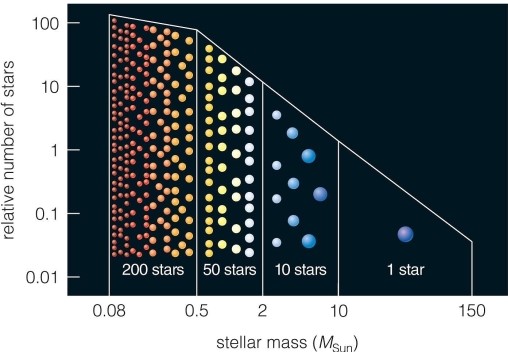 This schematic shows the number of stars formed in each mass range for each star more massive than 10 MSun. What is the mass range of the most common stars?
 (Multiple Choice)
4.9/5 (80)
(80) 
Filters
- Essay(0)
- Multiple Choice(0)
- Short Answer(0)
- True False(0)
- Matching(0)