



 Chat with AI
Exam 5: Light: the Cosmic Messenger

Exam 1: A Modern View of the Universe118 Questions
Exam 2: Discovering the Universe for Yourself137 Questions
Exam 3: The Science of Astronomy111 Questions
Exam 4: Making Sense of the Universe: Understanding Motion, Energy, and Gravity122 Questions
Exam 5: Light: the Cosmic Messenger148 Questions
Exam 6: Formation of the Solar System142 Questions
Exam 7: Earth and the Terrestrial Worlds193 Questions
Exam 8: Jovian Planet System98 Questions
Exam 9: Asteroids, Comets, and Dwarf Planets: Their Nature, Orbits, and Impacts130 Questions
Exam 10: Other Planetary Systems: the New Science of Distant Worlds86 Questions
Exam 11: Our Star114 Questions
Exam 12: Surveying the Stars146 Questions
Exam 13: Star Stuff142 Questions
Exam 14: The Bizarre Stellar Graveyard116 Questions
Exam 15: Our Galaxy124 Questions
Exam 16: A Universe of Galaxies160 Questions
Exam 17: The Birth of the Universe96 Questions
Exam 18: Dark Matter, Dark Energy, and the Fate of the Universe117 Questions
Exam 19: Life in the Universe94 Questions
Select questions type


Which of the following statements about electrical charge is true?
(Multiple Choice)
4.9/5  (78)
(78) Suppose you see two stars: a blue star and a red star. Which of the following can you conclude about the two stars? Assume that no Doppler shifts are involved. (Hint: Think about the laws of thermal radiation.)
(Multiple Choice)
4.9/5 (68)
(68) Currently, the largest optical telescope mirrors have a diameter of
(Multiple Choice)
4.9/5 (70)
(70) Which of the following wavelength regions cannot be studied with telescopes on the ground?
(Multiple Choice)
4.7/5 (82)
(82) Suppose that Star X and Star Y both have redshifts, but Star X has a larger redshift than Star Y. What can you conclude?
(Multiple Choice)
4.7/5 (77)
(77) Which of the following objects would be most likely to produce an emission- line spectrum?
(Multiple Choice)
5.0/5 (67)
(67) The simplified spectra for four stars is shown here. Which star has the lowest temperature? 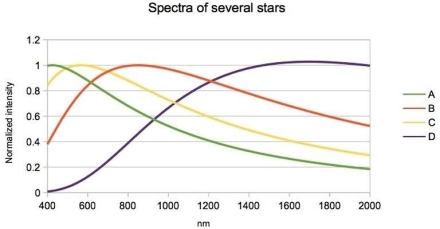
(Multiple Choice)
4.9/5 (79)
(79) The most common isotope of oxygen has atomic number 8 and atomic mass number 16. Another isotope has two extra neutrons. What are the atomic number and atomic mass number of this isotope?
(Essay)
4.9/5 (81)
(81) Visible light from a distant star can be spread into a spectrum by using a glass prism or .
(Multiple Choice)
4.8/5 (68)
(68) Which of the following best describes the fundamental difference between two different chemical elements (such as oxygen and carbon)?
(Multiple Choice)
4.8/5 (78)
(78) If we say that a material is opaque to ultraviolet light, we mean that it .
(Multiple Choice)
4.8/5 (83)
(83) When considering light as made up of individual "pieces," each characterized by a particular amount of energy, the pieces are called .
(Multiple Choice)
4.8/5 (86)
(86) Spectra from neutral atoms compared with spectra from ionized atoms of the same element
(Multiple Choice)
4.7/5 (84)
(84) A blue camera filter appears blue because it transmits blue light, absorbing all other colors.
(True/False)
4.8/5 (78)
(78) An isotope of fluorine has 9 protons and 10 neutrons. What are the atomic number and atomic mass number of this fluorine? If we added a proton to this fluorine nucleus, would the result still be fluorine? What if we added a neutron instead? Explain.
(Essay)
4.7/5 (76)
(76) Briefly explain how we can use spectral lines to determine an object's radial motion (toward or away from us). Can we also learn the object's tangential motion (across our line of sight)from its spectral lines?
(Essay)
4.8/5 (81)
(81) 
Filters
- Essay(0)
- Multiple Choice(0)
- Short Answer(0)
- True False(0)
- Matching(0)