



 Chat with AI
Exam 8: Jovian Planet System

Exam 1: A Modern View of the Universe118 Questions
Exam 2: Discovering the Universe for Yourself137 Questions
Exam 3: The Science of Astronomy111 Questions
Exam 4: Making Sense of the Universe: Understanding Motion, Energy, and Gravity122 Questions
Exam 5: Light: the Cosmic Messenger148 Questions
Exam 6: Formation of the Solar System142 Questions
Exam 7: Earth and the Terrestrial Worlds193 Questions
Exam 8: Jovian Planet System98 Questions
Exam 9: Asteroids, Comets, and Dwarf Planets: Their Nature, Orbits, and Impacts130 Questions
Exam 10: Other Planetary Systems: the New Science of Distant Worlds86 Questions
Exam 11: Our Star114 Questions
Exam 12: Surveying the Stars146 Questions
Exam 13: Star Stuff142 Questions
Exam 14: The Bizarre Stellar Graveyard116 Questions
Exam 15: Our Galaxy124 Questions
Exam 16: A Universe of Galaxies160 Questions
Exam 17: The Birth of the Universe96 Questions
Exam 18: Dark Matter, Dark Energy, and the Fate of the Universe117 Questions
Exam 19: Life in the Universe94 Questions
Select questions type


Which of the following gases is not a significant ingredient of the jovian planet atmospheres?
(Multiple Choice)
4.8/5  (82)
(82) What atmospheric constituent is responsible for the blue color of Uranus and Neptune?
(Multiple Choice)
4.8/5 (77)
(77) All the following statements are true. Which one is most important in explaining the tremendous tidal heating that occurs on Io?
(Multiple Choice)
4.9/5 (81)
(81) 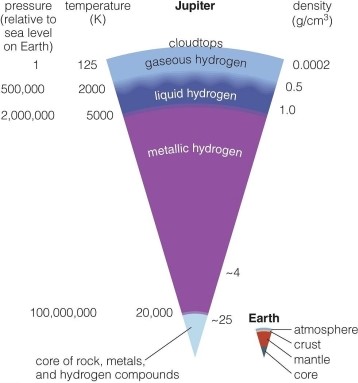 The Galileo spacecraft dropped a probe into Jupiter's atmosphere that survived 200 km, or 0.3% of Jupiter's radius. Which is the deepest layer that this probe was able to directly sample?
 (Multiple Choice)
4.8/5 (82)
(82) How do the size and mass of Jupiter's core compare to the size and mass of Earth?
(Multiple Choice)
4.9/5 (90)
(90) Explain how the resonance among Io, Europa, and Ganymede makes their orbits slightly elliptical.
(Essay)
4.8/5 (79)
(79) If the Jovian planets had solid surfaces, their large storms would likely dissipate faster.
(True/False)
4.7/5 (77)
(77) Which of the following statements about the moons of the jovian planets is not true?
(Multiple Choice)
4.9/5 (74)
(74) Which of the following best describes the composition of the particles forming Saturn's rings?
(Multiple Choice)
4.8/5 (84)
(84) What mechanism is most responsible for generating the internal heat of Io that drives its volcanic activity?
(Multiple Choice)
4.8/5 (83)
(83) Use these choices for the following questions.
-Which of the above applies to Titan?
(Multiple Choice)
4.8/5 (67)
(67) If Jupiter were 10 times more massive, it would actually have a smaller radius.
(True/False)
4.9/5 (87)
(87) 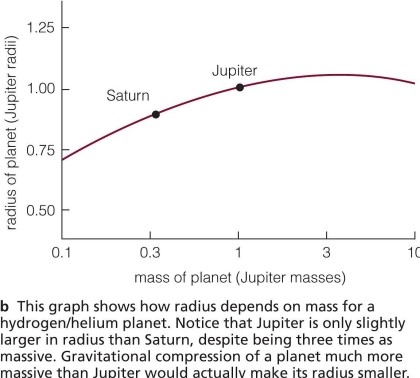 If a planet is found with a radius 5% greater than Jupiter, which is the best first estimate of that planet's mass?
 (Multiple Choice)
4.8/5 (85)
(85) Ganymede is larger than Mercury, but it is not classified as a planet because it orbits Jupiter as opposed to the sun.
(True/False)
4.9/5 (79)
(79) Which of the following best explains why we see horizontal "stripes" in photographs of Jupiter and Saturn?
(Multiple Choice)
4.8/5 (86)
(86) The water- ice particles forming Saturn's rings are frozen together into a thin sheet that rotates around Saturn like a solid body.
(True/False)
4.9/5 (83)
(83) 
Filters
- Essay(0)
- Multiple Choice(0)
- Short Answer(0)
- True False(0)
- Matching(0)