



 Chat with AI
Exam 9: Asteroids, Comets, and Dwarf Planets: Their Nature, Orbits, and Impacts

Exam 1: A Modern View of the Universe118 Questions
Exam 2: Discovering the Universe for Yourself137 Questions
Exam 3: The Science of Astronomy111 Questions
Exam 4: Making Sense of the Universe: Understanding Motion, Energy, and Gravity122 Questions
Exam 5: Light: the Cosmic Messenger148 Questions
Exam 6: Formation of the Solar System142 Questions
Exam 7: Earth and the Terrestrial Worlds193 Questions
Exam 8: Jovian Planet System98 Questions
Exam 9: Asteroids, Comets, and Dwarf Planets: Their Nature, Orbits, and Impacts130 Questions
Exam 10: Other Planetary Systems: the New Science of Distant Worlds86 Questions
Exam 11: Our Star114 Questions
Exam 12: Surveying the Stars146 Questions
Exam 13: Star Stuff142 Questions
Exam 14: The Bizarre Stellar Graveyard116 Questions
Exam 15: Our Galaxy124 Questions
Exam 16: A Universe of Galaxies160 Questions
Exam 17: The Birth of the Universe96 Questions
Exam 18: Dark Matter, Dark Energy, and the Fate of the Universe117 Questions
Exam 19: Life in the Universe94 Questions
Select questions type


Refer to the following scenario for the questions below.
Lost in the Solar System: You have been abducted by an alien being. After performing experiments on you, the alien gives you a "life- support belt", allowing you to survive in any environment, and dumps you somewhere in the solar system. Each question below gives a brief description of a place where you were left by the alien. Identify your location. Be as specific as possible. Include a brief explanation for your answer.
-You find yourself in a maelstrom, whipped by winds gusting at 10,000 km/hr, rising and falling in convective currents. On the rare occasions when you can assess your surroundings, you notice a horizon that seems to go on "forever" (or, at least, much farther than the horizon on Earth), and no solid surface anywhere. You get a glimpse of several large moons. The Sun races through your sky, requiring only about 5 hours to rise nearly due east, cross the meridian at an altitude of about 55° in the north, and then set due west.
(Essay)
4.7/5  (70)
(70) Visiting comets and asteroids: In recent years, several space probes have been sent to comets and asteroids to physically interact with them. Briefly describe three of these missions, and compare how each allows astronomers to better study the composition of these objects.
(Essay)
4.7/5 (74)
(74) What do astronomers mean when they refer to "gaps" in the asteroid belt between Mars and Jupiter?
(Multiple Choice)
5.0/5 (79)
(79) The last major dinosaurs were wiped out as a consequence of a major impact with the Earth about 65 million years ago. All but one of the following statements would be regarded as evidence for this claim.
(Multiple Choice)
4.9/5 (84)
(84) Classification in Science: Usually, the first task of any science is to classify the available observations. Often, the initial classification scheme reflects the historical order of discovery in addition to nature itself. In this question, we will use our solar system as an example. Make a complete list of all of the solar system components that you have studied in the last three chapters. Then try to place this list in historical order of discovery. For example, start your list with the Sun, Moon, Earth, and 5 "classical" planets, which have been known for all of human history, and end your list with Eris, the largest currently known Kuiper Belt object. Can you see the historical order of discovery reflected in the classification of objects on your list? Have there been occasions when this classification scheme has been revised? Finally, does the classification scheme for the solar system introduce any artificial divisions, making strict categories from objects with a continuous range of properties?
(Essay)
4.8/5 (75)
(75) What evidence led astronomers to conclude that the Oort cloud is a spherical distribution of comets?
(Multiple Choice)
4.9/5 (71)
(71) 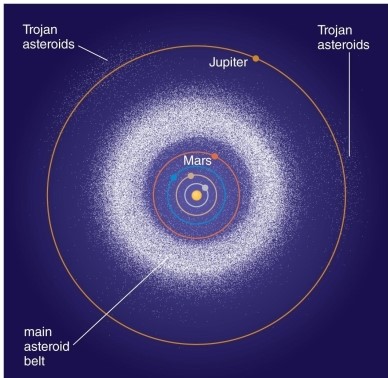 In what way(s)does this figure give a poor representation of the asteroid belt?
 (Multiple Choice)
4.9/5 (76)
(76) What is Pluto's moon Charon thought to have in common with our own Moon?
(Multiple Choice)
4.8/5 (72)
(72) Gaps in the asteroid belt (often called Kirkwood gaps)are caused by .
(Multiple Choice)
4.7/5 (84)
(84) Suppose we discover a new comet on an orbit that brings it closer to the Sun than Mercury every 125 years. What can we conclude?
(Multiple Choice)
4.8/5 (73)
(73) Refer to the following choices to answer the questions below. Choose the answer that best describes the chemical composition of the object.
-a Kuiper- belt object
(Multiple Choice)
4.8/5 (83)
(83) What part of a comet always points most directly away from the Sun?
(Multiple Choice)
4.7/5 (83)
(83) Refer to the following choices to answer the questions below. Choose the answer that best describes the chemical composition of the object.
-Comet Hale- Bopp
(Multiple Choice)
5.0/5 (75)
(75) What would be the consequence(s)of more frequent collisions between planets and asteroids?
(Multiple Choice)
4.9/5 (69)
(69) Which of the following statements about comets and asteroids is true?
(Multiple Choice)
4.9/5 (71)
(71) On average, how often do impacts large enough to produce mass extinction on the Earth occur?
(Multiple Choice)
4.8/5 (95)
(95) 
Filters
- Essay(0)
- Multiple Choice(0)
- Short Answer(0)
- True False(0)
- Matching(0)