



 Chat with AI
Exam 17: The Trade Off Between Inflation and Unemployment

Exam 1: What Is Economics226 Questions
Exam 2: The Economy Myth and Reality152 Questions
Exam 3: The Fundamental Economic Problem Scarcity and Choice250 Questions
Exam 4: Supply and Demand An Initial Look298 Questions
Exam 5: An Introduction To Macroeconomics215 Questions
Exam 6: The Goals Of Macroeconomic Policy211 Questions
Exam 7: Economic Growth Theory And Policy228 Questions
Exam 8: Aggregate Demand and The Powerful Consumer218 Questions
Exam 9: Demand Side Equilibrium Unemployment Or Inflation 212 Questions
Exam 10: Bringing In The Supply Side Unemployment and Inflation 228 Questions
Exam 11: Managing Aggregate Demand Fiscal Policy209 Questions
Exam 12: Money and The Banking System222 Questions
Exam 13: Monetary Policy Conventional and Unconventional204 Questions
Exam 14: The Financial Crisis and The Great Recession61 Questions
Exam 15: The Debate Over Monetary and Fiscal Policy215 Questions
Exam 16: Budget Deficits In The Short and Long Run210 Questions
Exam 17: The Trade Off Between Inflation and Unemployment219 Questions
Exam 18: International Trade and Comparative Advantage207 Questions
Exam 19: The International Monetary System Order Or Disorder 217 Questions
Exam 20: Exchange Rates and The Macroeconomy209 Questions
Select questions type


One of the reasons why the Phillips curve is no longer viewed as a "menu" of possible choices available to policy makers is that
(Multiple Choice)
4.9/5  (93)
(93) The government can fight inflation by manipulating both aggregate demand and aggregate supply.
(True/False)
4.9/5 (76)
(76) At the natural rate of unemployment,the long-run Phillips curve has a(n)
(Multiple Choice)
4.7/5 (69)
(69) If employees and employers always accurately predict inflation,what is the shape of the Phillips curve?
(Multiple Choice)
4.8/5 (78)
(78) Figure 17-8  -In Figure 17-8,which of the following points cannot be observed in the long run?
 (Multiple Choice)
4.8/5 (73)
(73) Inflation can come from the demand side or from the supply side of the economy.
(True/False)
4.8/5 (68)
(68) Figure 17-5 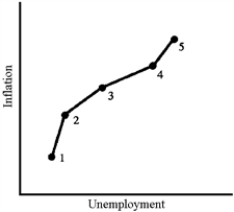 -Over a five-year period,economists observed that the unemployment-inflation relationship appeared as in Figure 17-5.Economic theory would conclude that the period
 (Multiple Choice)
5.0/5 (71)
(71) If the fluctuations in the economy's real growth rate from year to year are caused primarily by variations in the rate at which aggregate demand increases,then data would show
(Multiple Choice)
4.7/5 (93)
(93) Expansionary fiscal and monetary policy from 2008 to 2010,took the risk of being inflationary for the sake of avoiding additional unemployment.
(True/False)
4.8/5 (80)
(80) Most economists think that the economy's self-correcting mechanism is
(Multiple Choice)
4.8/5 (75)
(75) A vocal minority of economists,believers in the theory of rational expectations,insist that
(Multiple Choice)
4.9/5 (77)
(77) In the 1970s,why did the short-run Phillips curve fail to depict the unemployment-inflation trade-off?
(Essay)
4.7/5 (77)
(77) The U.S.economy in the 1990s benefited from an aggregate supply curve shifting outward.
(True/False)
4.9/5 (68)
(68) If aggregate demand had grown faster than it did from 2009 to 2010,then the U.S.economy would have experienced
(Multiple Choice)
4.9/5 (82)
(82) A decrease in the price of foreign oil will affect the U.S.economy by
(Multiple Choice)
5.0/5 (70)
(70) A non-policy reason for the reduction in the natural rate of unemployment is the
(Multiple Choice)
4.8/5 (89)
(89) If the short-run Phillips curve is fairly horizontal,attempts to fight inflation will generate considerable unemployment.
(True/False)
4.9/5 (69)
(69) Figure 17-8
-In Figure 17-8,which of the following points illustrate the expansionary monetary policies of the mid-1990s and the accompanying favorable supply shocks?
-In Figure 17-8,which of the following points illustrate the expansionary monetary policies of the mid-1990s and the accompanying favorable supply shocks? (Multiple Choice)
4.8/5 (75)
(75) 
Filters
- Essay(0)
- Multiple Choice(0)
- Short Answer(0)
- True False(0)
- Matching(0)