



 Chat with AI
Exam 17: The Trade Off Between Inflation and Unemployment

Exam 1: What Is Economics226 Questions
Exam 2: The Economy Myth and Reality152 Questions
Exam 3: The Fundamental Economic Problem Scarcity and Choice250 Questions
Exam 4: Supply and Demand An Initial Look298 Questions
Exam 5: An Introduction To Macroeconomics215 Questions
Exam 6: The Goals Of Macroeconomic Policy211 Questions
Exam 7: Economic Growth Theory And Policy228 Questions
Exam 8: Aggregate Demand and The Powerful Consumer218 Questions
Exam 9: Demand Side Equilibrium Unemployment Or Inflation 212 Questions
Exam 10: Bringing In The Supply Side Unemployment and Inflation 228 Questions
Exam 11: Managing Aggregate Demand Fiscal Policy209 Questions
Exam 12: Money and The Banking System222 Questions
Exam 13: Monetary Policy Conventional and Unconventional204 Questions
Exam 14: The Financial Crisis and The Great Recession61 Questions
Exam 15: The Debate Over Monetary and Fiscal Policy215 Questions
Exam 16: Budget Deficits In The Short and Long Run210 Questions
Exam 17: The Trade Off Between Inflation and Unemployment219 Questions
Exam 18: International Trade and Comparative Advantage207 Questions
Exam 19: The International Monetary System Order Or Disorder 217 Questions
Exam 20: Exchange Rates and The Macroeconomy209 Questions
Select questions type


European governments accepted prolonged periods of unemployment in the 1990s in order to reduce inflation.
(True/False)
4.7/5  (94)
(94) Which of the following could trigger demand-side inflation?
(Multiple Choice)
4.8/5 (84)
(84) The suggestion that the Fed concentrate only on reducing inflation is an attempt to
(Multiple Choice)
4.8/5 (85)
(85) Figure 17-8  -In Figure 17-8,the aggregate supply curve is shifting inward as we move from
 (Multiple Choice)
4.9/5 (74)
(74) Figure 17-8
-In Figure 17-8,policy makers can choose any of the following points as sustainable inflation-unemployment combinations:
-In Figure 17-8,policy makers can choose any of the following points as sustainable inflation-unemployment combinations: (Multiple Choice)
4.8/5 (77)
(77) What are some of the possible ways in which we could reduce the natural rate of unemployment?
(Essay)
4.7/5 (88)
(88) Which term refers to provisions in a law or a contract whereby monetary payments are automatically adjusted whenever a specified price index changes?
(Multiple Choice)
5.0/5 (64)
(64) Figure 17-6  -The short-run Phillips curve in Figure 17-6 would include which of the following points?
 (Multiple Choice)
4.7/5 (76)
(76) If workers underestimate inflation,the aggregate supply curve will tend to be
(Multiple Choice)
4.8/5 (91)
(91) If inflationary expectations are quite sluggish (that is,they do not adapt quickly),then the short-run Phillips curve will
(Multiple Choice)
4.9/5 (85)
(85) If expectations are rational,the difference between the actual rate of inflation and the expected rate of inflation will be zero.
(True/False)
4.8/5 (79)
(79) In December of 2007,with an unemployment rate of 5.0 percent,most economists believed this was above the natural rate.
(True/False)
4.8/5 (77)
(77) Every year from 1954 to 1984,the U.S.economy was characterized by higher output and lower prices.
(True/False)
4.9/5 (72)
(72) Figure 17-3 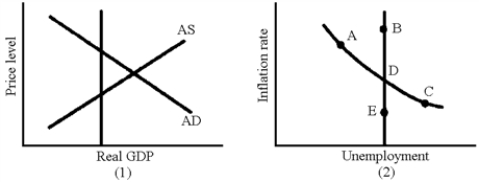 -Given the situation in graph (1)in Figure 17-3,what can be expected to change in graph (1)when the economy's self-correcting mechanism operates?
 (Multiple Choice)
4.8/5 (67)
(67) The economy's self-correcting mechanism always tends to push the unemployment rate back toward a specific rate of unemployment called
(Multiple Choice)
4.7/5 (82)
(82) The main process by which a recessionary gap is eliminated is a(n)
(Multiple Choice)
4.8/5 (79)
(79) If nominal wages increase at the same rate as inflation,then the aggregate supply curve will be a horizontal line.
(True/False)
4.8/5 (85)
(85) Policy makers who believe that the costs of inflation are very high will tend to favor which of the following during an inflationary gap?
(Multiple Choice)
4.9/5 (87)
(87) If policy makers do nothing in a recessionary gap,the most likely outcome is a
(Multiple Choice)
4.9/5 (81)
(81) 
Filters
- Essay(0)
- Multiple Choice(0)
- Short Answer(0)
- True False(0)
- Matching(0)