



 Chat with AI
Exam 17: The Trade Off Between Inflation and Unemployment

Exam 1: What Is Economics226 Questions
Exam 2: The Economy Myth and Reality152 Questions
Exam 3: The Fundamental Economic Problem Scarcity and Choice250 Questions
Exam 4: Supply and Demand An Initial Look298 Questions
Exam 5: An Introduction To Macroeconomics215 Questions
Exam 6: The Goals Of Macroeconomic Policy211 Questions
Exam 7: Economic Growth Theory And Policy228 Questions
Exam 8: Aggregate Demand and The Powerful Consumer218 Questions
Exam 9: Demand Side Equilibrium Unemployment Or Inflation 212 Questions
Exam 10: Bringing In The Supply Side Unemployment and Inflation 228 Questions
Exam 11: Managing Aggregate Demand Fiscal Policy209 Questions
Exam 12: Money and The Banking System222 Questions
Exam 13: Monetary Policy Conventional and Unconventional204 Questions
Exam 14: The Financial Crisis and The Great Recession61 Questions
Exam 15: The Debate Over Monetary and Fiscal Policy215 Questions
Exam 16: Budget Deficits In The Short and Long Run210 Questions
Exam 17: The Trade Off Between Inflation and Unemployment219 Questions
Exam 18: International Trade and Comparative Advantage207 Questions
Exam 19: The International Monetary System Order Or Disorder 217 Questions
Exam 20: Exchange Rates and The Macroeconomy209 Questions
Select questions type


If the income tax system were indexed,a person whose nominal income went up from $30,000 to $33,000 in a year when the price index rose by 10 percent would pay
(Multiple Choice)
4.8/5  (82)
(82) An economy eliminates a recessionary gap by reducing wages and prices.
(True/False)
4.7/5 (77)
(77) Figure 17-4 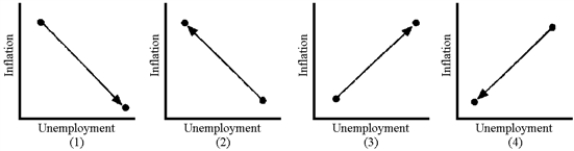 -Which panel in Figure 17-4 shows the movement associated with the supply-side changes of the 1990s?
 (Multiple Choice)
4.8/5 (77)
(77) Figure 17-6  -The long-run Phillips curve in Figure 17-6 (b)would include which of the following points?
 (Multiple Choice)
4.9/5 (78)
(78) Figure 17-6
-If the economy in 34-6 (b)is experiencing an inflationary gap (point g),the economy's self-correcting process will move unemployment to ____ and inflation to ____.
-If the economy in 34-6 (b)is experiencing an inflationary gap (point g),the economy's self-correcting process will move unemployment to ____ and inflation to ____. (Multiple Choice)
4.8/5 (92)
(92) Figure 17-7  -In Figure 17-7,the case for restrictive monetary and fiscal policy is strongest at point
 (Multiple Choice)
4.8/5 (76)
(76) According to rational expectations theory,a long period of unemployment is necessary to reduce inflation.
(True/False)
4.8/5 (85)
(85) Which of the following is most likely to lead to demand-side inflation?
(Multiple Choice)
4.9/5 (77)
(77) What is the crucial difference between inflation generated on the demand side versus inflation generated on the supply side?
(Multiple Choice)
4.7/5 (75)
(75) Workers expecting inflation will expect wage increases to be built into their wage contracts.
(True/False)
4.8/5 (74)
(74) Many economists think that,in the long run,the economy tends to move toward
(Multiple Choice)
4.8/5 (82)
(82) At one time,policy makers interpreted the Phillips curve as offering a menu of inflation-unemployment choices.Today,the curve is no longer viewed this way.Why has the interpretation changed?
(Essay)
4.8/5 (73)
(73) When deciding on an appropriate course of action to counter a recessionary gap,which of the following do policy makers consider?
(Multiple Choice)
4.8/5 (87)
(87) A movement from an upper point to a lower point on the Phillips curve shows
(Multiple Choice)
4.9/5 (81)
(81) Describe three arguments of why some economists object to the predictions of the rational expectations theory and do not subscribe to the conclusions of this approach.
(Essay)
4.8/5 (79)
(79) If AD and AS increase at exactly the same rate,the result will be
(Multiple Choice)
4.9/5 (66)
(66) Monetarists typically favor strong policy measures to fight recession.
(True/False)
4.9/5 (78)
(78) 
Filters
- Essay(0)
- Multiple Choice(0)
- Short Answer(0)
- True False(0)
- Matching(0)