



 Chat with AI
Exam 16: Cell Signaling

Exam 1: Cells: The Fundamental Units of Life64 Questions
Exam 2: Chemical Components of Cells74 Questions
Exam 3: Energy, Catalysis, and Biosynthesis73 Questions
Exam 4: Protein Structure and Function71 Questions
Exam 5: DNA and Chromosomes69 Questions
Exam 6: DNA Replication and Repair61 Questions
Exam 7: From DNA to Protein62 Questions
Exam 8: Control of Gene Expression68 Questions
Exam 9: How Genes and Genomes Evolve60 Questions
Exam 10: Analyzing the Structure and Function of Genes59 Questions
Exam 11: Membrane Structure57 Questions
Exam 12: Transport Across Cell Membranes67 Questions
Exam 13: How Cells Obtain Energy From Food71 Questions
Exam 14: Energy Generation in Mitochondria and Chloroplasts72 Questions
Exam 15: Intracellular Compartments and Protein Transport55 Questions
Exam 16: Cell Signaling60 Questions
Exam 17: Cytoskeleton59 Questions
Exam 18: The Cell-Division Cycle67 Questions
Exam 19: Sexual Reproduction and the Power of Genetics61 Questions
Exam 20: Cell Communities: Tissues, Stem Cells, and Cancer57 Questions
Select questions type


You are interested in cell-size regulation and discover that signaling through an enzyme-coupled receptor is important for the growth (enlargement) of mouse liver cells.Activation of the receptor activates adenylyl cyclase, which ultimately leads to the activation of PKA, which then phosphorylates a transcription factor called TFS on threonine 42.This phosphorylation is necessary for the binding of TFS to its specific sites on DNA, where it then activates the transcription of Sze2, a gene that encodes a protein important for liver cell growth.You find that liver cells lacking the receptor are 15% smaller than normal cells, whereas cells that express a constitutively activated version of PKA are 15% larger than normal liver cells.Given these results, predict whether you would expect the cell's size to be bigger or smaller than normal cells if cells were treated in the following fashion.
A.You change threonine 42 on TFS to an alanine residue.
B.You create a version of the receptor that is constitutively active.
C.You add a drug that inhibits adenylyl cyclase.
D.You add a drug that increases the activity of cyclic AMP phosphodiesterase.
E.You mutate the cAMP-binding sites in the regulatory subunits of PKA, so that the complex binds cAMP more tightly.
(Essay)
5.0/5  (72)
(72) The following happens when a G-protein-coupled receptor activates a G protein.
(Multiple Choice)
4.9/5 (76)
(76) Explain why the signal molecules used in neuronal signaling work at a longer range than those used in contact-dependent signaling.
(Essay)
4.8/5 (74)
(74) During nervous-system development in Drosophila, the membrane-bound protein Delta acts as an inhibitory signal to prevent neighboring cells from developing into neuronal cells.Delta is involved in __________ signaling.
(Multiple Choice)
4.9/5 (96)
(96) List in order the following types of cell signaling from the type of signaling in which the signal molecule travels the least distance to the type of signaling in which the signal molecule travels the largest distance.
contact-dependent signaling neuronal signaling
endocrine signaling paracrine signaling
(Essay)
4.8/5 (89)
(89) The activation of the serine/threonine protein kinase Akt requires phosphoinositide 3-kinase (PI 3-kinase) to
(Multiple Choice)
4.9/5 (74)
(74) Figure 16-36 shows how normal signaling works with a Ras protein acting downstream of an RTK.You examine a cell line with a constitutively active Ras protein that is always signaling.Which of the following conditions will turn off signaling in this cell line?  Figure 16-36
 (Multiple Choice)
4.7/5 (87)
(87) Which of the following mechanisms is NOT directly involved in inactivating an activated RTK?
(Multiple Choice)
4.7/5 (65)
(65) Antibodies are Y-shaped molecules that have two identical binding sites.Suppose that you have obtained an antibody that is specific for the extracellular domain of an RTK.When the antibody binds to the RTK, it brings together two RTK molecules.If cells containing the RTK were exposed to the antibody, would you expect the kinase to be activated, inactivated, or unaffected? Explain your reasoning.
(Essay)
5.0/5 (77)
(77) Cell lines A and B both survive in tissue culture containing serum but do not proliferate.Factor F is known to stimulate proliferation in cell line A.Cell line A produces a receptor protein (R) that cell line B does not produce.To test the role of receptor R, you introduce this receptor protein into cell line B, using recombinant DNA techniques.You then test all of your various cell lines in the presence of serum for their response to factor F, with the results summarized in Table 16-9. Cell line Factor F Response A - Factor F Cells do not proliferate A + Factor F Cells proliferate B - Factor F Cells do not proliferate B + Factor F Cells do not proliferate B + receptor R - Factor F Cells proliferate B + receptor R + Factor F Cells proliferate Table 16-9
Which of the following cannot be concluded from your results above?
(Multiple Choice)
4.8/5 (85)
(85) Choose the phrase in each pair that is likely to occur more rapidly in response to an extracellular signal.
A.changes in cell secretion/increased cell division
B.changes in protein phosphorylation/changes in proteins being synthesized
C.changes in mRNA levels/changes in membrane potential
(Essay)
4.7/5 (84)
(84) When Ras is activated, cells will divide.A dominant-negative form of Ras clings too tightly to GDP.You introduce a dominant-negative form of Ras into cells that also have a normal version of Ras.Which of the following statements is TRUE?
(Multiple Choice)
4.9/5 (83)
(83) Indicate by writing "yes" or "no" whether amplification of a signal could occur at the particular steps described below.Explain your answers.
A.An extracellular signaling molecule binds and activates a GPCR.
B.The activated GPCRs cause Gα to separate from Gβ and Gγ.
C.Adenylyl cyclase produces cyclic AMP.
D.cAMP activates protein kinase A.
E.Protein kinase A phosphorylates target proteins.
(Essay)
4.9/5 (79)
(79) The growth factor Superchick stimulates the proliferation of cultured chicken cells.The receptor that binds Superchick is a receptor tyrosine kinase (RTK), and many chicken tumor cell lines have mutations in the gene that encodes this receptor.Which of the following types of mutation would be expected to promote uncontrolled cell proliferation?
(Multiple Choice)
4.9/5 (95)
(95) The ethylene response in plants involves a dimeric transmembrane receptor.When the receptor is not bound to ethylene, the receptor binds to and activates a protein kinase, which activates an intracellular signaling pathway that leads to the degradation of a transcriptional regulator important for transcribing the ethylene-responsive genes (see Figure 16-33).You discover a phosphatase that is important for ethylene signaling, and you name it PtpE.Plants lacking PtpE never turn on ethylene-responsive genes, even in the presence of ethylene.You find that PtpE dephosphorylates serine 121 on the transcriptional regulator.Furthermore, plants lacking PtpE degrade the transcriptional regulator in the presence of ethylene. (A)
 (B)
 Figure 16-33
Which of the following statements is inconsistent with your data?
(B)
Figure 16-33
Which of the following statements is inconsistent with your data? (Multiple Choice)
4.7/5 (65)
(65) Akt promotes the survival of many cells by affecting the activity of Bad and Bcl2, as diagrammed in Figure 16-28.  Figure 16-28
Which of the following statements is FALSE?
Figure 16-28
Which of the following statements is FALSE? (Multiple Choice)
4.8/5 (90)
(90) When the neurotransmitter acetylcholine is applied to skeletal muscle cells, it binds the acetylcholine receptor and causes the muscle cells to contract.Succinylcholine, which is a chemical analog of acetylcholine, binds to the acetylcholine receptor on skeletal muscle cells but causes the muscle cells to relax; it is therefore often used by surgeons as a muscle relaxant.Propose a model for why succinylcholine causes muscle relaxation.What might be the mechanism to explain the different activities of acetylcholine and succinylcholine on the acetylcholine receptor?
(Essay)
4.9/5 (87)
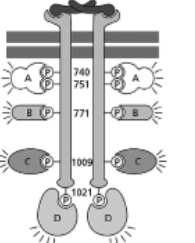
(87) When activated by the extracellular signal protein platelet-derived growth factor (PDGF), the PDGF receptor phosphorylates itself on multiple tyrosines (as indicated in Figure 16-61A by the circled Ps; the numbers next to these Ps indicate the amino acid number of the tyrosine).These phosphorylated tyrosines serve as docking sites for proteins that interact with the activated PDGF receptor.These proteins are indicated in the figure, and include the proteins A, B, C, and D.One of the cell's responses to PDGF is an increase in DNA synthesis, which can be measured by the incorporation of radioactive thymidine into the DNA.
To determine which protein or proteins-A, B, C, or D-are responsible for the activation of DNA synthesis, you construct mutant versions of the PDGF receptor that retain one or more tyrosine phosphorylation sites.You express these mutant versions in cells that do not make their own PDGF receptor.In these cells, the various mutant versions of the PDGF receptor are expressed normally, and, in response to PDGF binding, become phosphorylated on whichever tyrosines remain.You measure the level of DNA synthesis in cells that express the various mutant receptors and obtain the data shown in Figure 16-22B. (A)
 (B)
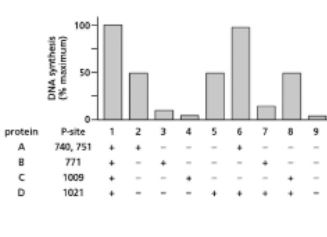 Figure 16-22
A.From these data, which, if any, of proteins A, B, C, and D are involved in the stimulation of DNA synthesis by PDGF? Explain your answer.
B.Which, if any, of these proteins inhibit DNA synthesis? Explain your answer.
C.Which, if any, of these proteins seem to have no detectable role in DNA synthesis? Explain your answer.
(B)
Figure 16-22
A.From these data, which, if any, of proteins A, B, C, and D are involved in the stimulation of DNA synthesis by PDGF? Explain your answer.
B.Which, if any, of these proteins inhibit DNA synthesis? Explain your answer.
C.Which, if any, of these proteins seem to have no detectable role in DNA synthesis? Explain your answer. (Essay)
4.8/5 (76)
(76) Which of the following statements about G-protein-coupled receptors (GPCRs) is FALSE?
(Multiple Choice)
4.7/5 (89)
(89) The local mediator nitric oxide stimulates the intracellular enzyme guanylyl cyclase by
(Multiple Choice)
4.8/5 (77)
(77) 
Filters
- Essay(0)
- Multiple Choice(0)
- Short Answer(0)
- True False(0)
- Matching(0)