Multiple Choice
The ethylene response in plants involves a dimeric transmembrane receptor.When the receptor is not bound to ethylene, the receptor binds to and activates a protein kinase, which activates an intracellular signaling pathway that leads to the degradation of a transcriptional regulator important for transcribing the ethylene-responsive genes (see Figure 16-33) .You discover a phosphatase that is important for ethylene signaling, and you name it PtpE.Plants lacking PtpE never turn on ethylene-responsive genes, even in the presence of ethylene.You find that PtpE dephosphorylates serine 121 on the transcriptional regulator.Furthermore, plants lacking PtpE degrade the transcriptional regulator in the presence of ethylene. (A) 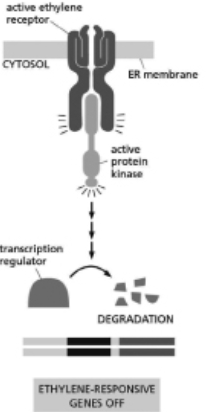
(B) 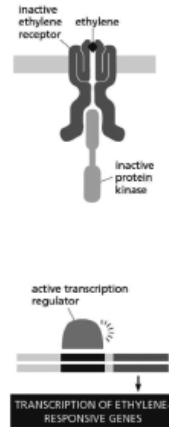
Figure 16-33
Which of the following statements is inconsistent with your data?
A) When the transcriptional regulator is phosphorylated, it activates transcription of the ethylene-responsive genes.
B) When the transcriptional regulator is not phosphorylated, it binds to DNA.
C) Activation of the protein kinase that binds to the ethylene receptor leads to inactivation of PtpE.
D) Binding of ethylene to its receptor leads to the activation of PtpE.
Correct Answer:

Verified
Correct Answer:
Verified
Q50: Cell lines A and B both
Q51: Choose the phrase in each pair that
Q52: When Ras is activated, cells will divide.A
Q53: Indicate by writing "yes" or "no" whether
Q54: The growth factor Superchick stimulates the proliferation
Q56: Akt promotes the survival of many cells
Q57: When the neurotransmitter acetylcholine is applied to
Q58: When activated by the extracellular signal protein
Q59: Which of the following statements about G-protein-coupled
Q60: The local mediator nitric oxide stimulates the