



 Chat with AI
Exam 11: Expenditure Multipliers

Exam 1: What Is Economics170 Questions
Exam 2: The Economic Problem145 Questions
Exam 3: Demand and Supply185 Questions
Exam 4: Measuring Gdp and Economic Growth126 Questions
Exam 5: Monitoring Jobs and Inflation113 Questions
Exam 6: Economic Growth95 Questions
Exam 7: Finance, Saving, and Investment138 Questions
Exam 8: Money, the Price Level, and Inflation129 Questions
Exam 9: The Exchange Rate and the Balance of Payments121 Questions
Exam 10: Aggregate Supply and Aggregate Demand129 Questions
Exam 11: Expenditure Multipliers166 Questions
Exam 12: The Business Cycle, Inflation, and Deflation105 Questions
Exam 13: Fiscal Policy96 Questions
Exam 14: Monetary Policy93 Questions
Exam 15: International Trade Policy119 Questions
Select questions type


The fraction of a change in disposable income that is saved is the
(Multiple Choice)
4.8/5  (81)
(81) Use the figure below to answer the following questions.
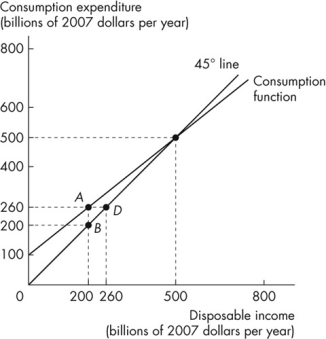 Figure 11.1.1
This figure describes the relationship between consumption expenditure and disposable income for an economy.
-Refer to Figure 11.1.1.When disposable income is $500 billion, saving is equal to
Figure 11.1.1
This figure describes the relationship between consumption expenditure and disposable income for an economy.
-Refer to Figure 11.1.1.When disposable income is $500 billion, saving is equal to (Multiple Choice)
4.8/5 (92)
(92) If there is an unplanned increase in inventories, aggregate planned expenditure is
(Multiple Choice)
4.9/5 (88)
(88) Suppose there is an increase in exports.Assuming the price level is held constant, which one of the following best describes the sequence of changes in the economy?
(Multiple Choice)
4.9/5 (78)
(78) Use the table below to answer the following questions.
Table 11.3.1
The following table shows the relationship between aggregate planned expenditure and real GDP in the hypothetical economy of Econoworld.
 -Refer to Table 11.3.1.If investment increases by $25 billion, the real GDP becomes
 (Multiple Choice)
4.8/5 (80)
(80) Use the information below to answer the following questions.
Fact 11.3.1
An economy has a fixed price level, no imports, and no income taxes.MPC is 0.5 and real GDP is $200 billion.Businesses incr investment by $2 billion.
-Consider Fact 11.3.1.The multiplier is
(Multiple Choice)
4.7/5 (84)
(84) The components of aggregate expenditure that are influenced by real GDP are
(Multiple Choice)
4.9/5 (76)
(76) In an economy, autonomous spending is $20 trillion and the slope of the AE curve is 0.8.The equation of the AE curve is
(Multiple Choice)
4.8/5 (81)
(81) The sum of the marginal propensity to save and the marginal propensity to consume
(Multiple Choice)
4.9/5 (90)
(90) Use the table below to answer the following questions.
Table 11.3.1
The following table shows the relationship between aggregate planned expenditure and real GDP in the hypothetical economy of Econoworld.
-Refer to Table 11.3.1.What is the slope of the AE curve?
-Refer to Table 11.3.1.What is the slope of the AE curve? (Multiple Choice)
4.9/5 (81)
(81) Use the figure below to answer the following questions.
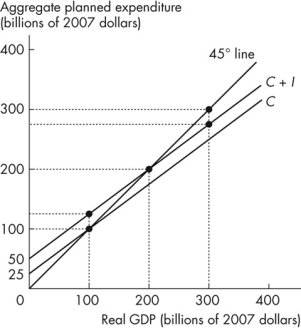 Figure 11.2.2
The economy depicted does not engage in international trade and has no government.Planned aggregate expenditure AE) is equal to the sum of consumption expenditure C) and investment I).
-Refer to Figure 11.2.2.When real GDP is $300 billion, real GDP
Figure 11.2.2
The economy depicted does not engage in international trade and has no government.Planned aggregate expenditure AE) is equal to the sum of consumption expenditure C) and investment I).
-Refer to Figure 11.2.2.When real GDP is $300 billion, real GDP (Multiple Choice)
4.8/5 (81)
(81) Use the table below to answer the following questions.
Table 11.3.1
The following table shows the relationship between aggregate planned expenditure and real GDP in the hypothetical economy of Econoworld.
-Refer to Table 11.3.1.The equilibrium level of real GDP is
-Refer to Table 11.3.1.The equilibrium level of real GDP is (Multiple Choice)
4.7/5 (79)
(79) When firms plan to restock their inventories, equilibrium expenditure_______ and real GDP_______.
(Multiple Choice)
4.7/5 (72)
(72) Use the information below to answer the following questions.
Fact 11.1.1
In an economy, when disposable income increases from $400 billion to $500 billion, consumption expenditure increases from billion to $540 billion.
-Consider Fact 11.1.1.When disposable income increases from $400 billion to $500 billion, saving
(Multiple Choice)
4.8/5 (81)
(81) Use the table below to answer the following questions.
Table 11.1.1
The following table shows the relationship between consumption expenditure C) and disposable income YD) for a hypothetical economy.  -Refer to Table 11.1.1.The marginal propensity to consume is
 (Multiple Choice)
4.9/5 (76)
(76) Use the figure below to answer the following questions.
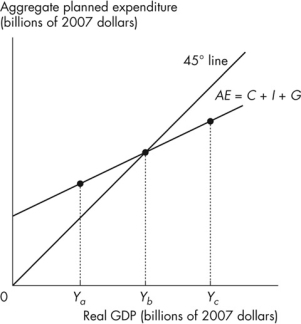 Figure 11.2.1
There are no exports or imports in this economy.
-Refer to Figure 11.2.1.When real GDP is equal to Yc, then aggregate planned expenditure is
Figure 11.2.1
There are no exports or imports in this economy.
-Refer to Figure 11.2.1.When real GDP is equal to Yc, then aggregate planned expenditure is (Multiple Choice)
4.9/5 (84)
(84) The multiplier shows that as _______ expenditure changes, real GDP changes by _______ amount.
(Multiple Choice)
4.8/5 (77)
(77) Use the figure below to answer the following questions.
Figure 11.2.1
There are no exports or imports in this economy.
-Refer to Figure 11.2.1.When real GDP is equal to Ya, then aggregate planned expenditure
Figure 11.2.1
There are no exports or imports in this economy.
-Refer to Figure 11.2.1.When real GDP is equal to Ya, then aggregate planned expenditure (Multiple Choice)
4.7/5 (73)
(73) An economy has a fixed price level, no imports, and no income taxes.MPC is 0.5 and real GDP is $300 billion.Businesses increase investment by $10 billion.The new level of real GDP is
(Multiple Choice)
4.9/5 (75)
(75) 
Filters
- Essay(0)
- Multiple Choice(0)
- Short Answer(0)
- True False(0)
- Matching(0)