



 Chat with AI
Exam 11: Expenditure Multipliers

Exam 1: What Is Economics170 Questions
Exam 2: The Economic Problem145 Questions
Exam 3: Demand and Supply185 Questions
Exam 4: Measuring Gdp and Economic Growth126 Questions
Exam 5: Monitoring Jobs and Inflation113 Questions
Exam 6: Economic Growth95 Questions
Exam 7: Finance, Saving, and Investment138 Questions
Exam 8: Money, the Price Level, and Inflation129 Questions
Exam 9: The Exchange Rate and the Balance of Payments121 Questions
Exam 10: Aggregate Supply and Aggregate Demand129 Questions
Exam 11: Expenditure Multipliers166 Questions
Exam 12: The Business Cycle, Inflation, and Deflation105 Questions
Exam 13: Fiscal Policy96 Questions
Exam 14: Monetary Policy93 Questions
Exam 15: International Trade Policy119 Questions
Select questions type


Suppose that investment decreases by $15 billion.If the multiplier is 2.5, the aggregate demand curve
(Multiple Choice)
4.9/5  (82)
(82) Everything else remaining the same, an increase in the marginal propensity to import _______the slope of the AE curve and _______ equilibrium expenditure.
(Multiple Choice)
4.9/5 (81)
(81) An increase in business investment at a constant price level
(Multiple Choice)
4.8/5 (75)
(75) Suppose that investment decreases by $15 billion.The multiplier is 2, and the short- run aggregate supply curve is positively sloped.In the short run, equilibrium real GDP
(Multiple Choice)
4.7/5 (81)
(81) Use the figure below to answer the following questions.
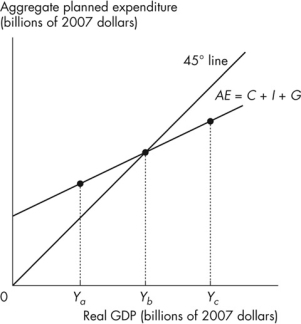 Figure 11.2.1
There are no exports or imports in this economy.
-Refer to Figure 11.2.1.Equilibrium real GDP
Figure 11.2.1
There are no exports or imports in this economy.
-Refer to Figure 11.2.1.Equilibrium real GDP (Multiple Choice)
4.8/5 (85)
(85) If a household's disposable income increases from $12,000 to $22,000 and at the same time its consumption expenditure increases from $4,000 to $9,000, then
(Multiple Choice)
4.8/5 (84)
(84) A shift in the aggregate expenditure curve as a result of a rise in the price level
(Multiple Choice)
5.0/5 (90)
(90) Use the information below to answer the following questions.
Fact 11.5.1
An economy has a consumption function of C = 10 + 0.8Y, investment equal to 6, government expenditure equal to 10, exports equal to 10, and an import function of M = 0.1Y.
-Refer to Fact 11.5.1.What is equilibrium real GDP in this economy?
(Multiple Choice)
4.8/5 (70)
(70) Use the table below to answer the following questions.
Table 11.1.3
 -Refer to Table 11.1.3.The marginal propensity to consume is
 (Multiple Choice)
4.8/5 (86)
(86) If the saving function is S = - 25 + 0.4YD, then the consumption function is
(Multiple Choice)
4.8/5 (79)
(79) Use the figure below to answer the following questions.
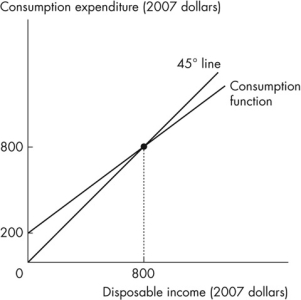 Figure 11.1.2
-Refer to Figure 11.1.2.Autonomous consumption is
Figure 11.1.2
-Refer to Figure 11.1.2.Autonomous consumption is (Multiple Choice)
4.8/5 (83)
(83) The aggregate expenditure curve and the aggregate demand curve are
(Multiple Choice)
5.0/5 (91)
(91) If investment increases by $200, and as a result income increases by $800, then the
(Multiple Choice)
4.9/5 (94)
(94) Use the table below to answer the following questions.
Table 11.1.1
The following table shows the relationship between consumption expenditure C) and disposable income YD) for a hypothetical economy.  -Refer to Table 11.1.1.The marginal propensity to save is
 (Multiple Choice)
4.8/5 (70)
(70) Use the figure below to answer the following questions.
 Figure 11.3.1
The economy shown in the graph does not engage in international trade and has no government.Planned aggregate expenditure equals the sum of consumption expenditure C) and investment I).
-Refer to Figure 11.3.1.The slope of the AE curve is
Figure 11.3.1
The economy shown in the graph does not engage in international trade and has no government.Planned aggregate expenditure equals the sum of consumption expenditure C) and investment I).
-Refer to Figure 11.3.1.The slope of the AE curve is (Multiple Choice)
4.8/5 (75)
(75) As the aggregate expenditure curve becomes steeper, the value of the multiplier becomes
(Multiple Choice)
4.9/5 (65)
(65) 
Filters
- Essay(0)
- Multiple Choice(0)
- Short Answer(0)
- True False(0)
- Matching(0)