



 Chat with AI
Exam 11: Expenditure Multipliers

Exam 1: What Is Economics170 Questions
Exam 2: The Economic Problem145 Questions
Exam 3: Demand and Supply185 Questions
Exam 4: Measuring Gdp and Economic Growth126 Questions
Exam 5: Monitoring Jobs and Inflation113 Questions
Exam 6: Economic Growth95 Questions
Exam 7: Finance, Saving, and Investment138 Questions
Exam 8: Money, the Price Level, and Inflation129 Questions
Exam 9: The Exchange Rate and the Balance of Payments121 Questions
Exam 10: Aggregate Supply and Aggregate Demand129 Questions
Exam 11: Expenditure Multipliers166 Questions
Exam 12: The Business Cycle, Inflation, and Deflation105 Questions
Exam 13: Fiscal Policy96 Questions
Exam 14: Monetary Policy93 Questions
Exam 15: International Trade Policy119 Questions
Select questions type


A change in consumption, in response to a change in income, is
(Multiple Choice)
4.8/5  (76)
(76) Use the figure below to answer the following questions.
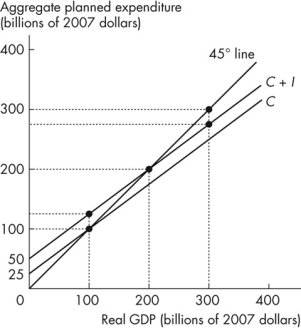 Figure 11.2.2
The economy depicted does not engage in international trade and has no government.Planned aggregate expenditure AE) is equal to the sum of consumption expenditure C) and investment I).
-Refer to Figure 11.2.2.Equilibrium expenditure is
Figure 11.2.2
The economy depicted does not engage in international trade and has no government.Planned aggregate expenditure AE) is equal to the sum of consumption expenditure C) and investment I).
-Refer to Figure 11.2.2.Equilibrium expenditure is (Multiple Choice)
4.9/5 (90)
(90) Use the figure below to answer the following questions.
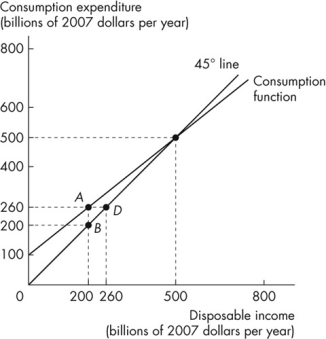 Figure 11.1.1
This figure describes the relationship between consumption expenditure and disposable income for an economy.
-Refer to Figure 11.1.1.When disposable income is equal to $200 billion, saving is
Figure 11.1.1
This figure describes the relationship between consumption expenditure and disposable income for an economy.
-Refer to Figure 11.1.1.When disposable income is equal to $200 billion, saving is (Multiple Choice)
4.8/5 (69)
(69) Use the figure below to answer the following questions.
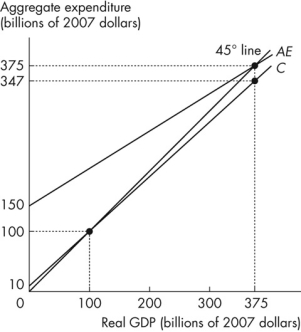 Figure 11.2.3
There are no taxes in this economy.
-In Figure 11.2.3, at the equilibrium level of real GDP, induced expenditure is
Figure 11.2.3
There are no taxes in this economy.
-In Figure 11.2.3, at the equilibrium level of real GDP, induced expenditure is (Multiple Choice)
4.7/5 (86)
(86) Which of the following quotations illustrates the idea of the multiplier?
(Multiple Choice)
4.8/5 (78)
(78) Use the figure below to answer the following questions.
 Figure 11.3.1
The economy shown in the graph does not engage in international trade and has no government.Planned aggregate expenditure equals the sum of consumption expenditure C) and investment I).
-Refer to Figure 11.3.1.The multiplier for this economy is
Figure 11.3.1
The economy shown in the graph does not engage in international trade and has no government.Planned aggregate expenditure equals the sum of consumption expenditure C) and investment I).
-Refer to Figure 11.3.1.The multiplier for this economy is (Multiple Choice)
4.8/5 (74)
(74) Use the figure below to answer the following questions.
Figure 11.2.2
The economy depicted does not engage in international trade and has no government.Planned aggregate expenditure AE) is equal to the sum of consumption expenditure C) and investment I).
-Refer to Figure 11.2.2.When real GDP is $100 billion,
Figure 11.2.2
The economy depicted does not engage in international trade and has no government.Planned aggregate expenditure AE) is equal to the sum of consumption expenditure C) and investment I).
-Refer to Figure 11.2.2.When real GDP is $100 billion, (Multiple Choice)
5.0/5 (80)
(80) Which of the following quotations illustrates an increase in aggregate expenditure?
(Multiple Choice)
4.9/5 (78)
(78) Use the table below to answer the following questions.
Table 11.1.2
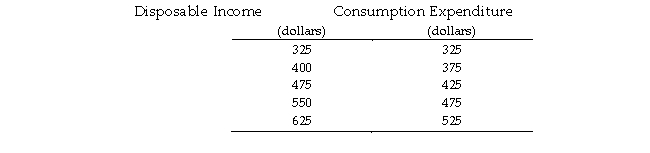 -Refer to Table 11.1.2.When saving is zero, what is the level of disposable income?
 (Multiple Choice)
4.7/5 (77)
(77) An increase in investment shifts the AE curve upward by an amount equal to the _______, and shifts the AD curve rightward by an amount equal to the _______.
(Multiple Choice)
4.9/5 (71)
(71) Everything else remaining the same, autonomous consumption
(Multiple Choice)
4.9/5 (76)
(76) Use the figure below to answer the following questions.
Figure 11.2.3
There are no taxes in this economy.
-In Figure 11.2.3, equilibrium expenditure is
Figure 11.2.3
There are no taxes in this economy.
-In Figure 11.2.3, equilibrium expenditure is (Multiple Choice)
4.9/5 (69)
(69) You observe that unplanned inventories are increasing.You predict that there will be
(Multiple Choice)
4.9/5 (82)
(82) If aggregate planned expenditure is less than real GDP, then inventories
(Multiple Choice)
5.0/5 (69)
(69) Use the information below to answer the following questions.
Fact 11.5.1
An economy has a consumption function of C = 10 + 0.8Y, investment equal to 6, government expenditure equal to 10, exports equal to 10, and an import function of M = 0.1Y.
-Refer to Fact 11.5.1.If autonomous consumption increases by 10, what is the new equilibrium real GDP for this economy?
(Multiple Choice)
4.8/5 (75)
(75) Use the figure below to answer the following questions.
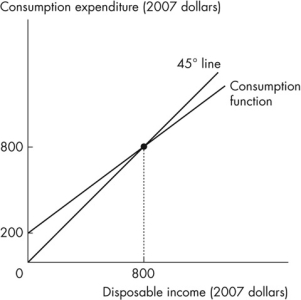 Figure 11.1.2
-Refer to Figure 11.1.2.The marginal propensity to consume is
Figure 11.1.2
-Refer to Figure 11.1.2.The marginal propensity to consume is (Multiple Choice)
4.7/5 (87)
(87) Refer to the table below to answer the following question.
Table 11.2.1
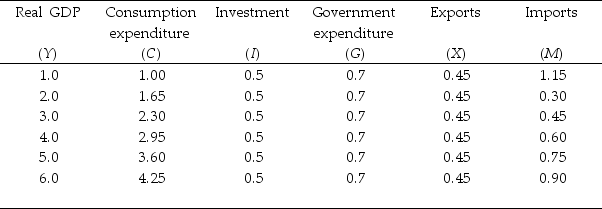 -Table 11.2.1 gives the aggregate expenditure schedule.Equilibrium expenditure is equal to
 (Multiple Choice)
4.7/5 (73)
(73) Suppose real GDP increases by $1 billion and, as a result, consumption increases by $500 million.This change in consumption is
(Multiple Choice)
5.0/5 (67)
(67) 
Filters
- Essay(0)
- Multiple Choice(0)
- Short Answer(0)
- True False(0)
- Matching(0)