



 Chat with AI
Exam 18: Earnings Per Share

Exam 1: Financial Reporting86 Questions
Exam 2: A Review of the Accounting Cycle94 Questions
Exam 3: The Balance Sheet and Notes to the Financial Statements72 Questions
Exam 4: The Income Statement82 Questions
Exam 5: Statement of Cash Flows and Articulation79 Questions
Exam 6: Earnings Management46 Questions
Exam 7: The Revenuereceivablescash Cycle81 Questions
Exam 8: Revenue Recognition74 Questions
Exam 9: Inventory and Cost of Goods Sold121 Questions
Exam 10: Investments in Noncurrent Operating Assets-Acquisition88 Questions
Exam 11: Investments in Noncurrent Operating Assets-Utilization and Retirement84 Questions
Exam 12: Debt Financing103 Questions
Exam 13: Equity Financing88 Questions
Exam 14: Investments in Debt and Equity Securities81 Questions
Exam 15: Leases80 Questions
Exam 16: Income Taxes77 Questions
Exam 17: Employee Compensation-Payroll, Pensions, Other Comp Issues78 Questions
Exam 18: Earnings Per Share78 Questions
Exam 19: Derivatives, Contingencies, Business Segments, and Interim Reports79 Questions
Exam 20: Accounting Changes and Error Corrections74 Questions
Exam 21: Statement of Cash Flows Revisited61 Questions
Exam 22: Accounting in a Global Market60 Questions
Exam 23: Analysis of Financial Statements57 Questions
Select questions type


On December 31, 2011, Masters Inc. had outstanding 180,000 shares of common stock. Net income for 2011 was $285,000. Outstanding options (granted July 1, 2011) to purchase 15,000 shares of common stock at $20 per share had not been exercised by December 31, 2011. During 2011, market prices for the common stock were:


(Essay)
4.9/5  (57)
(57) Franklin Corporation had 100 shares of common stock issued and outstanding at December 31, 2010. On July 1, 2011, Franklin issued a 10 percent stock dividend. Unexercised stock options to purchase 20 shares of common stock (adjusted for the 2011 stock dividend) at $20 per share were outstanding at the beginning and end of 2011. The average market price of Franklin's common stock (which was not affected by the stock dividend) was $25 per share during 2011. The ending market price was $40. Net income for the year ended December 31, 2011, was $2,200.
What was Franklin's 2011 basic earnings per share, rounded to the nearest cent?
(Multiple Choice)
4.9/5 (72)
(72) At December 31, 2010, Rollins Inc. had 400,000 shares of common stock outstanding. The company also had 40,000 shares of $7 convertible preferred stock. Each share is convertible into 4 shares of common stock. (Dividends were declared and paid.)


(Essay)
4.9/5 (88)
(88) In applying the treasury stock method of computing diluted earnings per share, when is it appropriate to use the average market price of common stock during the year as the assumed repurchase price?
(Multiple Choice)
4.9/5 (86)
(86) Earnings per share information should be reported for all of the following except
(Multiple Choice)
4.9/5 (78)
(78) On December 31, 2009, Jamfest Travel Inc. had 450,000 shares of no-par common stock issued and outstanding. All shares were sold for $7.50. On June 30, 2010, the firm issued an additional 135,000 shares for $7 per share. The 2010 income was $319,200. On September 1, 2009, a 15 percent stock dividend was issued to all common shareholders. On October 1, 2011, 60,000 shares were reacquired as treasury shares. Net income in 2011 was $278,063.

(Essay)
4.9/5 (84)
(84) When computing dilutive EPS, the treasury stock method can be used for all of the following except
(Multiple Choice)
4.8/5 (84)
(84) During 2011, Wright Corp. had outstanding 125,000 shares of common stock and 7,500 shares of noncumulative, 8 percent, $50 par preferred stock. Each preferred share is convertible into 8 shares of common stock. In 2011, net income was $231,500.

(Essay)
4.9/5 (70)
(70) The Stanley Corp. provides the following data for 2011:
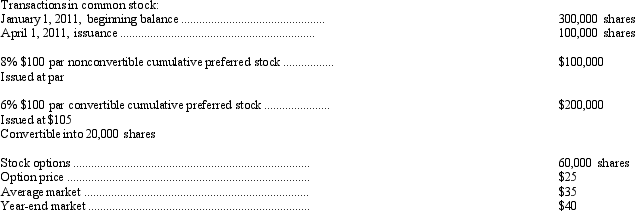 The net income for 2011 is $2,300,000. The company's tax rate is 30 percent. No conversions or options were exercised during 2011.

The net income for 2011 is $2,300,000. The company's tax rate is 30 percent. No conversions or options were exercised during 2011.
(Essay)
4.9/5 (70)
(70) A company with a 40% tax rate had 50,000 shares of common stock and the following three potentially dilutive issues outstanding for the entire year:
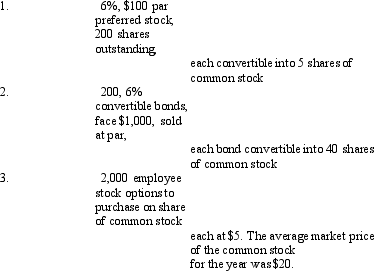 What is the correct ordering (ranking) of the dilutive issues for determining their inclusion into diluted earnings per share?
 (Multiple Choice)
4.9/5 (77)
(77) The main purpose of reporting diluted earnings per share is to
(Multiple Choice)
4.8/5 (85)
(85) Datatec, Inc., had 400,000 shares of $20 par common stock and 40,000 shares of $100 par, 6% cumulative, convertible preferred stock outstanding for the entire year ended December 31, 2011. Each share of the preferred stock is convertible into 5 shares of common stock. Datatec's net income for 2011 was $1,680,000. For the year ended December 31, 2011, the diluted earnings per share is
(Multiple Choice)
4.9/5 (85)
(85) Statement of Financial Accounting Standards No. 128, "Earnings Per Share," requires that earnings per share figures be presented only by companies with publicly held common stock or potential common stock.
List arguments for and against the exclusion of nonpublic companies from the requirement of reporting earnings per share.
(Essay)
4.8/5 (85)
(85) When using the if-converted method to compute diluted earnings per share, convertible securities should be
(Multiple Choice)
4.8/5 (68)
(68) On January 2, 2011, Worley Co. issued at par $50,000 of 4 percent bonds convertible, in total, into 5,000 shares of Worley's common stock. No bonds were converted during 2011. Throughout 2011 Worley had 5,000 shares of common stock outstanding. Worley's 2011 net income was $5,000. Worley's income tax rate is 40 percent. No potentially dilutive securities other than the convertible bonds were outstanding during 2011. Worley's diluted earnings per share for 2011 would be
(Multiple Choice)
4.9/5 (86)
(86) Which of the following is correct regarding the effect that dilutive convertible bonds have on the earnings per share computation?
(Multiple Choice)
4.9/5 (81)
(81) The following information applies to the next three questions:
James Corporation currently has stock rights outstanding for 2,000 common shares. The exercise price of these shares is $20. The options were issued in January of 2009. The average market price of the related common stock during the year 2009 was $25. The average market price of the related common stock during 2010 was $21 and during 2011 was $19. The company's fiscal year ends on December 31 of each year.
How should these stock rights be treated in the earnings per share calculation for the year ending December 31, 2011?
(Multiple Choice)
5.0/5 (92)
(92) Assume a company had net income of $20,000 and 8,000 shares of common stock outstanding the entire year. Also assume there were two potentially dilutive issues outstanding for the entire year:
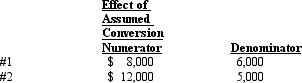 What is diluted earnings per share for this company for the year?
 (Multiple Choice)
4.8/5 (71)
(71) 
Filters
- Essay(0)
- Multiple Choice(0)
- Short Answer(0)
- True False(0)
- Matching(0)