



 Chat with AI
Exam 8: Revenue Recognition


Assume the Randall Corporation sold $30,000 worth of merchandise on the installment basis. The cost of the merchandise was $24,000, and collectibility of the receivable is uncertain. Collection in the current year on the account is $8,000. How much gross profit should be reported as realized?

 (89)
 Verified
A
The collection of credit sales is usually predictable and reasonably assured as a result of credit approval, collections procedures, and historical evidence. In such cases, revenue is appropriately recognized at the point of sale. If a company makes credit sales to customers of relatively poor credit risk, however, recognition of revenue at the point of sale may be inappropriate. Although revenue may have been earned and is measurable, ultimate collection of the proceeds on the sale are highly uncertain. The creditor in such circumstances may defer the recognition of revenue until the amount due is collected. The installment sales method thus may be used. Under the installment sales method, both sales and cost of sales are recognized in the period of sale, but the related gross margin is deferred to those periods in which cash is collected. The gross margin rate for the installment sales is computed and multiplied times the cash collection to determine the portion of deferred gross margin to be recognized.
Required:
Evaluate the conceptual soundness of the installment sales method.
(87) VerifiedRevenue in most instances should be reported if a valid, measurable claim against customers exists and the seller has substantially accomplished what it must do to be entitled to receive the benefits associated with the sale. The installment sales method is said to apply when collection is doubtful as a result of customers that have over-extended themselves and thus are poor credit risks. The likelihood that problems will be encountered in collecting these accounts suggests that billing and collection expenses associated with these accounts will be large and difficult to estimate.
Critics of the use of the installment sales method suggest that none of these problems is insurmountable. Although the amount of uncollectible accounts may be large, an estimate can be derived based either on past experience or the experience of other firms in the industry. The accounts receivable involved usually are protected by the fact that title to the goods does not pass to the customer until the account is paid in full.
Critics of the installment sales method cite two additional problems. The first is that the gross margin is deferred but expenses that help to generate the gross margin are not. Accurate apportionment of these expenses is virtually impossible and, as a result, usually is not attempted. The second issue relates to a basic assumption of the installment method. This method implicitly assumes that the full amount of the sale ultimately will be collected. Every dollar collected is assumed to have a profit component equal to the gross margin rate. This would be true only if it is certain that the total sales price will be collected.
If the completed-contract method is used, what is the basis for determining the income to be recognized in the second year of a three-year contract?
(79) VerifiedD
Lake Construction Company uses the completed-contract method for long-term construction contracts. The information for a specific contract as of January 1, 2011, is shown below.
 $600,000 of cost was incurred during 2011 and on December 31, 2011, the estimated remaining cost to complete was still $800,000. The correct balance for the Construction in Progress at December 31, 2011 is
 (97) If a company uses the completed-contract method of accounting for long-term construction contracts, then during the period of construction, financial information related to a long-term contract will
(82) CellMate, a cellular phone company, conducts a promotion in which new customers who sign a two-year contract receive a free phone. The contract requires the customer to pay a cancellation fee of $250 if the customer cancels the contract. CellMate charges a one-time activation fee of $60 and a monthly fee of $42 for ongoing service. The monthly fee is the same regardless of whether a free phone is provided. The phone costs CellMate $105, and CellMate sells the phone separately for $125. CellMate is not required to refund any portion of the fees paid for any reason. The customer has no obligation to CellMate if phone service is not provided. CellMate is a profitable business and has no reason to believe that the two-year service requirement will not be met.
Required:
1. Are the phone and the phone service (airtime) separate deliverables under this agreement?
2. What is the amount of revenue to be recognized upon signing of the agreement and delivery of the phone to the customer?
(68) In accounting for sales on consignment, sales revenue and the related cost of goods sold should be recognized by the
(88) For a construction firm using the completed-contract method, if costs exceed billings on some contracts by $1,000,000 and billings exceed costs by $800,000 on others, the contracts should ordinarily be reported as a
(78) Bywater Construction contracted to build a ship over a two year period. The contract price was $21,000,000 with an estimate total cost of $18,400,000. The following cost data relate to the construction period.
 Prepare the necessary journal entries for 2011, 2012, and 2013 assuming Bywater uses the percentage-of-completion method.
 (73) Leno Distributing, which began operating on January 1, appropriately uses the installment method of accounting. The following information pertains to Leno's operations for the first year:
 The balance in the deferred gross profit account at December 31 should be
 (87) Layton Construction Company has consistently used the percentage-of completion method of recognizing income. During 2011, Layton entered into a fixed-price contract to construct an office building for $10,000,000. Information relating to the contract is as follows:
 Contract costs incurred during 2012 were
 (74) The following data relate to a construction job started by Worthington Co. during 2011:
 See Worthington Co. information above. Under the completed-contract method, how much should Worthington recognize as gross profit for 2011?
 (74) The completed-contract method (as opposed to the percentage-of-completion method) of accounting for revenue from long-term construction contracts should be used in which of the following circumstances?
(85) Ajax Dry Cleaners, Inc. charges an initial franchise fee of $195,000. When the agreement is signed, a payment of $75,000 is due, followed by four annual payments of $30,000 at the end of each period. Ajax's normal borrowing rate is 12%. Prepare the entries to record the initial franchise fee on the books of Ajax under each of the following circumstances.

(78) The percentage-of-completion method is a generally accepted accounting procedure that allows revenue to be recognized prior to the completion of a project or product. Revenues and gross profit are recognized each period based upon the progress of the construction. Construction costs plus gross profit earned to date are accumulated in an inventory account (Construction in Progress) and progress billings are accumulated in a contra-inventory account (Billings on Construction in Progress).
Required:
Explain the effect on shareholders and managers if an enterprise did not use the percentage-of-completion method to account for long-term contracts and projects.
(81) On January 1, 2011 Rose Enterprises obtained a contract to construct a building. It was estimated at the beginning of the contract that it would take three years to complete the project at an expected cost of $200,000. The contract price was $250,000. The following information describes the status of the job at the close of production each year:
 Compute the items listed below for each year assuming the use of the percentage-of-completion cost-to-cost method. (Round all percentages to two decimals).
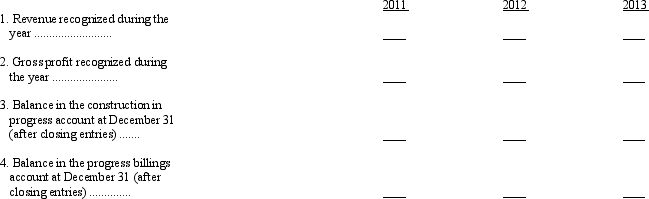
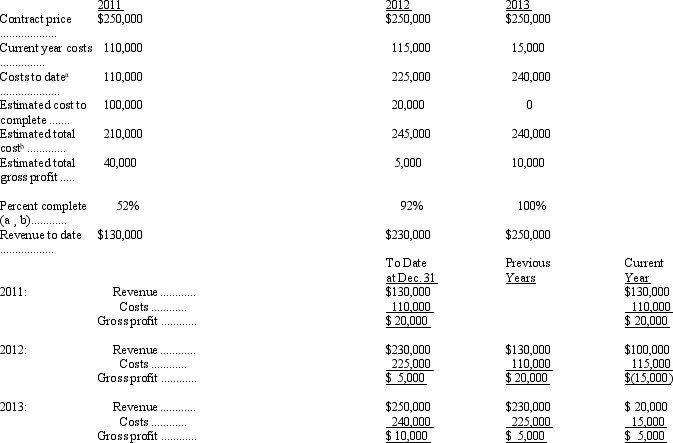
Compute the items listed below for each year assuming the use of the percentage-of-completion cost-to-cost method. (Round all percentages to two decimals).
(86) In 2011, Aldous Corp. began construction work under a three-year contract. The contract price is $800,000. Aldous used the percentage-of-completion method for financial accounting purposes. The income to be recognized each year is based on the proportion of costs incurred to total estimated costs for completing the contract. The financial presentations relating to this contract at December 31, 2011, appear below.
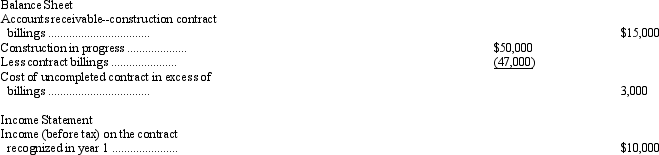 How much cash was collected in 2011 on this contract?
 (70) The following data relate to a construction job started by Worthington Co. during 2011:
 See Worthington Co. information above. Under the percentage-of-completion method, how much should Worthington recognize as gross profit for 2011?
 (86) If the percentage-of-completion method is used, what is the basis for determining the gross profit to be recognized in the second year of a three-year contract?
(80) 
Filters
- Essay(0)
- Multiple Choice(0)
- Short Answer(0)
- True False(0)
- Matching(0)