



 Chat with AI
Exam 12: U.S. Inflation, Unemployment, and Business Cycle

Exam 1: What Is Economics644 Questions
Exam 2: The Economic Problem503 Questions
Exam 3: Demand and Supply558 Questions
Exam 4: Measuring Gdp and Economic Growth375 Questions
Exam 5: Monitoring Jobs and Inflation434 Questions
Exam 6: Economic Growth450 Questions
Exam 7: Finance, Saving, and Investment260 Questions
Exam 8: Money, the Price Level, and Inflation616 Questions
Exam 9: The Exchange Rate and the Balance of Payments547 Questions
Exam 10: Aggregate Supply and Aggregate Demand452 Questions
Exam 11: Expenditure Multipliers: They Keynesian Model484 Questions
Exam 12: U.S. Inflation, Unemployment, and Business Cycle443 Questions
Exam 13: Fiscal Policy328 Questions
Exam 14: Monetary Policy284 Questions
Exam 15: International Trade Policy207 Questions
Select questions type


A decrease in the expected inflation rate leads to _ in the long- run Phillips curve and
In the short- run Phillips curve.
(Multiple Choice)
4.8/5  (81)
(81) Which of the following are TRUE?
I. New Keynesian economists believe that money wage rates are influenced by rational expectatio the price level.
II. New classical economists believe that money wage rates are influenced by rational expectations price level.
III. New classical economists believe expected changes in aggregate demand trigger business cycles
(Multiple Choice)
4.8/5 (70)
(70) The short- run Phillips curve gives much the same information as
(Multiple Choice)
4.9/5 (90)
(90) For a given level of anticipated inflation and natural unemployment rate, the short- run Phillips curve shows the relationship between
(Multiple Choice)
4.8/5 (89)
(89) The initial factors that can create a cost- push inflation do NOT include
(Multiple Choice)
4.8/5 (94)
(94) Which of the following is TRUE regarding the monetarist theory of the business cycle?
I. Monetarists assume that the quantity of money increases at a constant rate.
II. Fluctuations in interest rates cause business cycles.
III. Changes in the growth rate of the quantity of money affect aggregate demand.
(Multiple Choice)
4.8/5 (86)
(86) The long- run Phillips curve shows the relationship between the inflation rate and the unemployment rate when the
(Multiple Choice)
4.8/5 (100)
(100) Suppose aggregate demand increases by less than expected. Which of the following describes what will occur?
(Multiple Choice)
4.7/5 (79)
(79) The intertemporal substitution effect is the factor that creates business cycles in the Keynesian theory of the business cycle.
(True/False)
5.0/5 (80)
(80) A rise in the expected inflation rate leads to _ in the long- run Phillips curve and in the short- run Phillips curve.
(Multiple Choice)
4.9/5 (86)
(86) If the natural unemployment rate increases, then the long- run Phillips curve _ and the short- run Phillips curve .
(Multiple Choice)
4.7/5 (85)
(85) According to the real business cycle theory, technological change
(Multiple Choice)
4.8/5 (81)
(81) In real business cycle models, in order to increase real GDP after a negative technology shock, the government can
I. increase the quantity of money.
II. decrease the quantity of money.
(Multiple Choice)
4.9/5 (77)
(77) 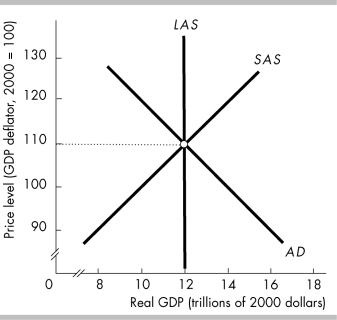 -Using the above figure, a recession in the monetarist model would start with a
 (Multiple Choice)
4.9/5 (78)
(78) 
Filters
- Essay(0)
- Multiple Choice(0)
- Short Answer(0)
- True False(0)
- Matching(0)