



 Chat with AI
Exam 12: U.S. Inflation, Unemployment, and Business Cycle

Exam 1: What Is Economics644 Questions
Exam 2: The Economic Problem503 Questions
Exam 3: Demand and Supply558 Questions
Exam 4: Measuring Gdp and Economic Growth375 Questions
Exam 5: Monitoring Jobs and Inflation434 Questions
Exam 6: Economic Growth450 Questions
Exam 7: Finance, Saving, and Investment260 Questions
Exam 8: Money, the Price Level, and Inflation616 Questions
Exam 9: The Exchange Rate and the Balance of Payments547 Questions
Exam 10: Aggregate Supply and Aggregate Demand452 Questions
Exam 11: Expenditure Multipliers: They Keynesian Model484 Questions
Exam 12: U.S. Inflation, Unemployment, and Business Cycle443 Questions
Exam 13: Fiscal Policy328 Questions
Exam 14: Monetary Policy284 Questions
Exam 15: International Trade Policy207 Questions
Select questions type


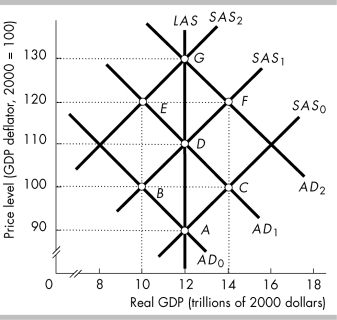 -In the above figure, if people correctly anticipate the increases in aggregate demand and the resulting inflation, the path will be from
 (Multiple Choice)
4.8/5  (84)
(84) Which of the following statements about the long- run Phillips curve is correct?
(Multiple Choice)
4.9/5 (85)
(85) What does the short- run Phillips curve indicate about the relationship between inflation and unemployment?
(Essay)
4.8/5 (74)
(74) A one- time increase in the price of oil followed by a one- time increase in aggregate demand produce
(Multiple Choice)
4.9/5 (85)
(85) According to the real business cycle theory, the immediate effects from a change in productivity incl which of the following?
I. Investment demand changes.
II. Demand for labor changes.
III. Government expenditures change.
(Multiple Choice)
4.8/5 (79)
(79)  -In the above figure, suppose that the economy currently is at point A. If the inflation rate rises and this rise is anticipated by the public, the economy moves to a point such as point
 (Multiple Choice)
4.8/5 (72)
(72) Suppose that following an expected decline in the price level, workers immediately renegotiate their money wage rates to match the fall in prices. This behavior is most consistent with
(Multiple Choice)
4.8/5 (68)
(68) Oil prices increase sharply, raising the price level and decreasing real GDP. The Fed has an incentive to
(Multiple Choice)
4.9/5 (95)
(95) Which of the following pieces of evidence is most consistent with the monetarist theory?
(Multiple Choice)
4.7/5 (59)
(59) In Figure B above, which of the following are being held constant while moving along the curve in the figure?
(Multiple Choice)
4.8/5 (64)
(64) An increase in the expected inflation rate leads to a movement upward along the short- run Phillips curve.
(True/False)
4.9/5 (70)
(70) Compare and contrast the Keynesian and Monetarist business cycle theories.
(Essay)
4.8/5 (77)
(77) Which of the following pieces of evidence is most consistent with the real business cycle theory?
(Multiple Choice)
4.8/5 (67)
(67) What was the U.S. experience with demand pull inflation during the 1960s and early 1970s?
(Essay)
4.8/5 (90)
(90) Along a short- run Phillips curve, suppose the expected inflation rate is 6 percent. If the inflation rate turns out to be 8 percent instead,
(Multiple Choice)
4.8/5 (75)
(75) If the short- run Phillips curve shifts rightward, what happens to the relationship between inflation and unemployment? If the short- run Phillips curve shifts leftward, what happens to the relationship between inflation and unemployment?
(Essay)
4.9/5 (94)
(94) Which of the following describes the Keynesian approach to the business cycle?
I. Unanticipated shocks to aggregate supply drive expansions and recessions.
II. The Keynesian theory is a real business cycle model of the economy.
III. A decrease in business confidence can trigger a recession.
(Multiple Choice)
4.7/5 (78)
(78) 
Filters
- Essay(0)
- Multiple Choice(0)
- Short Answer(0)
- True False(0)
- Matching(0)