



 Chat with AI
Exam 12: U.S. Inflation, Unemployment, and Business Cycle

Exam 1: What Is Economics644 Questions
Exam 2: The Economic Problem503 Questions
Exam 3: Demand and Supply558 Questions
Exam 4: Measuring Gdp and Economic Growth375 Questions
Exam 5: Monitoring Jobs and Inflation434 Questions
Exam 6: Economic Growth450 Questions
Exam 7: Finance, Saving, and Investment260 Questions
Exam 8: Money, the Price Level, and Inflation616 Questions
Exam 9: The Exchange Rate and the Balance of Payments547 Questions
Exam 10: Aggregate Supply and Aggregate Demand452 Questions
Exam 11: Expenditure Multipliers: They Keynesian Model484 Questions
Exam 12: U.S. Inflation, Unemployment, and Business Cycle443 Questions
Exam 13: Fiscal Policy328 Questions
Exam 14: Monetary Policy284 Questions
Exam 15: International Trade Policy207 Questions
Select questions type


Which theory distinguishes between expected and unexpected fluctuations in aggregate demand and asserts that only unexpected changes can affect real GDP?
(Multiple Choice)
5.0/5  (84)
(84) The figure above shows the initial aggregate demand curve, AD0, the initial short- run aggregate supply curve, SAS0, and the long- run aggregate supply curve, LAS. The points in the figure show possible combinations of real GDP and the price level at which the economy of Atlantia is in macroeconomic equilibrium. The economy is initially at point A. Then, Atlantia's oil producers form a price- fixing organization and increase the price of oil. Suppose that potential GDP does not change and that Atlantia's Central Bank takes no action. Draw the new
aggregate demand and short- run aggregate supply curves in the figure to show the effects of this event on Atlan real GDP and price level.
a) What happens to aggregate supply and aggregate demand?
b) What are the new equilibrium real GDP and price level?
c) Will the rise in the price of oil lead to inflation in Atlantia? Why or why not?
(Essay)
4.8/5 (86)
(86) Suppose that last year the economy of Suffera was experiencing an expected inflation rate of 8 percent and unemployment rate of 12 percent. An unanticipated increase in the inflation rate would
(Multiple Choice)
4.7/5 (74)
(74) "Shoe Industry under Pressure Amid Rising Costs "
Rising costs have forced about 15 per cent of shoe manufacturers in a major south China industrial c to shut down or relocate in the past year... [the firms have] identified rising wages as a key factor be the closures and relocations from Dongguan...The problems in the footwear industry reflect broader affecting manufacturers across China's Pearl River Delta..."
HYPERLINK "http://www.ft.com/" www.ft.com, 2/26/200
As the same pressures affect other industries across China, we expect to see
(Multiple Choice)
4.7/5 (67)
(67) Suppose that an economist finds that in most recessions, which are times when employment is low, that real interest rates are extremely high. This finding would pose the biggest problem for the
(Multiple Choice)
4.8/5 (84)
(84) Demand- pull inflation is an inflation that results from an initial .
(Multiple Choice)
4.8/5 (84)
(84) According to the real business cycle theory, an increase in the price of a resource, such as oil, that decreases the demand for loanable funds will _ employment and real GDP.
(Multiple Choice)
4.7/5 (85)
(85)  -In the above figure, the movement from point A to B to C to D to E represents
 (Multiple Choice)
4.8/5 (77)
(77) Real business cycle (RBC) theory predicts that the main source of economic fluctuations is
(Multiple Choice)
4.9/5 (72)
(72) A one- time increase in oil prices without any following change in aggregate demand produces
(Multiple Choice)
5.0/5 (76)
(76)  -Which of the above figures best shows the start of a demand- pull inflation?
 (Multiple Choice)
4.8/5 (88)
(88) 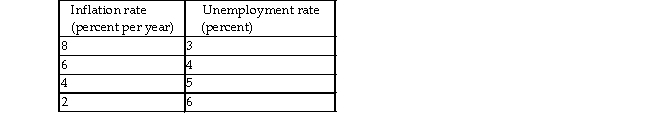 -An economy's natural unemployment rate is 4 percent. The table above gives some points on the economy's short- run Phillips curve. When the unemployment rate is 4 percent .
 (Multiple Choice)
4.9/5 (84)
(84) The cycle theory states that only unexpected fluctuations in aggregate demand are the main source of business cycles.
(Multiple Choice)
4.7/5 (76)
(76) 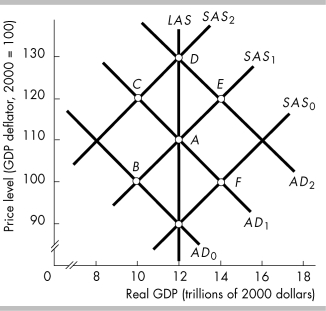 -The figure above shows the aggregate demand, short- run aggregate supply, and long- run aggregate supply curves for the economy of Tomorrowland. The economy is currently at point A. A cost- push rise in the price level will initially move the economy to point and to point
)
-The figure above shows the aggregate demand, short- run aggregate supply, and long- run aggregate supply curves for the economy of Tomorrowland. The economy is currently at point A. A cost- push rise in the price level will initially move the economy to point and to point
) (Multiple Choice)
5.0/5 (74)
(74) 
Filters
- Essay(0)
- Multiple Choice(0)
- Short Answer(0)
- True False(0)
- Matching(0)